

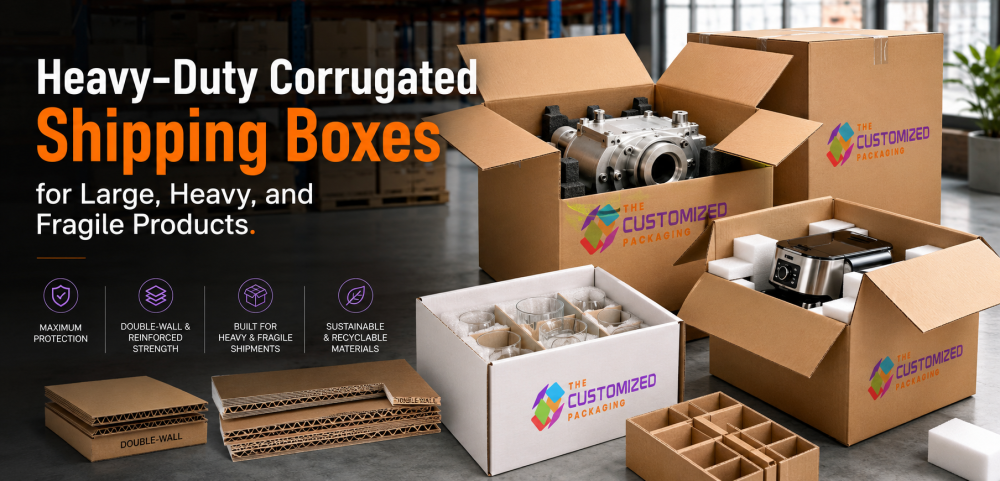
Heavy-Duty Corrugated Shipping Boxes for Large, Heavy, and Fragile Products
Shipping large, heavy, or fragile products requires more than placing the item inside a standard cardboard carton and adding extra tape. Products with substantial weight, sharp edges, delicate surfaces, breakable components, or unusual dimensions place greater pressure on every part of the packaging system. The outer walls, bottom panels, closures, inserts, dividers, cushioning materials, and internal spacing must work together to prevent damage during storage and transportation.
This is why businesses use heavy-duty corrugated shipping boxes for industrial equipment, automotive parts, electronics, machinery components, glass products, bottles, jars, candles, tools, appliances, furniture parts, ceramics, large retail products, and multi-item shipments. These boxes are designed to provide stronger resistance to compression, punctures, stacking pressure, vibration, impact, and repeated handling than lightweight shipping cartons.
A heavy-duty box may use double-wall or triple-wall corrugated board, reinforced bottom panels, stronger flute combinations, protective inserts, corner supports, dividers, and secure closure systems. The correct construction depends on the product weight, dimensions, center of gravity, fragility, shipping distance, pallet arrangement, and handling environment.
Strong material alone does not guarantee protection. A product can still become damaged inside a thick box when it is allowed to move, strike the walls, collide with another item, or place concentrated pressure on one panel. Accurate internal dimensions and a properly designed support system are just as important as board strength.
Custom heavy-duty corrugated boxes can be manufactured around the actual product instead of forcing the item into an unsuitable stock carton. Businesses can also add logos, handling instructions, orientation arrows, product codes, barcodes, warning symbols, QR codes, and other important information to the exterior.
At The Customized Packaging, we create heavy-duty shipping cartons, double-wall corrugated boxes, triple-wall packaging, industrial shipping boxes, custom boxes for fragile products, reinforced ecommerce cartons, protective inserts, dividers, corner supports, wholesale corrugated boxes, and bulk packaging for businesses throughout the USA.
For more comprehensive information about corrugated materials, flute profiles, printing, strength, box styles, inserts, wholesale production, and costs, read our main pillar blog titled “Custom Corrugated Boxes: The Complete Guide to Strong, Printed, and Wholesale Packaging.”
What Are Heavy-Duty Corrugated Shipping Boxes?
Stronger Packaging for Demanding Products and Delivery Conditions
Heavy-duty corrugated shipping boxes are reinforced cartons developed for products that create greater packaging risks because of their weight, fragility, size, shape, or transportation environment.
These boxes may use stronger liner papers, multiple fluted layers, reinforced panels, heavy-duty closures, custom inserts, dividers, edge protectors, and additional internal supports.
Single-wall boxes contain one fluted layer between two liners. They can provide suitable protection for many lightweight and moderately weighted products. Double-wall boxes contain two fluted layers and an additional liner, while triple-wall boxes contain three fluted layers and more liner sheets.
The additional layers can increase compression resistance, puncture resistance, stacking strength, and structural stability. However, the correct box cannot be selected only by counting the number of walls.
A well-designed single-wall box may perform better for a particular product than an oversized double-wall carton with no internal support. Product weight, box dimensions, flute direction, insert design, closure, moisture exposure, and stacking conditions all influence performance.
When Does a Product Need Heavy-Duty Corrugated Packaging?
Weight Is Important, but It Is Not the Only Factor
A product may require heavy-duty packaging because it is heavy, but fragility, shape, and shipping conditions can be equally important.
Glass bottles may not be extremely heavy individually, but several bottles inside one carton can create a concentrated load and a high risk of breakage. Electronics may be relatively lightweight but vulnerable to impact, vibration, and surface damage. Metal parts may have sharp edges that can puncture the carton from inside.
Large products can also place pressure on box panels because the wider surface areas may bend, bow, or collapse under stacking weight.
Businesses should consider heavy-duty corrugated boxes when products are frequently damaged in standard cartons, when several units are packed together, when boxes are palletized, or when shipments travel long distances through demanding distribution systems.
Products stored in warehouses for extended periods may also need stronger compression performance because the bottom cartons carry the weight of the boxes above them.
Why Standard Shipping Boxes May Fail
Lightweight Cartons Are Not Designed for Every Product
A standard stock carton is usually designed to serve a wide variety of general shipping needs. It may not match the exact product dimensions, weight distribution, or fragility.
When a heavy product is placed inside an oversized box, it can move during transportation and strike the carton walls. The impact can damage both the product and the box.
A product with sharp corners may gradually cut or puncture the board. Heavy items can cause the bottom flaps to separate if the closure is unsuitable. Boxes may also collapse when stacked beyond their compression capacity.
Excessive empty space creates additional risk because the product gains momentum before hitting the side of the carton. Adding more loose fill does not always solve the problem, especially when the product is heavy enough to compress the cushioning material.
Custom heavy-duty shipping boxes reduce these risks by combining suitable board construction with accurate sizing, internal supports, and reliable closures.
Heavy-Duty Corrugated Board Selection Guide
| Packaging requirement | Recommended direction | Common applications |
|---|---|---|
| Moderately heavy products | Strong single-wall or suitable double-wall board based on testing | Household items, packaged retail products, small tools, books |
| Heavy products | Double-wall corrugated construction with secure closures | Appliances, automotive parts, power tools, industrial components |
| Extremely heavy items | Triple-wall or engineered heavy-duty corrugated board | Machinery, large parts, export equipment, bulk industrial products |
| Fragile glass products | Strong outer carton with fitted dividers and cushioning | Bottles, jars, candles, ceramics, laboratory containers |
| Sharp-edged products | Puncture-resistant board with edge guards or protective sleeves | Metal parts, hardware, automotive components, tools |
| Large products | Reinforced panels with correct flute direction and internal bracing | Furniture parts, framed items, equipment, large retail products |
| Palletized shipments | Board selected for compression and stacking performance | Wholesale distribution, manufacturing, warehouse shipments |
| Long-distance shipping | Strong board with moisture awareness and internal product restraint | Interstate shipping, export packaging, industrial distribution |
| High-value electronics | Reinforced carton with fitted inserts and surface protection | Devices, equipment, instruments, computer hardware |
| Multiple heavy products | Divided compartments with reinforced base and outer walls | Product sets, replacement parts, bottles, industrial kits |
The final packaging specification should be confirmed through physical testing with the actual packed product.
Double-Wall Corrugated Boxes for Heavy Products
Two Fluted Layers Provide Greater Structural Support
Double-wall corrugated boxes contain two fluted layers separated by an additional liner. This construction generally provides more resistance to compression, punctures, stacking pressure, and rough handling than ordinary single-wall board.
Double-wall boxes are commonly used for automotive components, heavy tools, glass containers, appliances, industrial parts, electronics, bottled products, and wholesale shipments.
The two flute profiles may be combined to provide different performance characteristics. One flute may contribute cushioning, while the other creates puncture resistance and stacking strength.
Double-wall material can also help large cartons maintain their shape. Wide panels may bow or flex under product pressure, while stronger board creates better structural stability.
The additional strength comes with higher material cost, weight, and storage requirements. Businesses should confirm that double-wall construction is appropriate rather than automatically selecting the heaviest available option.
Triple-Wall Corrugated Boxes for Industrial Shipping
Heavy-Duty Construction Can Replace Some Traditional Crating Applications
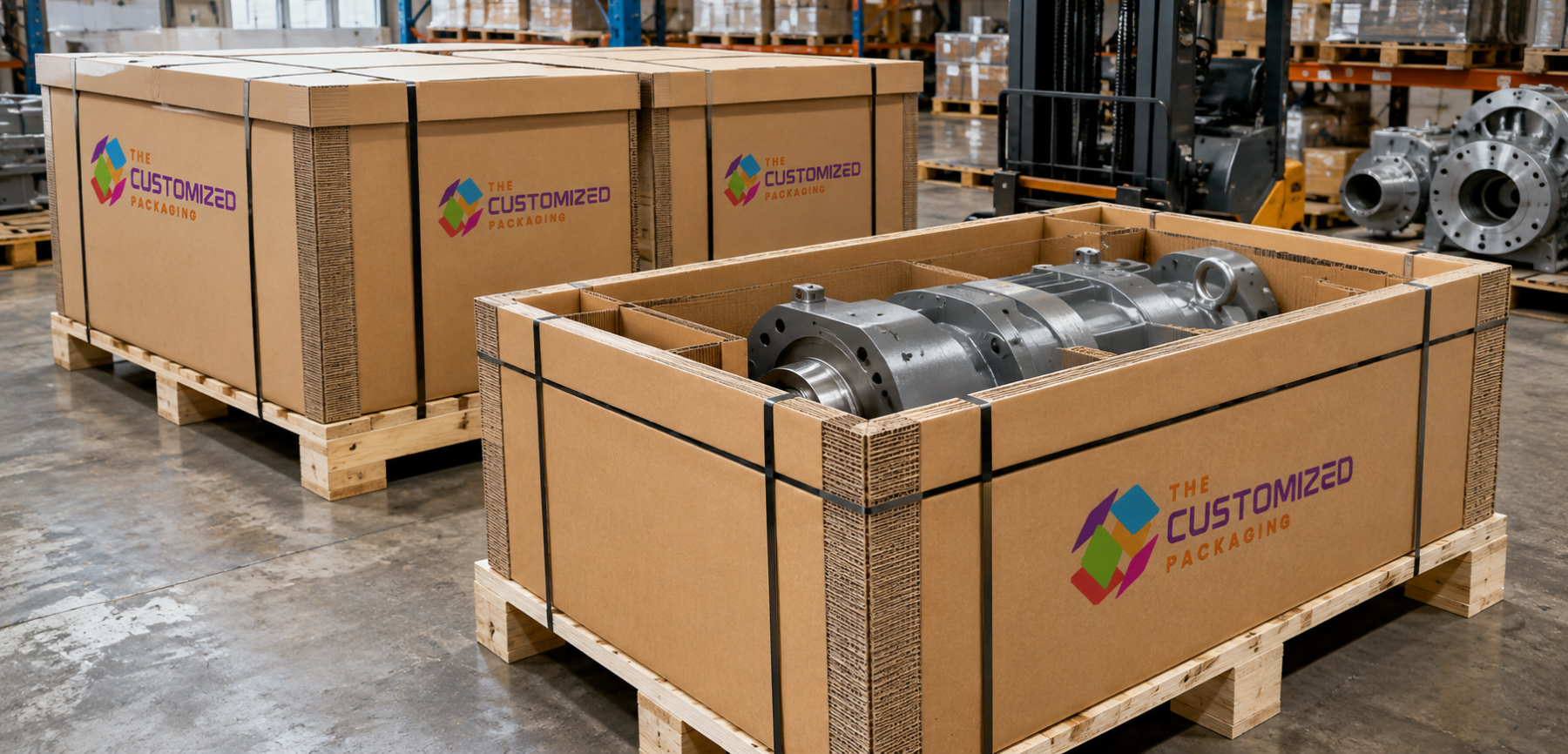
Triple-wall corrugated boxes contain three fluted layers and additional liner sheets. This structure creates substantial strength for large, heavy, and industrial products.
Triple-wall packaging may be used for machinery, automotive assemblies, replacement components, commercial equipment, export products, metal parts, and heavy bulk shipments.
These cartons can sometimes provide a lighter alternative to wooden crates, depending on the product and transportation environment.
The design must still consider the product’s center of gravity, lifting method, sharp edges, pallet support, moisture exposure, and internal movement.
Triple-wall packaging is not simply a larger version of a normal shipping box. It may require reinforced closures, heavy-duty tape, staples where appropriate, strapping, palletization, and internal bracing.
Businesses should work with an experienced heavy-duty corrugated box manufacturer when developing packaging for extremely heavy products.
Understanding ECT for Heavy-Duty Boxes
Edge Crush Performance Supports Stacking Strength
The Edge Crush Test, commonly referred to as ECT, measures how the corrugated board resists compression along its edge.
This measurement is important for cartons that will be stacked in warehouses, delivery vehicles, or palletized loads. The vertical edges of a box carry much of the stacking pressure.
A higher ECT rating may indicate greater compression resistance, but the rating should not be evaluated separately from box dimensions, flute direction, moisture conditions, product weight, and pallet arrangement.
A tall narrow box may behave differently from a wide shallow box even when both use the same board.
Businesses ordering heavy-duty corrugated boxes wholesale should provide details about how high the cartons will be stacked, how long they may remain in storage, and whether the load will be supported by a pallet.
Understanding Burst Strength
Puncture Resistance Is Important for Concentrated Pressure
Burst strength relates to how much pressure corrugated material can withstand before it ruptures.
This can be important for products with sharp corners, metal components, tools, bottles, machinery parts, and items that place concentrated pressure on the carton walls.
A box may have suitable stacking strength but still require additional protection against internal punctures.
Protective sleeves, edge guards, dividers, foam alternatives, corrugated pads, or molded supports can prevent sharp product features from contacting the box walls directly.
ECT and burst strength measure different performance qualities. The correct specification depends on the product and shipping environment.
Product Weight Must Be Distributed Correctly
Concentrated Loads Can Damage Strong Boxes
Heavy products should not rest on a small area of the box floor when the load can be distributed more evenly.
A narrow metal component or machine part may create intense pressure on one part of the bottom panel. Even strong corrugated board can bend or puncture when force is concentrated in a limited area.
Corrugated pads, reinforced bases, wooden supports where appropriate, molded components, or custom inserts can spread the product weight across a larger surface.
The center of gravity should also be considered. A top-heavy item may tip during handling and strike the side of the carton.
Businesses should identify the heaviest and sharpest product areas when developing custom packaging for large heavy products.
Reinforced Bottoms Prevent Box Failure
Heavy Products Place Significant Pressure on Lower Panels
The bottom of the carton carries the complete product weight. If the flaps, tape, glue, or board construction are unsuitable, the box may open or collapse during lifting.
Heavy-duty cartons may use reinforced bottom panels, overlapping flaps, additional corrugated pads, stronger adhesive, water-activated tape, staples where appropriate, or strapping.
The closure method should match the product weight and handling conditions. Adding more ordinary tape does not always provide reliable support when the base structure is weak.
Warehouse teams should also receive clear instructions about how the carton should be assembled and sealed.
A well-designed reinforced bottom improves safety during packing, lifting, storage, and transportation.
Heavy Products Need Internal Restraint
Strong Outer Walls Cannot Prevent Movement Alone
A heavy product that moves inside the carton can create significant impact force. Each time the shipment stops, turns, drops, or changes direction, the product may strike the box walls.
Loose cushioning may compress under the product weight and stop providing support.
Custom corrugated inserts can hold the product in a defined position and distribute pressure across the carton. Inserts may support the base, sides, top, corners, or specific product components.
The insert should prevent movement without applying harmful pressure to fragile surfaces.
Heavy products may also require several connected supports rather than one simple insert. The packaging structure should be tested as a complete system.
Protection Strategies for Heavy and Fragile Products
| Shipping risk | Possible packaging problem | Protective packaging response |
|---|---|---|
| Compression | Box panels collapse under stacking pressure | Stronger board, correct ECT, reinforced corners, suitable pallet pattern |
| Impact | Product strikes the box during drops or handling | Fitted inserts, cushioning, suspension structures, reduced internal movement |
| Punctures | Sharp edges break through carton walls | Edge guards, protective sleeves, pads, stronger liners |
| Vibration | Components loosen, scratch, or collide | Dividers, product restraints, surface protection, fitted compartments |
| Bottom failure | Flaps separate under product weight | Reinforced base, stronger closure, overlapping panels, suitable tape |
| Moisture exposure | Board strength decreases in humid conditions | Appropriate coatings, liners, storage controls, moisture-aware testing |
| Product-to-product contact | Multiple units collide and break | Corrugated partitions, dividers, individual compartments |
| Surface scratching | Finished products rub against inserts or other components | Tissue, protective sleeves, smooth liners, non-abrasive wraps |
| Tipping | Top-heavy products strike side walls | Wider base support, center-of-gravity control, internal bracing |
| Excessive empty space | Product gains momentum during transportation | Right-sized box, fitted supports, controlled clearance |
A strong packaging system should address the specific risks of the product rather than adding random materials.
Custom Corrugated Inserts for Fragile Products
Fitted Supports Help Prevent Breakage
Glass jars, bottles, candles, ceramics, laboratory products, displays, and delicate components need internal protection that limits movement.
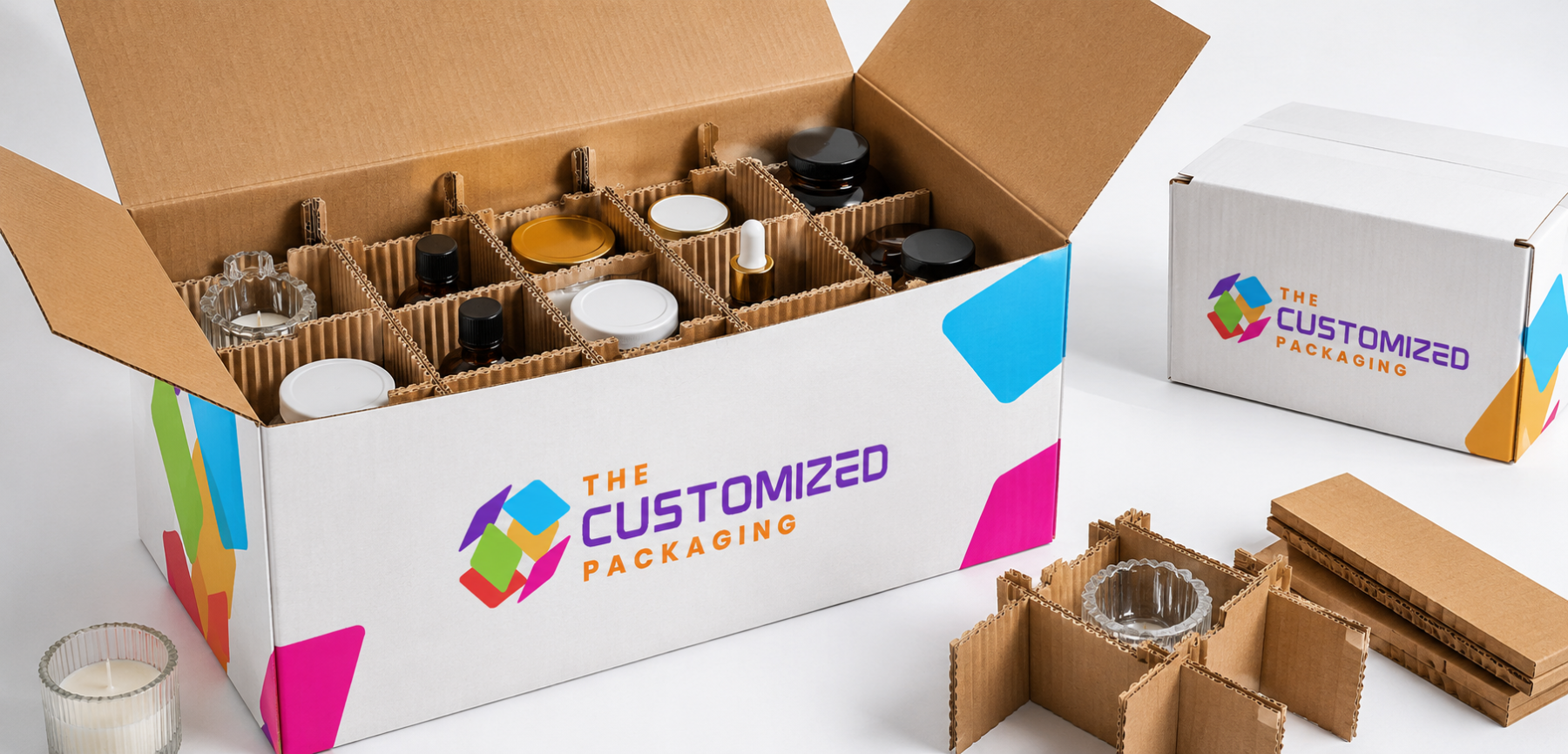
Corrugated box inserts for fragile products can create compartments, hold products upright, separate individual units, and reduce direct contact.
Bottle dividers can prevent glass containers from striking each other. Top and bottom pads can reduce vertical movement. Side supports can keep products centered inside the carton.
Corrugated inserts may be combined with molded pulp, paper cushioning, honeycomb structures, or other materials depending on the product.
The insert should not be selected only from a drawing. It should be tested with the actual product and complete box.
Dividers for Bottles, Jars, and Glass Products
Separation Reduces Product-to-Product Impact
When multiple glass items are packed together, the greatest risk may come from the products striking one another rather than the outer box.
Corrugated partitions divide the carton into individual cells. Each bottle, jar, or candle remains in a separate compartment.
The divider height should support the product correctly without interfering with closures, caps, lids, or easy removal.
Heavy glass containers may require additional bottom pads, top pads, or corner reinforcement.
Businesses looking to buy heavy-duty corrugated boxes for bottles and jars should provide the number of units, individual dimensions, total packed weight, and transportation method.
Heavy-Duty Packaging for Electronics
Sensitive Equipment Requires Impact and Movement Control
Electronics can be damaged through drops, vibration, pressure, static, moisture, and internal movement.
A heavy-duty corrugated box for electronics may include fitted compartments, corner blocks, suspension supports, product sleeves, cable sections, and accessory trays.
The outer board should resist compression, while the internal structure keeps the device away from the box walls.
The packaging may also need to support power adapters, cables, manuals, stands, and other components without allowing them to contact the main device.
Some electronics require specialized static-control materials in addition to corrugated packaging. Businesses remain responsible for selecting product-specific protective components.
Heavy-Duty Boxes for Automotive Parts
Dense Components Need Puncture and Weight Support
Automotive parts may be heavy, oily, sharp, irregularly shaped, or difficult to stabilize.
Brake components, engine parts, metal assemblies, replacement parts, tools, and accessories may require double-wall or triple-wall cartons with reinforced inserts.
Protective bags or liners may be needed when products contain grease, oil, or residue that could weaken or stain the board.
Sharp edges should be covered with caps, sleeves, pads, or edge guards before the item is placed inside the carton.
Printed exterior information can include part numbers, product quantities, handling symbols, orientation arrows, and destination details.
Businesses comparing the best heavy-duty corrugated box supplier for automotive parts should choose a manufacturer that can develop the internal protection as well as the outer box.
Corrugated Packaging for Industrial Components
Industrial Shipments Require Repeatable Packaging Processes
Industrial businesses often ship the same components repeatedly to customers, distributors, service centers, and manufacturing locations.
Custom packaging can create a repeatable packing method for warehouse employees. Each component has a defined position, closure method, and labeling area.
This consistency can reduce packing errors, product movement, and time spent improvising cushioning for each shipment.
Industrial corrugated shipping boxes may use double-wall board, reinforced bases, part dividers, heavy-duty inserts, pallet-ready dimensions, and printed handling instructions.
The box should be tested under realistic warehouse and transportation conditions before wholesale production.
Heavy-Duty Boxes for Machinery and Equipment
Large Products Need More Than Oversized Cartons
Machinery, commercial equipment, instruments, and large components may require engineered packaging.
The box should account for lifting points, center of gravity, protruding parts, detachable components, sharp edges, and accessory storage.
The product may need to be fixed to a base or supported with internal bracing so it cannot shift during transportation.
Some shipments may require a pallet, skid, crate, or hybrid structure rather than a corrugated carton alone.
A packaging specialist should evaluate the complete delivery method before recommending custom boxes for large machinery.
Packaging Large but Lightweight Products
Size Can Create Structural Challenges Even Without Heavy Weight
Not every large product is heavy. Lampshades, framed items, plastic components, displays, lightweight furniture parts, and promotional structures may occupy significant space without creating a high weight load.
Large panels can bow, bend, or become crushed even when the contents are light.
These products may need stronger board, internal braces, corner protection, or telescope-style boxes to maintain shape.
Custom sizing becomes especially important because oversized stock cartons can create excessive empty space and high dimensional shipping charges.
Large custom corrugated shipping boxes can be designed to protect the product while controlling package volume.
Corrugated Telescope Boxes for Large Products
Two-Piece Structures Provide Adjustable Depth and Coverage
Telescope boxes use a separate top and bottom section that overlap.
This structure can provide strong top-to-bottom protection and may accommodate large, long, or framed products.
Telescope cartons can be used for artwork, furniture parts, printed materials, industrial products, mirrors, signs, and equipment.
The amount of overlap influences strength and adjustability.
Internal corner supports, pads, and surface protection may be added for fragile products.
Custom Crate-Style Corrugated Packaging
Engineered Paper-Based Structures Can Support Demanding Shipments
Some heavy products can use reinforced corrugated structures designed to provide crate-like support.
These packages may combine triple-wall board, honeycomb panels, reinforced corners, internal braces, pads, and pallet bases.
The exact structure depends on product weight, destination, loading method, moisture exposure, and transportation risk.
Paper-based crate alternatives may reduce packaging weight compared with wooden structures, but they are not suitable for every industrial product.
Testing and professional structural evaluation are essential before replacing a traditional crate.
Moisture Can Reduce Corrugated Strength
Warehouse and Shipping Conditions Affect Performance
Corrugated board can lose strength when exposed to excessive humidity, water, condensation, or damp storage conditions.
Heavy products create greater risk because weakened board must continue carrying substantial weight.
Businesses should consider warehouse humidity, refrigerated environments, outdoor transfer points, export conditions, and seasonal weather.
Coatings, moisture-resistant liners, protective bags, pallet covers, or controlled storage may be considered where appropriate.
A coating should not be selected only for water resistance. It may also affect printing, recyclability, folding, glue performance, and cost.
Palletization Improves Heavy-Product Handling
Pallet Loads Need Stable Box Dimensions and Stacking Patterns
Heavy cartons are often easier and safer to move when they are palletized.
The box dimensions should fit the selected pallet efficiently without excessive overhang or large unsupported gaps.
Overhanging cartons are more vulnerable to crushing because the box edges are not supported by the pallet surface.
The stacking pattern should distribute weight evenly. Columns may provide strong vertical compression, while interlocking patterns can improve load stability in some situations.
Stretch wrap, strapping, edge protectors, slip sheets, and top caps may be used depending on the shipment.
Businesses ordering pallet-ready heavy-duty corrugated boxes should provide the pallet dimensions, boxes per layer, stacking height, and total load weight.
Clear Handling Instructions Reduce Shipping Risks
Printed Symbols Help Warehouse and Delivery Teams
Heavy and fragile shipments may need clear exterior instructions.
Common information includes “Fragile,” “Heavy,” “This Side Up,” “Do Not Stack,” lifting guidance, orientation arrows, product codes, weight labels, and handling symbols.
Instructions should be large, readable, and positioned where they remain visible after tape, labels, and pallet wrap are applied.
Printed warnings do not replace suitable packaging. A fragile label cannot protect a poorly supported product.
However, clear communication can reduce handling errors and help staff use the correct lifting or storage method.
Custom Printed Heavy-Duty Corrugated Boxes
Industrial Packaging Can Also Support Branding
Heavy-duty cartons do not need to remain plain.
Custom printed heavy-duty corrugated boxes can display the company logo, product name, part number, barcode, quantity, handling instructions, QR code, and shipping information.
One-color flexographic printing may be suitable for industrial and wholesale cartons. Full-color printing can be used for large retail products, electronics, appliances, and premium ecommerce shipments.
Branding should remain secondary to structural protection but can still improve recognition and warehouse identification.
Printed product codes and color systems may help staff identify similar cartons without opening them.
Ecommerce Shipping for Heavy and Fragile Products
Online Orders Must Survive Individual Courier Handling
Large or heavy ecommerce products may travel individually rather than as part of a stable pallet load.
Courier handling can include conveyor systems, manual lifting, drops, vehicle movement, and repeated transfers.
A heavy-duty ecommerce shipping box should protect the product while remaining within carrier size and weight requirements.
Easy-open features must not weaken the structure. Handles should only be added when the board and reinforcement can support their use.
The box may also need return-friendly features because customers may need to send heavy products back using the original packaging.
Businesses should test the complete package under realistic individual-parcel conditions before shipping at scale.
Return Packaging for Heavy Products
Reusable Structures Simplify Exchanges and Repairs
Heavy products can be difficult for customers to repackage when returns, repairs, replacements, or warranty service are needed.
A reusable shipping structure can help the customer return the product safely using the original box and inserts.
Printed return instructions may explain how the product should be positioned, which supports should be replaced, and how the carton should be closed.
The box may include a second adhesive strip, reusable closure, or clear tape guidance.
Return packaging is especially valuable for electronics, appliances, equipment, tools, and high-value products.
Test Heavy-Duty Packaging Before Production
Physical Testing Protects Products and Packaging Investment
A digital dieline cannot confirm how a heavy or fragile product will behave during transportation.
Businesses should request a prototype and pack it with the actual product, accessories, inserts, dividers, cushioning, manuals, and closures.
The completed package should be checked for product movement, bottom strength, panel bowing, insert pressure, closure security, stacking, label placement, and opening.
Testing may include compression, drops, vibration, puncture risk, pallet stability, and handling simulations depending on the product.
The sample should be evaluated after testing, not only before. Inspect the product, carton edges, bottom panels, inserts, closures, and internal contact points.
Testing is especially important before ordering wholesale heavy-duty corrugated boxes because a structural problem can affect the full production quantity.
Common Mistakes When Packaging Heavy Products
More Material Does Not Always Mean Better Protection
One common mistake is placing a heavy item in an oversized double-wall box and filling the remaining space with loose paper. The product may still move and compress the cushioning.
Another mistake is strengthening the side walls while ignoring the bottom closure. The carton may appear strong but fail when lifted.
Some businesses use foam, air pillows, or lightweight fillers that are not designed to support heavy loads. These materials may flatten quickly and stop restraining the product.
Incorrect weight distribution, unsupported sharp edges, missing corner protection, and poor pallet overhang can also cause failures.
The most effective packaging uses the right material in the right location rather than adding random layers.
How to Choose a Heavy-Duty Corrugated Box Supplier
Structural Knowledge Matters More Than a Generic Box Catalog
Businesses searching for the best heavy-duty corrugated box supplier should choose a company that asks detailed questions about the product and shipping environment.
The supplier should understand packed weight, internal dimensions, center of gravity, fragility, sharp edges, handling method, pallet pattern, storage time, delivery distance, and return requirements.
A professional manufacturer should be able to recommend board construction, flute combinations, inserts, dividers, closures, printing, and testing.
Businesses should ask whether the supplier provides physical prototypes, structural design support, production samples, quality checks, and repeat-order consistency.
A low-cost supplier may not provide good value when the packaging fails and the product must be replaced.
What Influences Heavy-Duty Corrugated Box Cost?
Stronger Packaging Uses More Material and Engineering
The cost of heavy-duty corrugated boxes depends on dimensions, board grade, flute combination, wall construction, box style, inserts, reinforcements, printing, quantity, freight, and delivery destination.
Double-wall and triple-wall board generally cost more than standard single-wall material.
Large boxes require more board and occupy more shipping and warehouse space. Reinforced bases, partitions, corner supports, custom pads, and engineered inserts add to the production specification.
Simple one-color printing may cost less than detailed full-color branding.
Wholesale quantities may reduce the unit price, but the total order value and storage requirements will be higher.
Businesses should compare the packaging cost against the value of the product and the potential expense of damage, replacement, returns, and lost customer trust.
Buy Heavy-Duty Corrugated Shipping Boxes Online
Accurate Details Help Suppliers Recommend the Right Structure
Businesses ready to buy heavy-duty corrugated shipping boxes should provide the internal dimensions, product weight, packed weight, fragility, product shape, box style, shipping method, quantity, inserts, printing, and delivery destination.
Photographs or drawings may help the supplier understand unusual shapes, sharp edges, or lifting points.
A quotation should clearly identify the board construction, dimensions, inserts, printing, tooling, quantity, production time, and freight.
Businesses should request a physical prototype before approving a large order.
Companies looking to order heavy-duty corrugated boxes online should avoid selecting a box only by dimensions. Two boxes of the same size may provide very different performance depending on the board and structural design.
Wholesale Heavy-Duty Corrugated Boxes
Bulk Production Supports Manufacturers and High-Volume Shippers
Manufacturers, distributors, industrial businesses, automotive suppliers, electronics companies, and large ecommerce brands may need recurring heavy-duty packaging.
Ordering heavy-duty corrugated boxes wholesale can reduce the cost per unit and help maintain consistent board, dimensions, inserts, closures, and printing.
One approved structure can create a repeatable packing process across multiple production cycles.
Before ordering in bulk, businesses should confirm product dimensions, testing results, warehouse storage, monthly usage, and expected design changes.
Wholesale orders should only begin after the complete package has been approved with the actual product.
Heavy-Duty Corrugated Boxes Across the USA
Strong Custom Packaging for Businesses Nationwide
At The Customized Packaging, we provide custom heavy-duty corrugated boxes for manufacturers, ecommerce companies, automotive suppliers, industrial businesses, electronics brands, glass product companies, candle businesses, retailers, and distributors throughout the USA.
We create double-wall shipping cartons, triple-wall packaging, reinforced product boxes, large corrugated cartons, custom inserts, partitions, bottle dividers, corner supports, pallet-ready boxes, printed industrial packaging, and wholesale custom boxes.
Businesses searching for heavy-duty corrugated boxes near me, heavy-duty corrugated box manufacturer USA, industrial packaging supplier USA, custom boxes for heavy products, or wholesale heavy-duty shipping boxes can request packaging developed around their actual product and delivery conditions.
We support businesses in New York, New Jersey, California, Texas, Florida, Illinois, Pennsylvania, Ohio, Georgia, North Carolina, Washington, Massachusetts, Virginia, Michigan, Arizona, Tennessee, Indiana, Missouri, Maryland, Wisconsin, Colorado, Minnesota, Nevada, Oregon, Kentucky, Utah, and other locations throughout the United States.
Want to Estimate Your Heavy-Duty Box Packaging Cost?
Try the Custom Box Packaging Cost Calculator
Want to estimate the price of your custom packaging before requesting a detailed quotation? Try our Custom Box Packaging Cost Calculator to calculate an initial estimate based on box style, dimensions, material, printing, finishing, inserts, and quantity.
The calculator can help businesses plan double-wall corrugated boxes, triple-wall packaging, large shipping cartons, industrial boxes, custom inserts, dividers, reinforced product packaging, and wholesale heavy-duty corrugated boxes.
The initial estimate may change according to the final board grade, flute combination, wall construction, box dimensions, reinforcement, insert system, printing, production quantity, freight, and delivery destination.
After reviewing the estimate, businesses can request a detailed heavy-duty corrugated packaging quote based on the actual product and shipping requirements.
Why Choose The Customized Packaging for Heavy-Duty Corrugated Boxes?
Packaging Designed for Strength, Protection, and Reliable Shipping
At The Customized Packaging, we help businesses create heavy-duty corrugated shipping boxes that protect large, heavy, valuable, and fragile products through storage, distribution, ecommerce delivery, and wholesale transportation.
We provide double-wall cartons, triple-wall boxes, reinforced shipping structures, pallet-ready packaging, industrial cartons, ecommerce boxes, bottle dividers, protective inserts, corner supports, corrugated pads, wholesale custom boxes, and bulk custom packaging.
Our services include custom dimensions, structural design support, board and flute recommendations, logo printing, handling instructions, custom inserts, digital proofs, physical sampling, and wholesale pricing.
As a professional custom corrugated box manufacturer and packaging supplier, we develop boxes according to the product weight, dimensions, fragility, center of gravity, shipping method, stacking conditions, order quantity, and destination.
Businesses remain responsible for confirming that the selected materials, strength, inserts, closures, printing, labeling, product-contact suitability, and packaging use meet the requirements applicable to their products and markets.
Final Thoughts
Heavy-Duty Packaging Protects Products When Standard Boxes Are Not Enough
Heavy-duty corrugated shipping boxes provide greater structural support for large, heavy, fragile, sharp-edged, valuable, and industrial products.
Double-wall and triple-wall board can improve compression, puncture, and stacking resistance, while reinforced bases, inserts, dividers, corner supports, and internal bracing help control product weight and movement.
The correct box should be developed around the actual product rather than selected only by external dimensions. Product weight, fragility, center of gravity, shipping method, pallet arrangement, moisture exposure, and storage conditions all influence packaging performance.
Whether you need custom boxes for heavy products, double-wall shipping cartons, triple-wall industrial boxes, packaging for glass products, reinforced ecommerce boxes, automotive parts packaging, protective inserts, or wholesale heavy-duty corrugated boxes, physical testing should be completed before bulk production.
For more comprehensive information, read our main pillar blog titled “Custom Corrugated Boxes: The Complete Guide to Strong, Printed, and Wholesale Packaging.”
At The Customized Packaging, we create heavy-duty corrugated packaging that is built to protect, designed to perform, and developed to help businesses ship large, heavy, and fragile products safely throughout the USA.
