

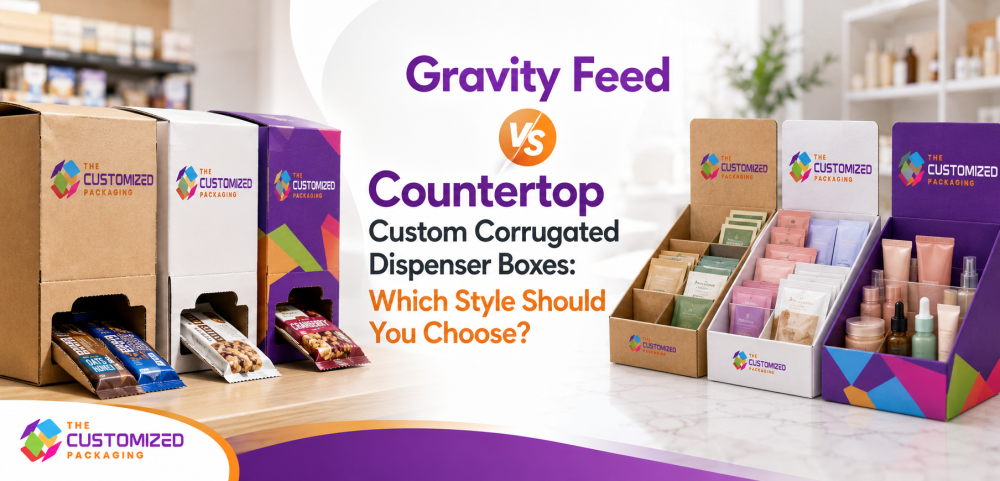
Gravity Feed vs Countertop Custom Corrugated Dispenser Boxes: Which Style Should You Choose?
Choosing the right dispenser box is not simply a matter of selecting an attractive shape. The packaging must match how the product is packed, transported, displayed, removed, restocked, and purchased. A structure that works well for individually wrapped snack bars may not perform correctly for flexible cosmetic sachets, coffee pods, hardware components, or promotional samples.
Two of the most widely used options are gravity-feed custom corrugated dispenser boxes and countertop custom corrugated dispenser boxes. Both styles organize several product units within one branded structure, but they manage product access and retail presentation differently.
A gravity-feed dispenser uses product weight, an angled base, an internal ramp, or a sloped channel to move the next item toward a lower dispensing opening. As one unit is removed, another moves into position. This makes the style useful for products that need continuous front-facing availability, including snack bars, small packets, pouches, pods, sachets, and compact cartons.
A countertop dispenser generally presents products through an open front, divided tray, raised platform, tiered arrangement, or accessible compartment. The product does not necessarily move automatically. Customers or employees select an item directly from the visible assortment. This style works well for cosmetics, tea sachets, promotional samples, small accessories, gift cards, stationery, healthcare products, and mixed product variations.
Both structures can be manufactured from kraft, white, white-top, recycled, E-flute, F-flute, B-flute, or litho-laminated corrugated materials. They can also include custom printing, logo placement, header panels, dividers, perforations, QR codes, barcodes, inserts, premium finishes, and wholesale production.
The best choice depends on product dimensions, weight, surface friction, quantity, orientation, customer interaction, shelf or counter space, shipping conditions, branding requirements, packing method, and order volume.
At The Customized Packaging, we create custom gravity-feed corrugated dispenser boxes, countertop display boxes, snack dispensers, sachet organizers, cosmetic displays, shelf-ready cartons, printed corrugated boxes with logo, internal ramps, dividers, custom headers, wholesale dispenser boxes, and bulk retail packaging for businesses throughout the USA.
For broader guidance about dispenser structures, flute profiles, materials, printing options, inserts, perforations, pricing, and wholesale production, read our main pillar article titled “Custom Corrugated Dispenser Boxes: The Complete Guide to Styles, Materials, Printing, and Wholesale Ordering.”
What Is a Gravity-Feed Corrugated Dispenser Box?
Products Move Toward the Opening as Units Are Removed
A gravity-feed dispenser is designed to keep the next product close to the access opening without requiring customers or employees to reach into the back of the carton.
The products may rest on a sloped base, folded corrugated ramp, angled insert, or specially designed internal channel. Gravity encourages the remaining units to slide or roll toward the front after the leading product is removed.
The opening is commonly positioned near the lower front panel. It should be large enough for convenient access but small enough to retain the remaining products.
Custom gravity-feed dispenser boxes can be designed with one product lane or several divided channels. A single lane may hold one snack flavor, while a multi-lane display can organize several flavors, colors, formulas, or sizes.
The performance of the structure depends heavily on the product. Rigid cartons and evenly shaped bars may move predictably, while flexible pouches can overlap, wrinkle, or become trapped.
This is why gravity-feed packaging should be tested with the actual packed product rather than approved only from digital dimensions.
What Is a Countertop Corrugated Dispenser Box?
Products Remain Visible in an Open Retail Display
A countertop dispenser is a compact display designed to sit on checkout counters, reception desks, café registers, pharmacy counters, salon workstations, trade-show tables, and other customer-facing surfaces.
The products are usually displayed upright, horizontally, in divided rows, on raised tiers, or inside an open-front tray.
Customers select products directly instead of relying on an automatic feed mechanism.
A custom corrugated countertop display box may include a raised header panel that carries the logo, product name, benefits, promotional message, or QR code.
Dividers can separate tea blends, snack flavors, skincare formulas, accessory types, product sizes, or promotional variations.
Countertop boxes are especially valuable when the product packaging itself contributes to the display. Colorful sachets, tubes, small cartons, pouches, and carded products can remain visible and become part of the overall branding.
The structure should use the available counter footprint efficiently while remaining stable as products are removed.
Gravity Feed vs Countertop Dispenser Boxes at a Glance
| Comparison area | Gravity-feed dispenser box | Countertop dispenser box |
|---|---|---|
| Product movement | Products automatically move toward the opening | Products remain in fixed or manually selected positions |
| Best product shape | Uniform, stackable, or slide-friendly items | Upright sachets, mixed products, tubes, cards, and varied shapes |
| Primary access point | Lower front dispensing opening | Open front, top, tier, or divided compartment |
| Customer experience | Quick removal of one unit at a time | Wider browsing and product comparison |
| Display appearance | Maintains a front product position as stock decreases | Shows a larger visible assortment |
| Internal components | Often requires a ramp, channel, or angled base | May use dividers, risers, trays, or compartments |
| Retail footprint | Can hold deeper product inventory within a compact front | Often uses more visible front width |
| Restocking | Products must be aligned correctly for reliable flow | Usually easier to refill by compartment |
| Structural complexity | Product flow requires precise testing | Often simpler unless tiered or highly divided |
| Typical applications | Snack bars, packets, pods, pouches, small cartons | Cosmetics, sachets, samples, accessories, tea, stationery |
| Branding area | Front wall, side panels, and header | Header, front lip, dividers, side panels, and back panel |
| Cost direction | Ramp and testing may add cost | Simple trays may cost less, but dividers and tiers add cost |
| Best sales environment | Fast product selection and repeated dispensing | Product discovery, comparison, and impulse purchases |
Neither style is universally better. The correct option is the one that matches the product and the retail interaction.
How Gravity-Feed Dispenser Boxes Work
The Product, Ramp, and Opening Must Function as One System
Gravity-feed performance depends on the relationship between the product weight, wrapper surface, internal angle, box width, side-wall clearance, and front opening.
If the ramp is too shallow, the next product may remain at the back.
If the angle is too steep, several products may move forward together or place too much pressure on the front unit.
If the internal lane is too wide, products may rotate and jam.
If the lane is too narrow, wrappers may scrape against the walls and stop moving.
The lower opening must allow the first product to be removed without releasing several units at once.
Corrugated guides or dividers may be added to maintain alignment.
The first, middle, and final products should all dispense reliably. A system that works only while the box is completely full is not ready for wholesale production.
How Countertop Dispenser Boxes Work
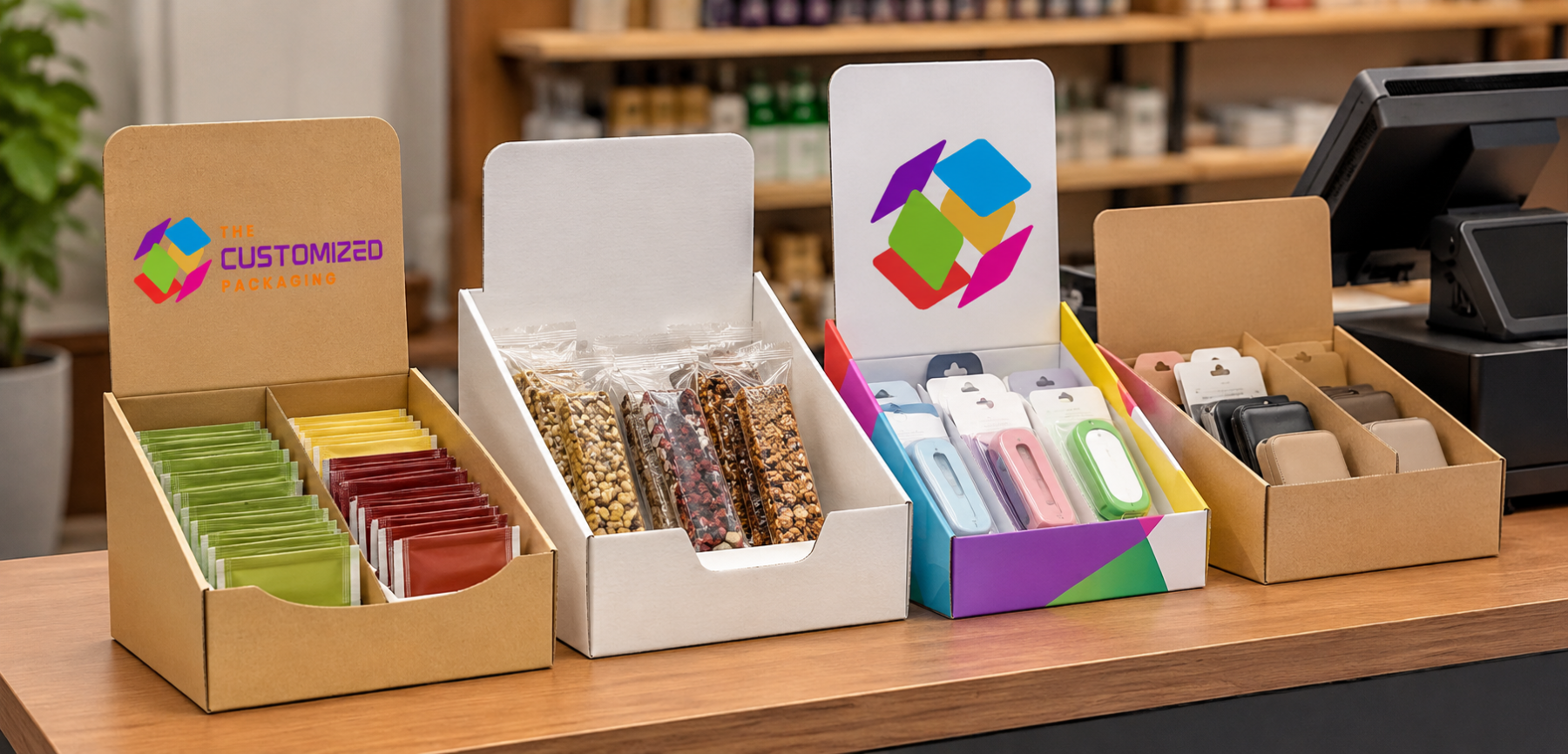
Open Presentation Makes Product Selection Easy
Countertop dispensers generally prioritize visibility and direct access.
Products may stand upright behind a low front wall, rest inside a tray, sit on tiered platforms, or remain separated within compartments.
The customer can compare several flavors, colors, formulas, or product types before making a selection.
A tea display may organize green, herbal, black, and fruit blends in separate sections. A cosmetic display may present hydrating, brightening, calming, and exfoliating formulas. A snack display may show several flavors side by side.
The front panel should retain the products without hiding too much of their packaging.
The header should remain tall enough for branding but proportionate enough to keep the display stable.
Countertop boxes may be simpler than gravity-feed structures because they do not need an angled feed system, but complex dividers, tiered supports, or premium headers can still require custom structural development.
Which Style Is Better for Snack Bars?
Gravity Feed Supports Quick Selection and Continuous Product Flow
Snack bars, energy bars, protein bars, granola bars, candy bars, and other uniformly shaped packaged products are often good candidates for gravity-feed boxes.
The bars can be placed horizontally or vertically according to the wrapper dimensions and display requirements.
An internal ramp can move each unit toward a lower opening.
This helps the front of the dispenser remain active even after several products have been sold.
A gravity-feed design can also hold more inventory behind a relatively narrow front-facing area.
However, snack wrappers vary. Smooth plastic film may slide easily, while matte, paper-based, textured, or highly flexible wrappers may create more friction.
Bars with irregular toppings, thick sealed ends, or uneven dimensions may overlap.
A countertop snack display may be a better choice when the business wants customers to compare several flavors or when the product does not slide consistently.
Which Style Is Better for Sachets?
Countertop Compartments Often Provide Better Product Organization
Tea sachets, coffee packets, condiments, cosmetic samples, serum pouches, seasoning packets, and promotional sachets are lightweight and flexible.
These products may not have enough weight to move consistently through a gravity-feed system.
Thin sachets can overlap, bend, or become trapped against one another.
A divided countertop dispenser often provides better control. Products can remain upright within narrow compartments, allowing customers to see the front artwork and select a particular flavor or formula.
Gravity feed may still work when sachets are packed inside small rigid cartons or when the individual packets have enough thickness and stiffness.
A sample should be tested before selecting the final structure.
Which Style Is Better for Cosmetics?

Countertop Displays Support Premium Presentation and Product Comparison
Cosmetic products often depend on color, packaging design, formula identification, and visual presentation.
Sheet-mask sachets, serum packets, hand creams, lip products, small tubes, applicators, wipes, and beauty samples can be arranged inside a custom cosmetic countertop display box.
A tall header provides space for the logo, formula, product benefits, model photography, botanical graphics, or promotional message.
Dividers can separate shades, fragrances, formulas, or skin concerns.
The customer can browse the visible assortment instead of receiving whichever product reaches a gravity-feed opening first.
Gravity feed can work for uniform cosmetic cartons, individually boxed lip products, or identical sachets sold one at a time.
For mixed or premium cosmetic assortments, the countertop structure generally provides more branding flexibility.
Which Style Is Better for Coffee Pods and Capsules?
Product Shape Determines Whether Gravity Feed Is Practical
Coffee pods and capsules may work in gravity-feed packaging when the internal ramp and opening are designed around their diameter, height, and orientation.
A channel can move pods toward the front while preventing them from turning sideways.
However, rounded products can roll unpredictably when the lane is too wide or the ramp is too steep.
A countertop tray with shaped compartments may provide better control for premium pod assortments.
The tray can organize several flavors by color and allow customers to compare varieties.
A gravity-feed box is more suitable when the business wants quick access to one pod type, while a divided countertop display is useful when product choice is important.
Which Style Is Better for Small Accessories?
Shape, Value, and Security Should Guide the Decision
Charging cables, batteries, adapters, gift cards, stationery, craft products, small tools, automotive parts, and promotional items vary greatly in shape and weight.
Carded accessories usually work well in open countertop displays, hanging structures, or tiered boxes.
Small rigid cartons may work in gravity-feed channels when the dimensions are consistent.
Heavy metal components may place excessive pressure on a lower opening. They may require reinforced B-flute or double-wall corrugated material and a countertop or workplace dispenser with a strong base.
Higher-value accessories may also need security features or placement behind a staffed counter.
The packaging style should support controlled access without making the product difficult to inspect or scan.
Product Suitability Comparison
| Product type | Recommended style | Why it may work best | Testing priority |
|---|---|---|---|
| Protein and snack bars | Gravity feed or divided countertop | Uniform bars can slide; divided boxes show flavors | Wrapper friction and ramp angle |
| Tea sachets | Countertop display | Upright compartments improve visibility | Compartment width and packet height |
| Coffee sachets | Countertop or gravity feed | Depends on packet thickness and product variety | Packet overlap and opening size |
| Coffee pods | Gravity feed or shaped countertop tray | Feed channels suit one variety; trays support assortments | Rolling, rotation, and lane width |
| Cosmetic sachets | Countertop display | Supports premium branding and formula comparison | Front-wall height and product visibility |
| Small cosmetic cartons | Gravity feed or countertop | Uniform cartons may slide consistently | Carton dimensions and surface friction |
| Condiment packets | Open countertop or wide-access dispenser | Supports high-volume service and restocking | Moisture exposure and easy access |
| Candy and small snacks | Gravity feed | Continuous front product supports impulse sales | Product size consistency |
| Gift cards | Countertop compartment display | Allows category and design comparison | Stability and card retention |
| Charging cables | Countertop or hanging display | Product selection and compatibility remain visible | Product security and barcode access |
| Hardware parts | Reinforced countertop dispenser | Strong base supports heavy contents | Packed weight and front-wall strength |
| Healthcare sachets | Countertop or top-access dispenser | Clear labeling and controlled organization | Instructions and product retention |
Physical product testing should confirm the recommendation before final manufacturing.
Product Shape Is the First Decision Factor
Uniform Products Are Easier to Feed Automatically
Gravity-feed systems perform best when each unit has consistent dimensions and a stable shape.
Small cartons, rigid wrappers, rectangular bars, pods, and uniformly packed products are easier to guide through a controlled channel.
Flexible, irregular, lightweight, or sticky products are more likely to overlap.
Countertop displays can accommodate a wider variety of shapes because the products do not need to slide automatically.
Mixed assortments, tubes, pouches, sachets, carded products, and irregular accessories can be arranged inside separate compartments.
Businesses should provide physical product samples when shape or wrapper behavior is difficult to communicate through dimensions alone.
Product Weight Affects Gravity Feed
Lightweight Items May Not Move Reliably
Gravity feed depends partly on product weight.
A heavier unit may slide forward consistently, while an extremely light sachet may remain in place even when the ramp is angled.
However, excessive weight can create another problem.
A large stack of heavy products can place pressure on the front unit and the lower opening.
The front wall, base, and internal ramp may need reinforcement.
Countertop displays do not depend on automatic movement, making them more flexible for lightweight products.
The complete packed weight still determines the required corrugated grade and base strength.
Product Surface Friction Can Cause Jamming
Wrapper Material Should Be Tested Inside the Box
Glossy film, matte paper, textured pouches, foil wrappers, coated cartons, and soft plastic surfaces behave differently.
Two smooth packages may slide easily.
Matte or paper-based wrappers may grip one another.
Flexible film can fold at the sealed edge and catch against the corrugated surface.
The flute liner and printing finish may also affect friction.
A coated internal ramp may perform differently from untreated kraft board.
Businesses should test the actual production wrapper rather than an empty or temporary sample package.
Counter Space and Shelf Depth Influence the Structure
Gravity Feed Often Uses Depth While Countertop Displays Use Width
A gravity-feed box can store several products behind one another, allowing the business to use shelf or counter depth.
This can be useful when front-facing width is limited.
A countertop assortment often uses more width because several products or compartments remain visible side by side.
This provides stronger product comparison but can consume more counter space.
The business should provide the available width, depth, and height before the dieline is created.
The display should not block payment equipment, customer access, nearby products, or staff movement.
Product Visibility and Selection
Countertop Displays Show More of the Assortment
A gravity-feed opening generally highlights the leading product.
This works well when every unit is the same or when the sequence does not matter.
A countertop display can show several products simultaneously.
This makes it better for flavors, formulas, colors, sizes, or product variations.
A brand may also combine both approaches by using several gravity-feed lanes inside one wider countertop structure.
Each lane can contain a different flavor while moving products forward automatically.
This hybrid format provides both organized selection and product flow, although it requires more complex development.
Customer Interaction and Buying Speed
Gravity Feed Supports Fast Removal
Gravity-feed dispensers are useful when customers already understand the product and want to remove one unit quickly.
Snack bars, candy, coffee pods, packets, and common consumables often benefit from this interaction.
Countertop displays encourage customers to browse and compare.
This can support new products, cosmetics, samples, specialty tea, accessories, and premium assortments.
The business should consider whether the customer needs speed or product education.
A product with several benefits or variations may require a header and broader display area.
A familiar single product may perform better in a compact gravity-feed box.
Branding Opportunities on Gravity-Feed Boxes
The Front Product and Printed Header Work Together
Gravity-feed packaging can display the logo on the front retaining wall, side panels, top panel, and raised header.
The leading product remains visible through the opening, making the individual wrapper part of the display.
The design should ensure that the brand logo remains visible when the box is full.
The opening can be framed with brand colors, patterns, ingredient graphics, or directional artwork.
A short call to action can encourage customers to take one product.
The side panels can include benefits, QR codes, flavor information, or product instructions.
Branding Opportunities on Countertop Boxes
Larger Visible Panels Support More Detailed Messaging
Countertop displays often provide a larger header and wider front panel.
This allows businesses to present the logo, product name, benefits, promotional message, formula, flavor guide, or product-family information.
Dividers can use color coding or printed compartment labels.
Interior artwork may become visible as the products are removed.
A cosmetic brand can use premium gradients and botanical artwork. A snack company can use ingredient images and bold colors. A tea brand can use blend names and illustrations.
The printed design should remain clear and should not compete with the visible product packaging.
Kraft Materials for Both Dispenser Styles
Natural Corrugated Board Supports Practical Branding
Natural kraft corrugated board can be used for both gravity-feed and countertop structures.
It provides a brown, organic, industrial, or minimalist appearance.
One-color printing can create economical wholesale packaging.
Dark purple, black, green, red, orange, or navy artwork can contrast effectively against kraft.
Kraft works well for natural snacks, organic-style products, tea, coffee, hardware, workplace supplies, and artisan brands.
Businesses should test light colors because the brown background can change their appearance.
White ink or a printed label may improve contrast but can add production cost.
White and White-Top Corrugated Materials
Bright Surfaces Support Detailed Retail Printing
White corrugated material creates a clean background for cosmetics, healthcare products, food sachets, electronics, and premium retail displays.
White-top board can provide a smooth exterior printing surface while retaining a kraft or recycled-looking interior.
Full-color graphics, pastel shades, photographs, and gradients generally appear more clearly on white material.
Both gravity-feed and countertop boxes can use white corrugated board.
The business should consider scuffing, handling marks, coatings, storage, and transportation when maintaining a clean appearance.
Selecting the Correct Corrugated Flute
E Flute Supports Refined Displays While B Flute Supports More Weight
E flute is widely used for custom retail dispenser packaging because it provides rigidity with a relatively thin profile.
It supports precise folds, clean openings, header panels, and high-quality printing.
F flute may be used for smaller and more compact displays.
B flute can provide stronger puncture resistance for heavier products, warehouse dispensers, shelf-ready cases, or larger gravity-feed structures.
C flute and double-wall materials may be appropriate for large or industrial applications.
The opening can weaken part of the panel, so the material should be reviewed after the front section is cut.
The strongest material is not always the best option. Excess thickness can increase cost, freight, storage volume, and assembly difficulty.
Internal Ramps in Gravity-Feed Boxes
The Ramp Angle Controls Product Flow
A gravity-feed ramp may be integrated into the box or supplied as a separate corrugated insert.
Integrated ramps can reduce the number of components, while separate inserts may provide greater control over the angle.
The ramp should support the product without bending under the packed weight.
Side guides can prevent units from rotating.
The angle should move the product consistently without creating excessive pressure.
A prototype should be tested under realistic storage and retail conditions because humidity and repeated use may affect corrugated performance.
Dividers in Countertop Dispenser Boxes
Compartments Organize Several Product Variations
Countertop displays can use paperboard or corrugated dividers to separate products.
The dividers should remain tall enough to prevent mixing but low enough for easy selection.
Each compartment can have a printed label, color block, or product name.
Dividers add material, tooling, and assembly steps.
Businesses should decide whether several product variations genuinely need separate lanes or whether one wider compartment would be sufficient.
The display should remain easy to restock.
Hybrid Gravity-Feed Countertop Displays
One Structure Can Combine Automatic Flow with Product Choice
Some businesses do not need to choose only one style.
A hybrid display can include multiple gravity-feed lanes within a countertop box.
Each lane may contain a different snack flavor, pod variety, sachet, or small carton.
The raised header communicates the overall brand, while compartment labels identify each product.
This structure can maintain front-facing inventory and support product comparison.
However, multiple feed lanes require accurate dimensions and more testing.
Each product variation must behave consistently within its channel.
The hybrid design may also cost more because it uses dividers, ramps, a wider structure, and additional die-cutting.
Restocking Gravity-Feed Dispenser Boxes
Products Must Be Loaded in the Correct Direction
Gravity-feed systems require organized loading.
Products should face the correct direction and remain aligned within the lane.
A top-loading or rear-loading structure can make restocking easier.
Employees should not need to dismantle the complete display.
Printed loading instructions may help when several retail locations use the same packaging.
The box should allow employees to refill it without bending wrappers or disrupting the internal ramp.
Restocking Countertop Dispenser Boxes
Open Compartments Support Quick Refilling
Countertop displays are generally easy to refill because the products remain accessible from the top or front.
Employees can add items to individual compartments.
The display can also make low inventory easy to identify.
However, open access may allow products to become mixed when the compartments are not clearly defined.
Printed labels and color coding can support accurate restocking.
The box should maintain a neat appearance even when partially filled.
Shipping Gravity-Feed Dispenser Boxes
Internal Components Must Remain Secure During Transportation
A gravity-feed dispenser may be shipped assembled, partially assembled, flat, or inside an outer shipping carton.
When the products are packed inside the same box used for retail display, the internal ramp and product arrangement must survive transportation.
Products should not shift into positions that cause jamming.
A tear-away shipping panel can protect the opening until the box reaches the store.
The perforation must remain closed during transit and remove cleanly at the retail location.
Shipping Countertop Dispenser Boxes
Shelf-Ready Structures Can Reduce Retail Handling
Countertop displays can also function as shipping-and-display cartons.
The products remain enclosed during transportation.
Retail employees remove a perforated front or top section and place the remaining box on the counter.
This reduces unpacking and product arrangement.
Premium countertop displays may instead be shipped flat and assembled separately to protect the printed surfaces.
The correct approach depends on the material, artwork, product weight, destination, and retail setup process.
Which Style Is More Economical?
Simple Countertop Boxes Often Cost Less, but the Specification Matters
A basic countertop tray with a front cutout may use fewer components and less structural development than a gravity-feed dispenser with an internal ramp.
This can make a simple countertop box more economical.
However, a premium countertop display with several dividers, tiered supports, full-color printing, a custom header, and luxury finishes can cost more than a simple kraft gravity-feed box.
Pricing depends on dimensions, board grade, flute profile, opening design, ramps, dividers, printing, quantity, tooling, finishes, and freight.
Businesses should compare complete specifications rather than assuming one style is always cheaper.
Gravity Feed vs Countertop Cost Factors
| Cost consideration | Gravity-feed box | Countertop display box |
|---|---|---|
| Structural development | May require more testing for product flow | Usually simpler unless tiered or divided |
| Internal components | Ramp, rails, or feed channels may add cost | Dividers, risers, and compartments may add cost |
| Material use | Deeper structure may use more board | Wider headers and displays may use more board |
| Tooling | Custom lower openings and ramp components may require tooling | Header shapes and compartment systems may require tooling |
| Printing area | Front, sides, and header provide branding space | Often offers larger visible print surfaces |
| Assembly labor | May require ramp installation or careful folding | Simple trays assemble quickly; divided boxes take longer |
| Packing labor | Products must be aligned for reliable feeding | Products can often be loaded by compartment |
| Testing requirement | High because product movement must be confirmed | Moderate, focused on fit and stability |
| Wholesale unit cost | Can fall significantly at higher quantities | Also benefits from volume production |
| Freight and storage | Deep structures may increase flat blank size | Wide headers and dividers may increase shipment volume |
A supplier should quote both structures when the product could perform in either style.
Minimum Order Quantities
Printing and Structural Complexity Influence the MOQ
The minimum order quantity for custom gravity-feed dispenser boxes or custom countertop display boxes depends on the manufacturer, dimensions, corrugated material, tooling, printing process, and finishing.
Digital printing may support lower quantities for prototypes, product launches, seasonal campaigns, and regional testing.
Flexographic printing can become more economical for larger wholesale orders.
Litho-laminated graphics may require medium or high quantities because of the additional printing and lamination stages.
Complex ramps, dividers, custom headers, windows, foil, and embossing can increase the practical MOQ.
Businesses searching for corrugated dispenser boxes no minimum may need to compare structural samples, short-run digital printing, stock displays with custom labels, and fully customized manufacturing.
Wholesale Ordering for Gravity-Feed Boxes
Testing Should Be Completed Before Bulk Manufacturing
Gravity-feed boxes should not move directly from a concept to a large wholesale production run.
The actual product should be tested through several complete dispensing cycles.
The sample should be filled, partially emptied, refilled, moved, and used under realistic conditions.
The business should evaluate whether products jam, rotate, overlap, or release too quickly.
The printed artwork and barcodes should also be reviewed.
Once the structure performs reliably, wholesale gravity-feed dispenser boxes can help maintain consistent lane widths, ramp angles, openings, materials, and branding across retail locations.
Wholesale Ordering for Countertop Displays
Retail Fit and Branding Should Be Approved First
Countertop boxes should be tested on the actual counter, shelf, or reception desk when possible.
The business should confirm the footprint, header visibility, customer access, product arrangement, stability, and restocking process.
The logo should remain visible when the box is full and partially empty.
Dividers should keep product variations organized.
Once approved, wholesale countertop dispenser boxes can create a consistent retail presentation across stores, franchises, cafés, salons, pharmacies, and trade-show locations.
How to Decide Based on Your Sales Goal
Fast Dispensing and Product Discovery Require Different Structures
A business focused on fast removal of one familiar product may benefit from gravity feed.
This is common for snacks, candy, pods, packets, and frequently used consumables.
A business focused on product discovery, comparison, sampling, or premium presentation may benefit from a countertop display.
Cosmetics, specialty tea, healthcare products, accessories, and multi-flavor assortments often require more visible choice.
A hybrid structure may work when customers need both selection and automatic product flow.
The sales goal should be considered alongside structural performance.
How to Decide Based on Your Product Range
Single Products and Mixed Assortments Need Different Display Logic
A gravity-feed box works naturally for one product or one variation per lane.
A countertop display can present several variations within one open box.
Businesses with a single best-selling snack may use one gravity-feed dispenser.
Businesses with six tea blends may prefer a divided countertop display.
Brands with several high-volume snack flavors may use a multi-lane gravity-feed counter box.
The number of product variations should be confirmed before the dieline is developed.
How to Decide Based on Branding
Countertop Displays Offer More Visible Design Space
Both styles support custom printing and logos.
Countertop displays often provide larger headers and more direct product presentation.
This makes them useful for new brands, promotional launches, cosmetics, and products requiring explanation.
Gravity-feed boxes can still provide strong branding through a printed header, front wall, and side panels.
They may create a cleaner and more focused message around one product.
The design should remain visible at different inventory levels.
How to Decide Based on Retail Labor
Simpler Restocking Can Reduce Operational Time
Countertop displays are often easier for employees to refill quickly.
Gravity-feed systems require more careful alignment.
However, gravity feed can reduce the need for employees to pull products forward after each sale.
The business should consider the complete retail workflow.
A structure that costs slightly more but saves repeated staff time may provide better overall value.
A physical sample can be used to measure assembly and restocking time.
How to Choose a Dispenser Box Manufacturer
The Supplier Should Understand Product Flow and Retail Presentation
A professional custom corrugated dispenser box manufacturer should ask about the product dimensions, weight, wrapper material, quantity, orientation, retail space, shipping method, printing, and order volume.
For gravity-feed boxes, the supplier should evaluate friction, ramp angle, lane width, and opening size.
For countertop displays, the supplier should evaluate stability, product visibility, header size, dividers, and footprint.
Businesses should request a structural dieline, digital proof, physical prototype, material specification, printing details, minimum order quantity, tooling cost, production time, and freight quote.
The cheapest supplier may not provide the best structure.
Questions to Ask Before Choosing a Style
Clear Product Information Leads to Better Recommendations
Businesses should ask whether the product has been physically tested in the proposed structure.
They should confirm how the first, middle, and final units will be removed.
They should ask whether an internal ramp or divider is required and whether it is integrated or supplied separately.
The supplier should explain the proposed corrugated flute, board strength, printing process, assembly method, and retail setup.
Businesses should also confirm whether the quote includes samples, cutting dies, printing plates, inserts, packing, and freight.
Buy Gravity-Feed or Countertop Dispenser Boxes Online
Provide the Complete Product and Retail Specification
Businesses ready to buy custom corrugated dispenser boxes online should provide the product length, width, thickness, weight, wrapper type, quantity per box, product variations, available display space, material preference, printing requirements, order quantity, and delivery ZIP code.
A physical product sample can improve accuracy.
The supplier can then compare a gravity-feed structure with a countertop design.
The quotation should identify the dimensions, corrugated material, flute profile, opening, ramp, dividers, printing method, tooling, quantity, production time, and freight.
Businesses searching to order gravity-feed dispenser boxes online or buy countertop display boxes wholesale should compare identical specifications.
Gravity-Feed and Countertop Dispenser Boxes Across the USA
Custom Retail Displays for Businesses Nationwide
At The Customized Packaging, we provide custom gravity-feed corrugated dispenser boxes and custom countertop dispenser boxes for snack brands, tea and coffee businesses, cosmetic companies, pharmacies, healthcare suppliers, retailers, cafés, salons, hotels, electronics stores, manufacturers, offices, warehouses, and ecommerce businesses throughout the USA.
We create single-lane and multi-lane gravity-feed boxes, divided countertop displays, snack-bar dispensers, sachet organizers, cosmetic displays, shelf-ready packaging, kraft boxes, white corrugated displays, full-color printed packaging, custom ramps, dividers, headers, and packaging with logo.
Businesses searching for gravity-feed dispenser boxes near me, countertop display box manufacturer USA, wholesale corrugated dispenser boxes, custom printed retail displays, or order dispenser boxes online can request packaging developed around their products and sales environment.
We support businesses throughout New York, New Jersey, California, Texas, Florida, Illinois, Pennsylvania, Ohio, Georgia, North Carolina, Washington, Massachusetts, Virginia, Michigan, Arizona, Tennessee, Indiana, Missouri, Maryland, Wisconsin, Colorado, Minnesota, Nevada, Oregon, Kentucky, Utah, and other locations across the United States.
Want to Compare the Cost of Both Styles?
Try the Custom Box Packaging Cost Calculator
Businesses deciding between gravity-feed and countertop packaging can use the Custom Box Packaging Cost Calculator to develop an initial estimate based on dimensions, structure, material, printing, finishing, inserts, and quantity.
The calculator can help compare gravity-feed boxes with internal ramps, open countertop displays, multi-compartment dispensers, snack-bar packaging, sachet organizers, cosmetic displays, shelf-ready cartons, kraft boxes, white corrugated packaging, and full-color retail displays.
The final quotation may change according to the corrugated flute, board grade, product weight, opening, ramp, dividers, header, printing coverage, tooling, order quantity, freight, and delivery destination.
After reviewing the estimate, businesses can request a detailed custom corrugated dispenser box quote for both styles.
Why Choose The Customized Packaging?
Structural Recommendations Based on the Actual Product
At The Customized Packaging, we help businesses compare gravity-feed and countertop structures according to product behavior, customer interaction, retail space, branding, packing, and wholesale requirements.
We provide kraft corrugated board, white material, white-top liners, E flute, F flute, B flute, digital printing, flexographic printing, litho-laminated graphics, custom ramps, multiple feed lanes, dividers, tiered inserts, header panels, tear-away sections, digital proofs, physical samples, and wholesale pricing.
Our dispenser packaging supports snacks, sachets, cosmetics, coffee pods, healthcare products, electronics accessories, stationery, hardware, promotional products, and other small retail or workplace items.
As a professional custom box manufacturer and retail packaging supplier, we develop each structure around product dimensions, packed weight, wrapper behavior, dispensing method, retail presentation, order quantity, and delivery destination.
Businesses remain responsible for confirming that selected materials, inks, coatings, adhesives, inserts, labeling, environmental claims, and product-contact components meet the requirements applicable to their products and markets.
Final Thoughts
Choose Gravity Feed for Product Flow and Countertop Displays for Product Choice
The decision between gravity-feed custom corrugated dispenser boxes and countertop custom corrugated dispenser boxes should begin with the product and customer experience.
Gravity-feed boxes are well suited to uniform products that slide consistently and need to remain close to a lower dispensing opening. They can support fast access, compact front-facing space, and continuous product presentation.
Countertop displays are better suited to mixed assortments, upright sachets, cosmetics, samples, accessories, and products customers want to compare. They provide more visible branding space and flexible organization through dividers, risers, and compartments.
Product shape, weight, wrapper friction, quantity, retail footprint, branding, restocking, shipping, and budget should all influence the final selection.
Businesses do not always need to choose one format exclusively. A multi-lane gravity-feed countertop display can combine automatic movement with product variety.
A physical prototype remains the most reliable way to determine whether the chosen structure will work.
Whether you need gravity-feed snack dispensers, coffee-pod boxes, sachet displays, cosmetic countertop packaging, multi-compartment displays, shelf-ready cartons, wholesale corrugated dispenser boxes, or custom printed packaging with logo, the correct structure can improve product access, retail visibility, and customer convenience.
For complete guidance about dispenser styles, materials, flute profiles, printing, inserts, pricing, and wholesale production, read our main pillar article titled “Custom Corrugated Dispenser Boxes: The Complete Guide to Styles, Materials, Printing, and Wholesale Ordering.”
At The Customized Packaging, we create dispenser packaging that is built to protect, engineered to organize, and designed to help businesses choose the right structure for selling, dispensing, and growing throughout the USA.
