

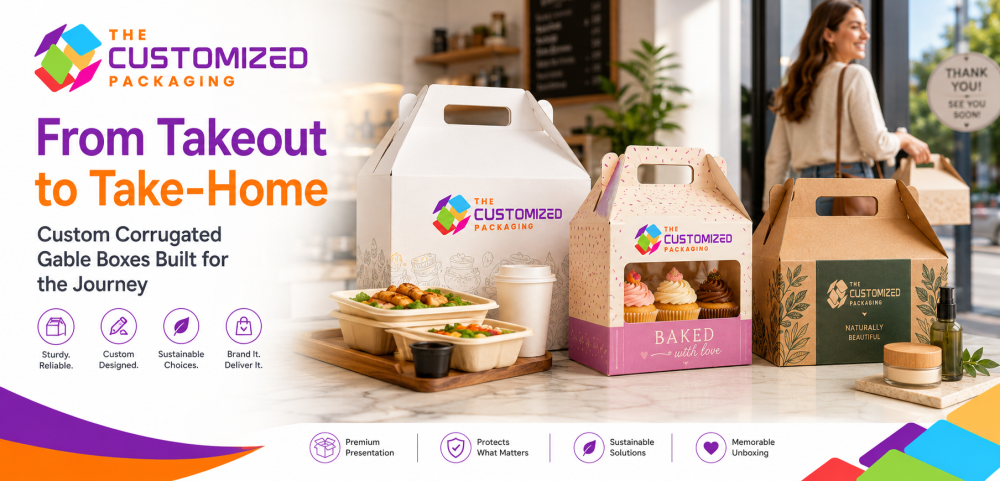
From Takeout to Take-Home: Custom Corrugated Gable Boxes Built for the Journey
Packaging for takeaway meals, bakery orders, retail purchases, gifts, promotional kits, and event products must perform beyond the checkout counter. The package may begin inside a restaurant, bakery, store, warehouse, fulfillment center, hotel, conference venue, or catering facility, but its real performance is tested after the customer picks it up.
The box may be carried through a crowded store, placed on a pickup shelf, loaded into a vehicle, moved through an office, transported to a home, stored inside a refrigerator, opened at an event, photographed for social media, or reused to hold remaining products. Every stage creates different demands involving strength, balance, closure security, moisture, heat, product movement, handle comfort, and brand presentation.
Custom corrugated gable boxes are designed for this complete journey.
Their distinctive structure combines a protective corrugated body with sloping upper panels and an integrated carrying handle. The lower section contains and supports the products, while the built-in handle helps customers transport the package without requiring a separate shopping bag in many applications.
The corrugated construction provides more rigidity than lightweight folding cardstock. This makes the box suitable for takeaway food containers, bakery assortments, cupcakes, cookies, cosmetics, candles, jars, retail bundles, corporate gifts, event meals, promotional products, subscription kits, and other products that require both portability and protection.
A well-designed gable box should remain stable from the moment it is assembled until it reaches the customer’s final destination. The handle should support the packed weight. The bottom should not open or bow. The closure should remain secure. The products should not slide into one side. Printed panels should remain clean and visible. Inserts and dividers should maintain organization throughout transportation.
Custom printed corrugated gable boxes with logo also turn the journey into an extended branding opportunity. The bakery name, restaurant logo, retail brand, event identity, website, QR code, social-media handle, reorder information, product instructions, and promotional message can remain visible while the package travels through public and private environments.
At The Customized Packaging, we manufacture food carry boxes, restaurant takeaway gable packaging, bakery cartons, window gable boxes, retail gift packaging, cosmetic kits, reinforced-handle structures, custom dividers, printed inserts, wholesale corrugated gable boxes, and bulk carry-ready packaging for businesses throughout the USA.
For complete guidance about structural styles, flute profiles, handle engineering, bottoms, closures, windows, printing, inserts, pricing, and wholesale ordering, read our main pillar article titled “Custom Corrugated Gable Boxes: The Carry-Ready Packaging That Gets Brands Noticed.”
What Does “Built for the Journey” Mean?
Packaging Must Perform During Every Stage of Customer Handling
A package can look attractive while sitting on a counter and still fail after the customer begins carrying it.
The complete journey may include assembly, loading, temporary storage, customer pickup, walking, vehicle transportation, repeated lifting, refrigeration, delivery, opening, product use, and disposal or reuse.
The packaging must therefore be evaluated as a complete system rather than a decorative outer shell.
The handle, side walls, corners, bottom, closure, corrugated flute, liners, inserts, labels, and products all influence one another.
A strong handle connected to weak side panels may still fail. A reinforced base cannot prevent tipping when the product weight is concentrated on one side. A secure closure may open when internal containers are packed too tightly. A premium printed surface can lose its appearance when moisture or grease reaches untreated material.
Packaging built for the journey considers these problems before production.
The box should be developed around the actual product dimensions, individual item weights, total packed load, carrying distance, storage environment, customer behavior, transportation method, and expected holding period.
Why the Journey Matters for Brand Perception
Customers Judge Packaging While They Carry, Open, and Use It
The customer experience does not end when the package leaves the store.
A box that feels secure can communicate professionalism. A handle that remains comfortable can make the business appear thoughtful. A balanced package can create confidence that the products will reach their destination safely.
In contrast, a box that tilts, bends, opens unexpectedly, leaks, or becomes uncomfortable to carry can reduce customer trust.
Customers may associate packaging quality with product quality, even when the product itself remains unaffected.
This is particularly important for premium bakery orders, catering meals, corporate gifts, cosmetics, candles, specialty foods, retail bundles, and event kits. These products often depend on presentation as well as function.
The package may also be seen by coworkers, family members, guests, delivery staff, event attendees, and social-media audiences. A successful carrying experience can extend the brand beyond the original buyer.
The Takeout-to-Take-Home Packaging Journey
| Journey stage | Main packaging challenge | Recommended design response | Branding opportunity |
|---|---|---|---|
| Assembly | Staff must prepare the box quickly and correctly | Clear folds, auto-lock or snap-lock bottom, intuitive tabs | Interior marks or printed setup guidance |
| Product loading | Contents may be different sizes, weights, or temperatures | Custom inserts, dividers, trays, and balanced arrangement | Branded inserts, cards, and product guides |
| Temporary storage | Boxes may be stacked, chilled, or placed on pickup shelves | Suitable flute, moisture testing, stable base, clear labels | Visible logo and organized customer-name area |
| Customer pickup | The box must be easy to identify and lift | Comfortable handle, secure closure, order label | Logo, product category, QR code, and customer message |
| Walking and carrying | Weight transfers through the handle and upper panels | Reinforced handle and balanced internal layout | Broad side panels create portable advertising |
| Vehicle transportation | Products can slide, tip, collide, or leak | Fitted inserts, dividers, level base, tamper seal | Branded exterior remains visible during handoff |
| Arrival at destination | The package should remain upright and presentable | Flat bottom, rigid walls, clean printed surface | Packaging becomes part of the table or event display |
| Opening | Customers need convenient access without damaging products | Reliable locking tabs and controlled opening | Interior printing, thank-you message, and reorder QR code |
| Product use | Customers may reopen or store remaining items | Reclosable structure and durable walls | Repeated logo exposure supports recognition |
| Disposal or reuse | Materials and components may need separation | Clear instructions based on actual materials | Transparent environmental communication |
The structure should perform consistently at every stage rather than focusing only on the first customer impression.
Custom Corrugated Gable Boxes for Restaurant Takeout
One Carry Box Can Organize a Complete Meal Order
Restaurants, cafés, delis, food trucks, meal-preparation companies, grocery stores, and hospitality businesses can use custom corrugated takeaway gable boxes to organize several food components inside one carry-ready package.
The box may contain a main meal container, side dishes, sauces, dessert, napkins, utensils, condiments, and promotional materials.
Unlike a flexible bag, the corrugated body helps the containers remain upright and reduces pressure between items.
A custom divider can separate hot and cold products. A fitted tray can keep containers from moving. A reinforced base can support heavier orders. A tamper-evident label can help show whether the closure has remained sealed.
The package can display the restaurant logo, website, phone number, online menu, reorder QR code, social-media handle, reheating instructions, delivery guidance, loyalty message, and customer-care information.
The dimensions should be developed around the actual food containers. Oversized packaging can allow products to move, while an overly tight structure may place pressure against the walls and closure.
The complete order should be tested during real preparation, holding, pickup, carrying, and delivery conditions.
Hot Food Packaging Requires Heat and Moisture Planning
Steam Can Affect Both Product Quality and Corrugated Strength
Hot meals and freshly prepared food can release steam after packing.
When moisture remains trapped inside the gable box, it can create condensation, soften crispy foods, weaken untreated paper fibers, and leave visible marks on the printed exterior.
Ventilation openings can help release heat and moisture.
These openings may appear on the side panels, upper slopes, rear wall, or selected corners. Their size and quantity should reflect the food type, temperature, holding period, and delivery distance.
Too much ventilation can reduce heat retention. Too little ventilation may allow condensation to build.
A burger and fries may require a different airflow strategy from pasta, rice bowls, baked foods, or fried chicken.
The business should test the package using the actual meal, container, temperature, travel time, and storage environment.
The outer corrugated box normally acts as secondary food packaging. Appropriate food containers, wraps, trays, cups, or liners should be used when direct contact with corrugated material is not intended.
Grease Resistance Protects the Take-Home Presentation
Oils and Sauces Can Damage Untreated Packaging
Butter, cooking oil, sauces, cheese, frosting, syrup, and other ingredients can stain corrugated board.
Visible grease marks may reduce the professional appearance and weaken the material.
A liner, food tray, wrap, cup, coated insert, or other suitable internal component can help protect the outer box.
The required barrier depends on the food type, temperature, contact time, and transportation conditions.
Businesses should confirm the intended use of the board, inks, coatings, adhesives, labels, liners, and inserts.
Terms such as food-safe, greaseproof, moisture-resistant, biodegradable, compostable, and recyclable should only be used when supported by the complete material specification.
Custom Corrugated Gable Boxes for Bakery Orders
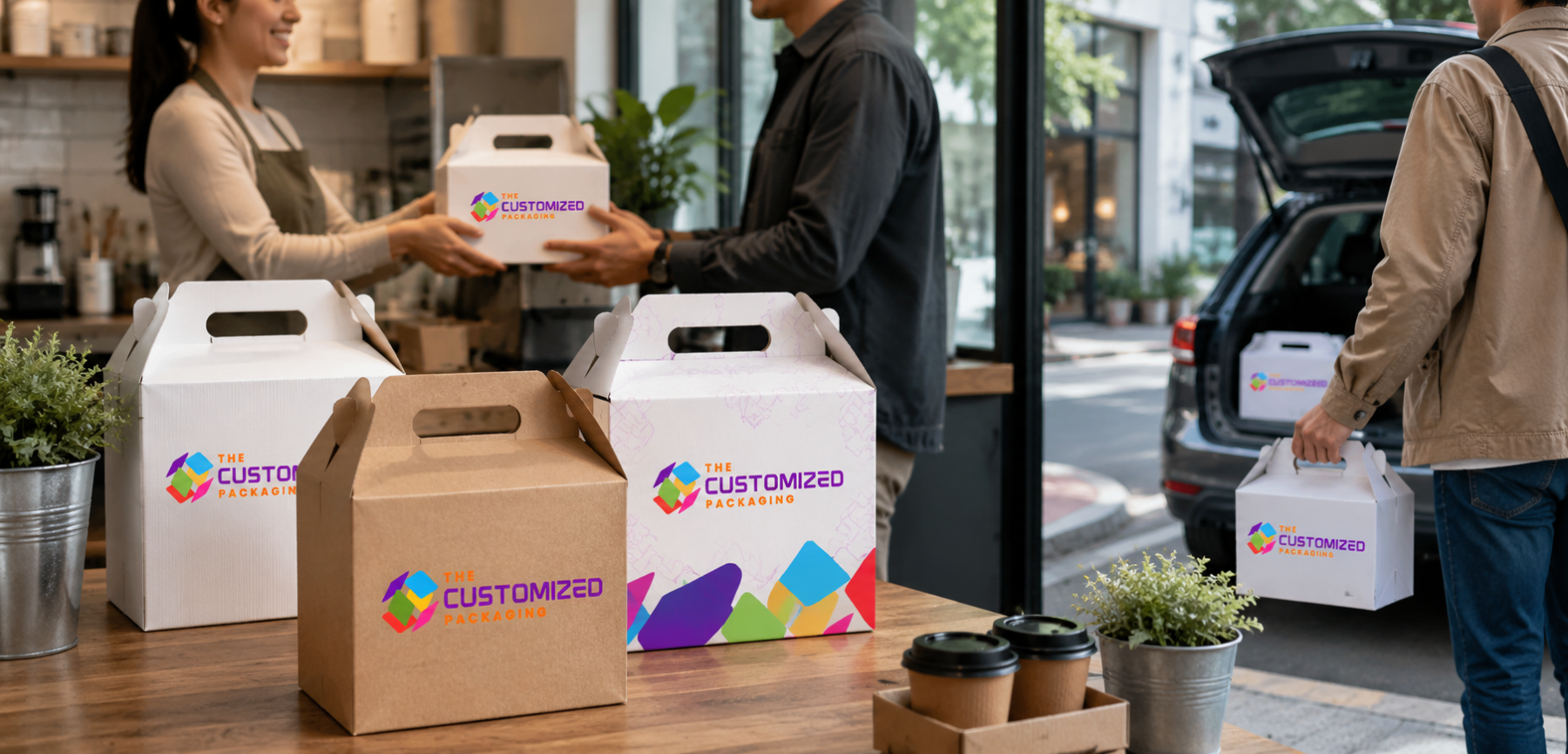
Dessert Packaging Must Protect Appearance as Well as Product
Bakery products are often purchased for celebrations, offices, family gatherings, gifts, meetings, and events. Their visual presentation can be as important as their flavor.
Custom corrugated bakery gable boxes can carry cupcakes, muffins, cookies, pastries, doughnuts, brownies, macarons, dessert jars, mini cakes, and mixed assortments.
Cupcake inserts can keep individual products upright. Dividers can prevent cookies and pastries from mixing. A recessed tray can keep a cake board from sliding. Raised platforms can position products behind a clear window.
The box height should provide enough clearance for frosting, toppers, decorative picks, flowers, sprinkles, and bakery liners.
The handle must support the complete weight of the products, inserts, trays, and box.
A bakery should test the packaging with fully decorated products rather than empty cups or undecorated samples. Decorations often increase the product height and may contact the upper panels or window.
Window Gable Boxes Extend Bakery Presentation
Customers Can See Products Without Opening the Package
A clear window can reveal cupcakes, cookies, macarons, pastries, doughnuts, and dessert assortments while keeping the box closed.
This can improve pickup excitement and help customers confirm the order before leaving the bakery.
The window may appear on the front panel, side panel, or upper slope.
The opening should reveal the most attractive product area without removing too much structural material.
A large window can weaken the wall and may require stronger corrugated board, a wider frame, or a reinforced structure.
The window film and adhesive should remain secure during refrigeration, handling, and transportation.
Condensation, scratching, clarity, material type, and disposal should be considered before production.
Businesses should avoid describing every window box as plastic-free or fully recyclable unless the complete package supports that claim.
Cupcake and Dessert Inserts Protect the Journey
Internal Supports Keep Delicate Products Upright
Cupcakes and decorated desserts can be damaged by sudden movement even when the outer box remains intact.
A fitted cupcake insert supports the product near its base and helps prevent tipping.
The opening should match the cup diameter. An opening that is too wide may allow movement, while one that is too narrow can damage the wrapper or slow loading.
The box height must provide enough space for frosting and toppers.
For mixed dessert boxes, dividers can separate cookies, brownies, macarons, pastries, and mini cakes.
The insert, product, and outer box should be tested together.
A generic insert may not fit custom bakery liners or unusually shaped products.
Gable Boxes for Local Delivery
Vehicle Movement Creates Different Risks from Hand Carrying
Local delivery exposes packaging to braking, turns, vibration, repeated lifting, and temperature changes.
The box should be placed on a level vehicle floor, stable shelf, or delivery platform rather than a sloped seat.
A non-slip mat can help reduce movement.
Products inside the gable box should fit securely or use dividers and inserts.
The bottom should remain flat and should not bow under the packed weight.
The closure should remain sealed throughout the route.
A customer-name area, order number, delivery address, meal type, or product label can help drivers and staff identify the correct package.
The exterior branding should remain visible without interfering with operational labels.
Tamper-Evident Gable Packaging
A Sealed Closure Can Support Customer Confidence
Restaurants, bakeries, healthcare businesses, sample programs, and delivery companies may apply a tamper-evident label across the closure.
The label can display the logo, customer name, order number, packing time, or handling message.
The seal should break or show visible damage when the package is opened.
It should not block the handle opening or make the box difficult to carry.
Adhesive performance should be tested under heat, refrigeration, humidity, grease exposure, and normal handling.
A tamper-evident label can provide a visible sign that the package remained closed, but it does not replace correct food handling, chain-of-custody procedures, or other applicable requirements.
Gable Boxes for Gift Take-Home Packaging
Portable Gift Presentation Can Eliminate a Separate Bag
Retailers, gift companies, cosmetic brands, candle businesses, event planners, and corporate programs can use custom corrugated gift gable boxes for products that customers or recipients carry away.
The package may hold candles, mugs, stationery, apparel accessories, gourmet foods, cosmetics, toys, books, home products, and self-care items.
Tissue paper, shredded filler, dividers, custom inserts, ribbons, stickers, and printed cards can strengthen the presentation.
The gable handle makes the package ready to carry without requiring another shopping bag in many applications.
The distinctive shape can also make the gift feel more intentional than a basic rectangular carton.
The structure should match the actual product weight. Glass jars, bottles, candles, and dense gift sets may require reinforced handles, stronger bottoms, and internal supports.
Corporate Gifts and Employee Kits
Branded Boxes Can Travel Through Workplaces and Events
Companies may use gable boxes for onboarding programs, employee appreciation, client gifts, conferences, training sessions, holiday campaigns, internal events, and recognition programs.
The package can contain notebooks, pens, mugs, snacks, electronics accessories, apparel items, brochures, ID materials, and promotional products.
Custom compartments help keep the kit organized.
The exterior can display the company logo, program name, recipient area, event branding, website, QR code, or campaign message.
Recipients may carry the box through offices, hotels, conference centers, transportation areas, or homes, increasing brand visibility beyond the original distribution point.
The box may also remain on a desk or shelf after opening.
For large corporate programs, businesses should evaluate flat storage, assembly time, packing labor, staged delivery, regional distribution, and leftover packaging inventory.
Retail Gable Boxes for Take-Home Product Bundles
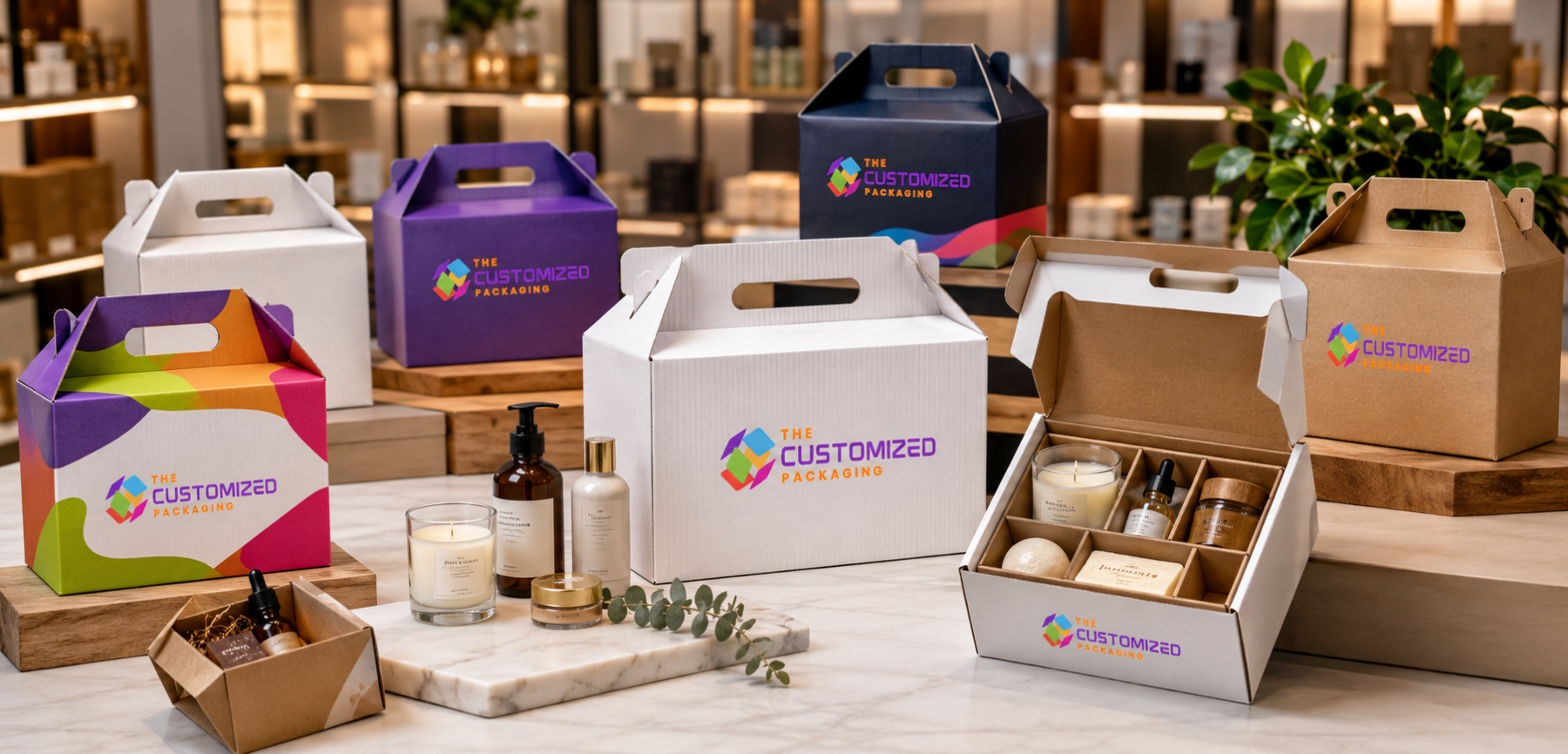
Several Products Can Become One Branded Purchase
Retail businesses can use gable packaging for seasonal collections, product bundles, specialty foods, cosmetics, stationery, toys, home goods, accessories, candles, and promotional offers.
The box can serve as both the product container and customer carrier.
This can create a more polished take-home experience than placing several products inside an unprinted shopping bag.
Custom sizing keeps products organized and reduces unnecessary movement.
The structure can be supplied flat and assembled near the checkout area, or it can be preassembled for premium gift sets.
One structural design may support several product combinations through different inserts, labels, sleeves, or digital printing.
The retailer should confirm that every product combination remains within the approved weight and dimensional limits.
Cosmetic and Skincare Gable Packaging
Product Sets Need Organization During Carrying
Cosmetic and skincare brands can use gable boxes for travel kits, sample sets, holiday collections, skincare routines, promotional bundles, salon products, and self-care gifts.
The package may contain bottles, tubes, jars, droppers, sachets, brushes, applicators, and product cards.
Custom inserts help keep the products upright and prevent glass or plastic containers from colliding.
White corrugated material supports bright artwork, photography, gradients, and pastel colors. Kraft can create a natural or minimalist presentation. Litho-laminated graphics and premium finishes can support luxury positioning.
The packaging should be tested for pump protection, leakage, cap security, product movement, and total packed weight.
A premium exterior should always be supported by a functional interior.
Candle and Home-Fragrance Gable Boxes
Concentrated Glass Weight Requires Reinforcement
Candles, room sprays, wax melts, and diffusers are popular gift products, but glass containers can place significant stress on the handle and base.
A corrugated gable structure can provide portability and presentation when it is engineered correctly.
The box may require a snap-lock or auto-lock bottom, reinforced handle panels, corrugated partitions, molded-pulp inserts, corner supports, or fitted product platforms.
The contents should remain balanced across the base.
Several heavy candles placed on one side can make the box tilt and increase stress on the upper panels.
The exterior can display fragrance names, candle-care instructions, burn warnings, ingredients, social-media information, and reorder details.
Product Balance Is Essential During the Journey
Uneven Weight Can Make a Strong Box Feel Unstable
Total packed weight is important, but weight distribution is equally important.
A box containing four evenly arranged products may carry more comfortably than a box with one dense jar placed near a side wall, even when the total weight is identical.
Heavy products should be positioned near the center whenever possible.
Custom inserts can keep items in approved locations. Dividers can stop dense products from sliding together. A rigid tray can distribute pressure across the bottom.
The packaging manufacturer should receive information about the individual weight and position of every item.
A physical prototype should be filled according to the real packing plan and carried by several users.
Handle Design Determines Carrying Performance
The Integrated Handle Must Support the Complete Package
The handle is created through overlapping, folded, or interlocking upper panels.
When the package is lifted, the load transfers through the handle into the upper panels, side walls, corners, and base.
A handle can tear when the opening is too close to a fold, the liner is weak, the die-cut corners are sharp, or the packed weight is uneven.
The opening should provide enough room for a comfortable grip.
Rounded corners can reduce stress points.
Heavy packages may require double-layer panels, folded reinforcement, stronger linerboard, wider handle areas, or instructions encouraging customers to support the box from below.
The handle should be tested using the maximum expected load and realistic carrying duration.
Handle Comfort Affects Customer Satisfaction
A Box Can Be Strong but Still Unpleasant to Carry
A narrow cutout may press against the customer’s fingers. Misaligned panels can create an uneven edge. Thick corrugated board can feel bulky when the opening is too small.
The correct handle dimensions depend on the box size, packed weight, carrying distance, and expected customer use.
A bakery box carried from a counter to a nearby vehicle may need different handle comfort from a conference kit carried between sessions for several hours.
The sample should be tested by different users.
The handle should feel stable without excessive flexing.
The package should also remain easy to set down and lift again.
Choosing the Correct Bottom Structure
The Base Supports the Entire Journey
A simple tuck bottom may work for lightweight gifts, confectionery, and small retail products.
A snap-lock or 1-2-3 bottom uses interlocking panels to provide greater support.
An auto-lock bottom is pre-glued and opens into position when the box is expanded. This can improve packing speed for restaurants, bakeries, events, retailers, and fulfillment centers.
A reinforced or fully glued base may be used for demanding loads.
The bottom should remain flat on counters, shelves, refrigerators, vehicle floors, tables, and delivery racks.
A bowed base can make containers lean or create pressure against one side.
The sample should be tested with the complete product load rather than an empty carton.
Secure Closures Protect the Contents
The Top Must Remain Closed During Movement
Corrugated gable boxes may use interlocking handle panels, tuck flaps, side tabs, slot locks, adhesive seals, sleeves, ribbons, or tamper-evident labels.
The closure should remain secure when the box is lifted and tilted.
It should also be easy for staff to close during busy operations.
An overfilled package can push outward against the top panels and weaken the closure.
Internal dimensions should allow enough room for products, inserts, liners, and tissue.
Food packaging may use a branded security label. Gift packaging may use ribbon or a decorative seal. Retail packaging may use reusable locking tabs.
The closure should not cover the handle or important printed information unless the design requires it.
Corrugated Gable Box Journey Planning
| Packaging factor | Question to confirm | Recommended planning direction |
|---|---|---|
| Internal dimensions | Do all products fit without pressure or excessive empty space? | Measure the complete packed arrangement |
| Total packed weight | Can the handle, side walls, and bottom support the load? | Test the maximum expected weight |
| Weight distribution | Are heavy items concentrated on one side? | Use inserts and balanced positioning |
| Carrying distance | Will the customer carry the box briefly or for a long period? | Adjust handle size and reinforcement |
| Transportation method | Will the package travel by hand, vehicle, courier, or event distribution? | Test vibration, tilting, stacking, and repeated lifting |
| Product temperature | Will the contents be hot, chilled, frozen, or room temperature? | Review ventilation, moisture, and board performance |
| Grease or liquid risk | Could food, cosmetics, or containers leak? | Use appropriate internal packaging and barriers |
| Assembly volume | How many boxes must staff prepare per hour? | Compare manual-lock and auto-bottom designs |
| Closure requirement | Does the package need resealing or tamper evidence? | Select locks, labels, sleeves, or seals |
| Product movement | Can products slide, tip, or collide? | Add dividers, trays, platforms, or fitted inserts |
| Branding visibility | Which panels remain visible while carried? | Place logos on broad permanent surfaces |
| Operational labels | Is space needed for names, barcodes, meal types, or order numbers? | Reserve a clean labeling area |
| Storage environment | Will flat boxes experience moisture, heat, or crushing? | Store in clean, dry, protected conditions |
| Order quantity | Is the project a sample, short run, or wholesale program? | Match printing and tooling to the volume |
| Delivery destination | What ZIP code and receiving conditions apply? | Include freight in the final quotation |
Providing these details helps a packaging supplier recommend an appropriate structure and material.
E-Flute Corrugated Gable Boxes
Fine Fluting Supports Retail Appearance and Accurate Folding
E flute is widely used for bakery, takeaway, cosmetic, gift, and retail gable boxes.
It offers greater rigidity than lightweight paperboard while maintaining a relatively refined profile.
The surface supports detailed printing, windows, handle openings, locking tabs, and precise folds.
E flute may work well for moderate product weights, but the final performance depends on the box size, liner strength, handle design, and bottom structure.
Large meals, glass containers, and heavy gift sets may require reinforcement or a stronger flute.
F-Flute Gable Packaging
Thin Corrugated Board Suits Lightweight Products
F flute is thinner than E flute and can create a compact, refined package.
It may suit confectionery, cosmetic samples, small gifts, stationery, favors, and lightweight retail products.
The material supports detailed die-cutting and clean folding.
It may not provide enough strength for heavy meals, candles, jars, bottles, or large product assortments.
The supplier should test the actual packed load before recommending it for production.
B-Flute for Heavier Take-Home Packages
Greater Thickness Provides More Structural Support
B flute offers greater thickness and puncture resistance than microflute materials.
It can support catering meals, large bakery assortments, candles, glass jars, bottles, hardware kits, and heavier retail bundles.
The thicker profile can affect printing smoothness, handle folding, closure alignment, flat storage, and shipment volume.
White-top linerboard or litho lamination may improve the appearance when detailed graphics are required.
Businesses should compare strength benefits with additional cost and bulk.
Kraft Corrugated Gable Boxes
Natural Material Supports Artisan and Practical Branding
Custom kraft corrugated gable boxes are popular with bakeries, cafés, restaurants, specialty-food brands, handmade-product businesses, candle companies, gift sellers, and environmentally styled retailers.
The natural brown surface creates a warm, rustic, simple, or practical appearance.
Black, dark purple, orange, green, red, and navy can create strong contrast.
Pastel shades, light colors, and photography may appear muted because the kraft background affects the final print.
One-color or two-color flexographic printing can provide an economical solution for wholesale orders.
White ink or an underbase can improve brightness but may add production stages.
White Corrugated Gable Boxes
Bright Surfaces Support Full-Color Branding
White corrugated material provides a cleaner background for photographs, gradients, illustrations, light colors, and detailed logos.
It is commonly used for cosmetics, premium foods, retail gift sets, corporate kits, events, and promotional packaging.
White-top linerboard can provide a white exterior with a kraft interior.
White packaging may show grease, dirt, and scuffing more easily than natural kraft.
Coatings or laminations may improve appearance, although they can influence price, moisture performance, and recycling guidance.
Digital Printing for Short and Changing Programs
Lower Setup Supports Testing and Seasonal Packaging
Digital printing reproduces full-color graphics without conventional printing plates.
It is useful for product launches, events, seasonal campaigns, personalized programs, short runs, multiple artwork variations, and lower order quantities.
One gable-box structure can support different flavors, stores, events, clients, or promotions through changing artwork.
The unit price may remain higher than flexographic printing for large volumes, but the lower setup can reduce inventory risk.
Businesses searching for custom corrugated gable boxes with low MOQ may benefit from digital production.
Flexographic Printing for Wholesale Gable Boxes
Direct Printing Can Provide Economical Branding at Scale
Flexographic printing applies ink directly to corrugated material using custom plates.
It works well for logos, text, patterns, handling information, product codes, and limited-color artwork.
One-color kraft boxes can create strong branding at a competitive wholesale price.
Each printed color may require a separate plate.
The setup cost becomes easier to distribute across medium and large production quantities.
Highly detailed photography and smooth gradients may require digital printing or litho lamination.
Litho-Laminated Gable Boxes for Premium Products
High-Resolution Graphics Strengthen Take-Home Presentation
Litho lamination uses a separately printed sheet applied to corrugated board.
This process supports photography, gradients, detailed illustrations, small typography, and accurate brand colors.
It is frequently used for cosmetics, corporate gifts, premium foods, retail bundles, candles, promotional kits, and national campaigns.
The additional printing, lamination, die-cutting, and converting stages may increase MOQ, cost, and lead time.
The premium print quality should support the value and position of the product.
Logo Placement for Carrying Visibility
Branding Should Remain Visible Beyond the Checkout Counter
The broad front and back panels are usually the strongest locations for the primary logo.
A smaller logo or tagline can appear near the handle, but the customer’s hand may cover this area.
The side panels can display the website, social-media handle, QR code, product information, or promotional message.
Food packaging may require space for a customer name, order number, meal category, barcode, or pickup label.
The artwork should remain away from handle openings, folds, glue areas, tabs, windows, and perforations.
A three-dimensional mockup can show whether the logo remains visible after assembly and while the package is carried.
QR Codes Support Reordering After Take-Home
Packaging Can Connect Customers to the Next Purchase
A QR code can link customers to an online menu, bakery order form, product page, loyalty program, review profile, event page, subscription service, tutorial, or special offer.
The code should appear on a flat printed panel with enough contrast and blank space.
It should not cross a fold, cutout, textured area, or window.
Businesses should test the QR code on several mobile devices.
The destination should remain active while the packaging is in use.
A brief instruction can explain the benefit of scanning.
Social-Media-Friendly Take-Home Packaging
Attractive Boxes Can Appear in Photos and Unboxing Content
Customers may photograph packaging that feels distinctive, colorful, premium, or gift-ready.
The gable shape, window, handle, inserts, products, ribbons, tissue paper, and printed panels can create a strong visual presentation.
The logo should remain visible in both closed-box and open-box photographs.
A social-media handle or campaign hashtag can make tagging easier.
The package must still protect the contents. Visual appeal should support structural performance rather than replace it.
Flat Packing and Storage Efficiency
Boxes Can Remain Compact Before Use
Corrugated gable boxes are generally supplied flat.
This can reduce storage and transportation volume compared with fully assembled packaging.
The blanks should remain in a clean, dry environment away from water, grease, direct sunlight, pests, strong odors, and excessive humidity.
Stacks should be protected from crushing and bending.
Different sizes, artwork versions, product categories, or client designs should be labeled clearly.
Auto-lock-bottom boxes may occupy slightly more flat-storage space because of their glued construction, but they can reduce assembly labor.
Assembly Speed Influences Operational Cost
A Faster Structure May Justify a Higher Unit Price
Restaurants, bakeries, caterers, retailers, and fulfillment operations may assemble hundreds or thousands of boxes.
A manual-lock design may cost less but require more folding steps.
An auto-lock bottom can open more quickly.
A snap-lock bottom may provide stronger support but require a specific assembly sequence.
The employees expected to use the packaging should test the sample.
Clear creases, intuitive tabs, and reliable locks help reduce packing errors.
Businesses should compare unit price with labor time instead of evaluating packaging cost alone.
Shipping and Carrying Tests
Real Movement Reveals Problems a Static Sample Cannot Show
The completed sample should be filled with actual products and moved through realistic conditions.
It should be lifted by the handle, carried, placed in a vehicle, set down, lifted again, opened, and closed.
The business should evaluate handle comfort, base flexing, closure security, side-wall strength, product movement, balance, scuffing, and label performance.
Hot food should be tested for steam and condensation.
Chilled products should be tested for refrigeration and moisture.
Glass products should be tested for collision and concentrated weight.
The sample should use the maximum expected load rather than a lighter demonstration arrangement.
Wholesale Custom Corrugated Gable Boxes
Bulk Production Supports Consistent Customer Experiences
Businesses using carry-ready packaging regularly may benefit from wholesale custom corrugated gable boxes.
Larger production quantities can distribute the cost of structural development, cutting dies, printing plates, color setup, and machine preparation across more units.
Wholesale manufacturing also helps maintain consistent dimensions, handle performance, bottom construction, printing, inserts, colors, and logo placement.
Restaurants, bakeries, retailers, caterers, gift businesses, cosmetic companies, candle brands, event planners, corporate programs, subscription services, manufacturers, wholesalers, and distributors may order gable boxes in bulk.
Before ordering, businesses should confirm the approved physical sample, expected monthly usage, available storage, seasonal demand, product changes, artwork life, and delivery schedule.
The lowest unit price does not create value when excessive packaging becomes outdated.
Minimum Order Quantities
Printing and Structural Complexity Influence Production Minimums
The MOQ depends on box dimensions, flute profile, board grade, printing method, inserts, windows, handle reinforcement, finishing, and supplier capabilities.
Digital printing may support lower quantities for launches, tests, events, and seasonal campaigns.
Flexographic printing generally becomes more economical for medium and large wholesale quantities.
Litho-laminated printing, foil, embossing, custom windows, reinforced handles, and multi-part inserts may require higher minimums.
Businesses searching for custom corrugated gable boxes no minimum may need to compare one-off samples, stock boxes with branded labels, short-run digital printing, and fully customized wholesale production.
Lower quantities generally create a higher unit cost.
What Influences Corrugated Gable Box Pricing?
The Complete Journey Specification Determines the Quote
The price of custom corrugated gable boxes depends on dimensions, corrugated grade, flute profile, handle design, reinforcement, bottom style, closure, printing, inserts, windows, ventilation, finishing, tooling, quantity, packing, and freight.
A simple one-color kraft gable box generally costs less than a full-color litho-laminated structure with a window, custom insert, reinforced handle, and premium finish.
Large and tall boxes use more material.
Auto-lock bottoms and reinforced handles add converting steps.
Custom inserts and dividers increase material and tooling.
Flat-packed boxes usually cost less to ship than preassembled packaging.
Businesses should request complete delivered pricing instead of comparing only advertised starting prices.
How to Request an Accurate Gable-Box Quote
Complete Product Information Reduces Revisions
Businesses ready to request pricing should provide the internal length, width, and height; dimensions of every product; individual item weights; total packed weight; quantity per box; carrying distance; transportation method; storage conditions; handle preference; bottom style; closure; printing; insert requirements; order quantity; and delivery ZIP code.
The supplier should also understand whether the package will hold hot food, chilled products, glass containers, cosmetics, gifts, or other special products.
Physical product samples can improve structural accuracy.
The manufacturer should prepare a dieline showing cuts, folds, locks, handle openings, glue areas, windows, and printable panels.
A physical prototype should be packed and carried before wholesale production.
How to Choose a Corrugated Gable Box Manufacturer
Structural Experience Should Support Printing and Branding
A professional custom corrugated gable box manufacturer should understand handle pressure, bottom strength, product balance, material selection, food-service conditions, inserts, printing, assembly, transportation, and customer use.
The supplier should ask detailed questions rather than recommending one standard box for every product.
Businesses should request material specifications, a dieline, digital proof, physical sample, printing details, MOQ, tooling charges, production lead time, packing method, and freight.
The manufacturer should explain why the proposed flute, liner, bottom, handle, insert, closure, and printing process are appropriate.
A low-priced package may not provide good value when the handle tears, the bottom opens, the products move, or the structure is difficult to assemble.
Buy Custom Corrugated Gable Boxes Online
Detailed Specifications Produce More Reliable Packaging
Businesses ready to buy custom corrugated gable boxes online should provide complete product and journey requirements.
The supplier can then recommend the correct dimensions, material, flute, bottom, handle reinforcement, closure, inserts, windows, printing method, and finishing.
A custom dieline should be approved before artwork production.
The physical sample should be tested using the maximum expected load.
The final quotation should identify dimensions, material, printing, tooling, inserts, finishing, quantity, production time, packing, and freight.
Businesses comparing custom corrugated gable box suppliers in the USA should compare identical specifications rather than choosing only according to the lowest price.
Custom Corrugated Gable Boxes Across the USA
Takeout, Take-Home, and Carry-Ready Packaging Nationwide
At The Customized Packaging, we provide custom corrugated gable boxes for restaurants, bakeries, cafés, caterers, retailers, cosmetic companies, candle brands, event planners, hotels, schools, gift businesses, promotional agencies, ecommerce companies, manufacturers, wholesalers, and distributors throughout the USA.
We manufacture restaurant takeaway boxes, bakery carry packaging, window gable boxes, gift cartons, cosmetic kits, candle boxes, retail bundles, corporate packaging, auto-lock structures, reinforced handles, custom inserts, dividers, and full-color printed boxes with logo.
Businesses searching for custom corrugated gable boxes near me, corrugated gable box manufacturer USA, wholesale gable boxes with logo, custom food carry boxes, bakery packaging supplier USA, retail gable box manufacturer, or order corrugated gable boxes online can request packaging developed around their products and transportation requirements.
We support businesses throughout New York, New Jersey, California, Texas, Florida, Illinois, Pennsylvania, Ohio, Georgia, North Carolina, Washington, Massachusetts, Virginia, Michigan, Arizona, Tennessee, Indiana, Missouri, Maryland, Wisconsin, Colorado, Minnesota, Nevada, Oregon, Kentucky, Utah, and other locations across the United States.
Want to Estimate Your Corrugated Gable Box Cost?
Try the Custom Box Packaging Cost Calculator
Businesses planning takeaway, bakery, gift, or retail packaging can use the Custom Box Packaging Cost Calculator to develop an initial estimate based on dimensions, structure, material, printing, finishing, inserts, and quantity.
The calculator can help estimate restaurant gable boxes, bakery packaging, gift carry boxes, cosmetic kits, candle boxes, retail bundles, corporate packaging, event meal cartons, window structures, reinforced-handle boxes, and custom inserts.
The final price may change according to flute profile, board strength, packed weight, handle reinforcement, bottom style, closure, printing coverage, windows, ventilation, dividers, inserts, premium finishes, tooling, assembly, order quantity, freight, and delivery destination.
After reviewing the estimate, businesses can request a detailed custom corrugated gable box quote based on their complete product and journey specifications.
Why Choose The Customized Packaging?
Packaging Developed for the Complete Take-Home Experience
At The Customized Packaging, we create custom corrugated gable boxes that help businesses protect products, organize orders, simplify carrying, improve customer handoffs, and strengthen brand visibility.
We provide natural kraft board, white corrugated material, white-top liners, E flute, F flute, B flute, reinforced handles, snap-lock bottoms, auto-lock bases, secure closures, windows, ventilation, custom inserts, dividers, digital printing, flexographic printing, litho-laminated graphics, premium finishes, prototypes, and wholesale pricing.
Our gable packaging supports takeaway meals, bakery assortments, retail bundles, gifts, cosmetics, candles, corporate kits, event meals, promotional products, and other portable applications.
As a professional custom box manufacturer and packaging supplier, we develop each structure around product dimensions, total packed weight, carrying distance, product balance, transportation, storage, branding, order quantity, and delivery destination.
Businesses remain responsible for confirming that selected materials, inks, coatings, adhesives, windows, liners, inserts, seals, environmental claims, and product-contact components meet the requirements applicable to their products and markets.
Final Thoughts
The Best Gable Boxes Protect the Product from Counter to Destination
Custom corrugated gable boxes are designed to support the complete journey from takeout to take-home.
Their integrated handles make products easier to carry, while the corrugated body provides the rigidity needed for food containers, bakery assortments, gifts, cosmetics, candles, retail bundles, corporate kits, and promotional products.
The handle, bottom, closure, inserts, dividers, side walls, and material should work together as one structural system.
Restaurant packaging may require ventilation, grease-resistant internal components, and tamper-evident seals. Bakery boxes may require windows, cupcake inserts, and decoration clearance. Gift and retail boxes may require premium graphics, tissue, ribbons, and fitted compartments. Candle and cosmetic packaging may require reinforced structures and product supports.
Kraft corrugated board can create a natural or artisan appearance. White material can support brighter artwork. Digital printing can help with short campaigns and multiple designs. Flexographic printing can provide economical branding for wholesale quantities. Litho lamination can create detailed premium graphics.
Physical testing remains essential because the box must perform during assembly, loading, pickup, carrying, vehicle transportation, storage, opening, and product use.
Whether you need takeaway gable boxes, bakery carry packaging, local delivery cartons, gift boxes, cosmetic kits, candle packaging, retail bundles, wholesale corrugated gable boxes, or custom printed packaging with logo, the correct structure can protect the product and preserve the brand experience throughout the journey.
For complete information about corrugated materials, handles, structural styles, closures, inserts, printing, pricing, and wholesale production, read our main pillar article titled “Custom Corrugated Gable Boxes: The Carry-Ready Packaging That Gets Brands Noticed.”
At The Customized Packaging, we create corrugated gable packaging that is built for pickup, engineered for carrying, and designed to help products and brands complete the journey throughout the USA.
