

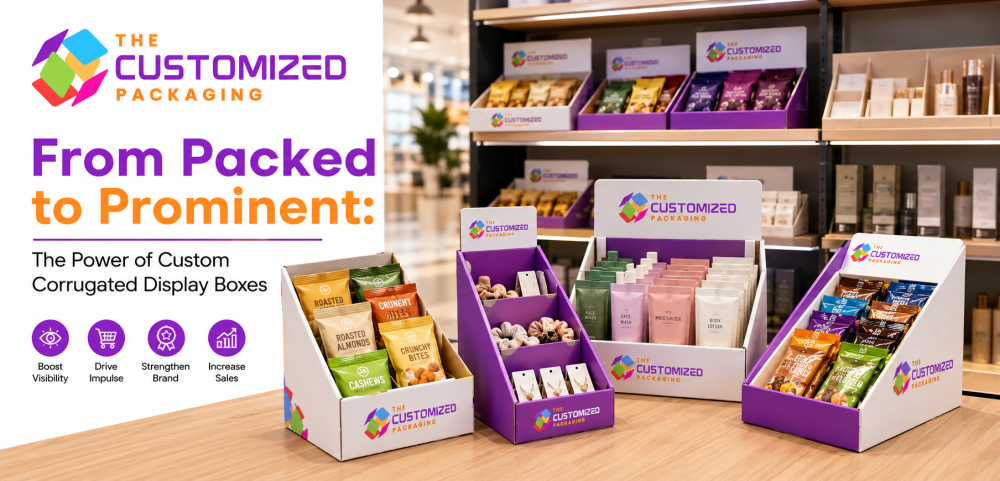
From Packed to Prominent: The Power of Custom Corrugated Display Boxes
A product can be carefully manufactured, professionally packaged, and successfully transported to a retail store, yet still struggle to attract customers when it reaches the shelf. Shipping protection may keep the merchandise safe, but it does not automatically make the product noticeable, understandable, or easy to purchase.
This is where custom corrugated display boxes create value.
These structures help products move from being packed inside transportation cartons to becoming prominent, organized, and customer-facing merchandise inside grocery stores, pharmacies, cafés, beauty shops, convenience stores, electronics retailers, hardware businesses, department stores, trade-show booths, and specialty retail locations.
A custom display box can arrive as a closed shipping carton and convert into a retail-ready tray. It can sit on a checkout counter, occupy a shelf, hang beside an end cap, stand on the retail floor, organize products into compartments, elevate merchandise through tiers, or move items forward through a gravity-feed system.
The display can hold snack bars, candy, sachets, cosmetics, skincare products, tea packets, coffee pods, healthcare items, electronics accessories, stationery, batteries, toys, tools, hardware components, promotional samples, and many other small or medium-sized products.
The power of custom corrugated retail display packaging comes from its ability to perform several tasks at once. It protects products during transportation, maintains product arrangement, simplifies store setup, improves visibility, communicates the brand, organizes variations, supports customer access, and keeps the merchandise presentable as inventory decreases.
Custom printing adds another level of value. Custom printed corrugated display boxes with logo can carry the company name, brand colors, product benefits, flavor, formula, usage guidance, promotional offers, QR codes, barcodes, website details, social-media handles, and product information.
The objective is not simply to create a decorative container. The objective is to make products easier to notice, easier to understand, easier to compare, and easier to buy.
At The Customized Packaging, we manufacture countertop displays, shelf-ready cartons, gravity-feed displays, tiered boxes, PDQ packaging, floor displays, sidekick units, peg-hook structures, custom inserts, kraft retail displays, full-color printed packaging, wholesale corrugated display boxes, and bulk retail packaging for businesses throughout the USA.
For broader guidance about structures, corrugated materials, flute profiles, branding, printing methods, inserts, retail placement, pricing, and wholesale manufacturing, read our main pillar article titled “Custom Corrugated Display Boxes: How Smart Retail Packaging Turns Browsers into Buyers.”
What Does “Packed to Prominent” Mean in Retail Packaging?
Packaging Should Continue Working After Transportation
A conventional shipping carton performs an important but limited role. It contains products and protects them during warehousing, transportation, palletization, and delivery.
Once the shipment reaches the store, the carton is often opened and discarded. Retail employees then remove the individual products, arrange them on a shelf, adjust their position, and attempt to create a presentable display.
A custom corrugated display box extends the packaging lifecycle.
The box may protect products during shipping and then convert into the final customer-facing presentation. A removable panel, tear-away cover, open tray, raised header, tiered insert, or internal ramp can transform the transportation package into an organized selling unit.
This means the brand retains more control over how products appear after delivery.
The product facing, quantity, flavor order, formula separation, logo position, header message, and customer access can all be planned before the packaging leaves the manufacturing or fulfillment facility.
The product is no longer simply delivered to the store. It arrives ready to become prominent.
Why Product Prominence Matters in Stores
Retail Customers Often Make Decisions Within Seconds
Retail shelves, checkout counters, and promotional areas contain many competing messages.
Customers may see dozens of products during a short shopping trip. They rarely stop to investigate every item in detail.
Products that remain hidden behind taller merchandise, placed inside plain cartons, or arranged inconsistently may receive little attention.
A custom display creates a visual boundary around the product.
The structure separates the merchandise from surrounding items and makes the presentation appear intentional. Raised headers, contrasting colors, open fronts, angled trays, product tiers, and branded side panels can guide customer attention.
Product prominence does not require excessive size or complicated construction.
A compact countertop display with clear branding can be more effective than a large but poorly organized unit.
The display should fit the location, match the product, communicate the message quickly, and support convenient customer interaction.
How Corrugated Display Boxes Improve Retail Visibility
Structural Design Can Move Products into the Customer’s Line of Sight
A display box can improve visibility through its shape as well as its printing.
A raised header lifts the logo and product message above the merchandise.
A tiered insert raises the second and third rows so they are not hidden behind the front products.
A low front retaining wall reveals more of the individual packaging.
A gravity-feed ramp keeps the next unit close to the front opening.
A sidekick display uses vertical fixture space where customers naturally pass.
A floor display creates a dedicated product zone inside an aisle or promotional area.
These features help products occupy retail space more effectively.
The design should consider the customer’s normal viewing angle. A counter display may be viewed from the front and above. A shelf-ready tray may be seen primarily from the aisle. A floor display may be approached from several directions.
The logo, product name, opening, and key message should be positioned accordingly.
Display Packaging Creates a Dedicated Brand Zone
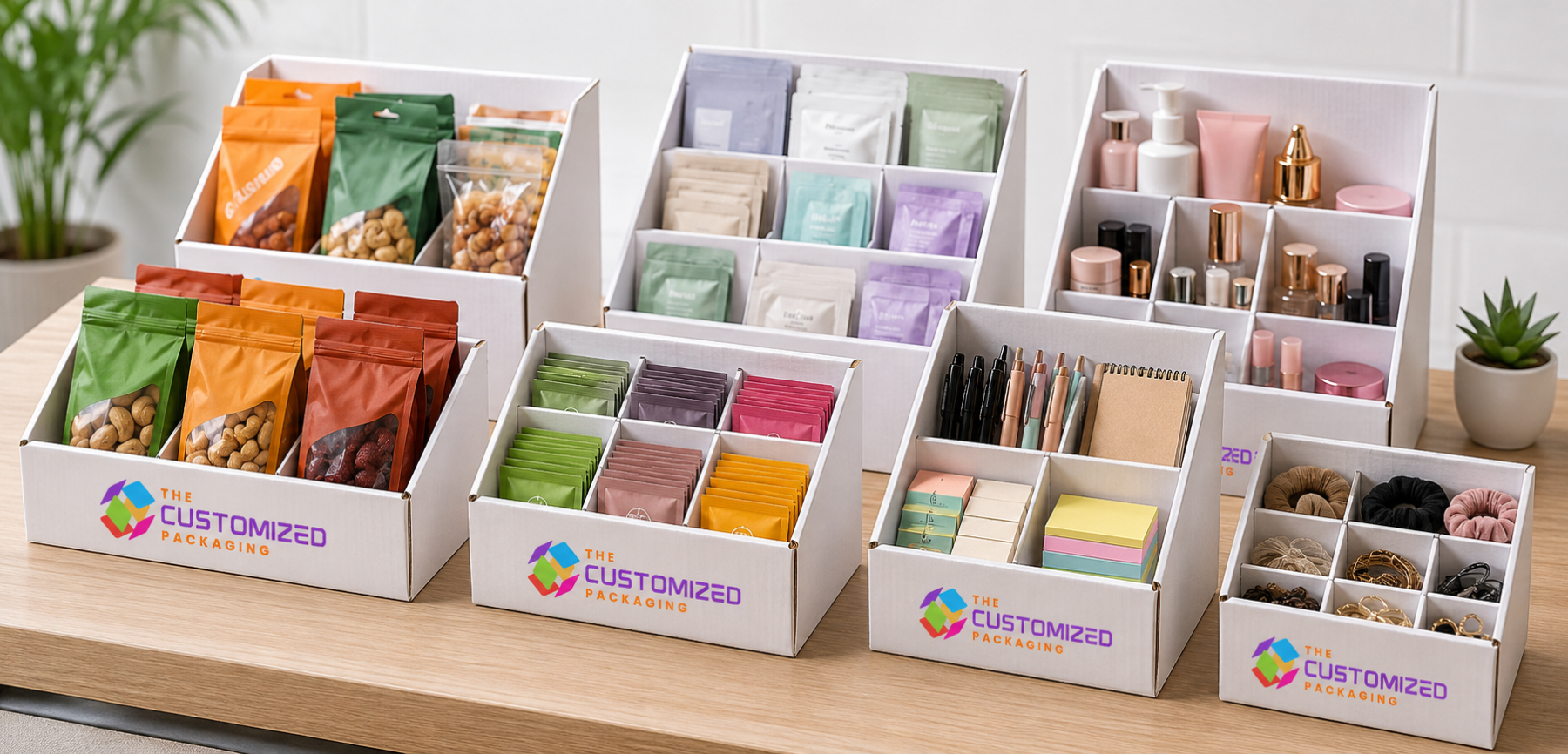
Several Products Can Appear as One Coordinated Presentation
Small products may look scattered when they are placed individually on a shelf or counter.
A custom display groups them into one recognizable unit.
Consistent logo placement, typography, color, pattern, and structural style can connect several product variations.
A snack brand may use one display for chocolate, fruit, nut, and protein varieties.
A skincare company may organize hydrating, brightening, calming, and exfoliating formulas.
A hardware supplier may separate sizes and part types.
An electronics brand may organize cables, chargers, adapters, and batteries.
The display makes the product family easier to understand.
It also provides more printable space than the individual product package. The display can communicate the broader brand story, campaign message, category benefit, product guide, or promotional offer.
Corrugated Display Boxes Support Product Organization
Organized Merchandise Is Easier to Compare and Purchase
Poorly organized merchandise creates visual confusion.
Products may lean, fall backward, become mixed, or disappear behind one another.
Custom dividers, inserts, rails, shelves, and compartments can maintain the intended arrangement.
The internal dimensions should match the actual finished product packaging.
If the box is too wide, products may rotate or lean. If it is too narrow, packages can become difficult to remove or restock.
Compartment labels can help customers compare product variations.
Color-coded sections can identify flavors, formulas, sizes, or uses.
An organized display can also support retail staff by making low inventory and incorrect placement easier to identify.
Main Ways Custom Displays Make Products Prominent
| Display feature | How it improves prominence | Best use | Important consideration |
|---|---|---|---|
| Raised header panel | Lifts the brand and product message above nearby merchandise | Countertop, shelf, and promotional displays | Header must remain stable as inventory decreases |
| Open front | Reveals individual products and improves access | Snacks, sachets, cosmetics, accessories | Front wall should retain products without hiding them |
| Tiered insert | Keeps rear products visible above the front row | Cosmetics, bottles, small cartons, and samples | Each level must support the product weight |
| Gravity-feed ramp | Moves the next unit toward the front opening | Snack bars, packets, pods, and small cartons | Product friction and ramp angle require testing |
| Custom compartments | Separates variations and creates visual order | Tea, skincare, stationery, hardware, and accessories | Compartment width must match the product |
| Contrasting brand colors | Helps the display stand apart from surrounding products | Competitive retail shelves and checkout areas | Colors should reproduce correctly on the selected board |
| Printed front panel | Places the logo and product message near the selection point | Countertop and shelf-ready displays | Products should not cover the branding |
| Side-panel graphics | Supports visibility from multiple customer approaches | End caps, floor displays, and checkout counters | Important artwork should remain away from folds |
| Product-facing inserts | Keeps the most recognizable package panel visible | Retail products with important front labels | Insert tolerances should allow easy loading |
| Floor-standing structure | Creates a larger dedicated product zone | Promotions, seasonal products, and high-volume merchandise | Stability and load capacity are essential |
| Sidekick or hanging display | Uses vertical space beside shelves or fixtures | Packets, batteries, cables, candy, and small tools | Hanging areas require reinforcement |
| Window or cutout | Reveals enclosed products while retaining structure | Gifts, cosmetics, food, and premium merchandise | The opening should not weaken the panel excessively |
A physical sample helps confirm whether the selected visibility features perform correctly inside the intended retail environment.
Countertop Displays Turn Limited Space into Product Exposure
Compact Displays Can Support Impulse Buying
Checkout counters and reception desks are valuable because customers are already prepared to interact with the business or complete a purchase.
A custom corrugated countertop display box can use this limited space to present small products clearly.
Snack bars can appear beside a café register. Cosmetic samples can sit near a salon checkout. Batteries can be positioned beside an electronics counter. Tea sachets can be arranged at a hotel beverage station.
The display should remain compact and should not interfere with payment terminals, receipts, shopping bags, staff movement, or food preparation.
A header panel can use vertical space for branding without requiring a wider base.
The products should be easy to see and remove.
The display should remain stable when it is full, half empty, and nearly depleted.
Shelf-Ready Boxes Move Products Directly into Retail
Faster Setup Can Keep Products Available for Sale
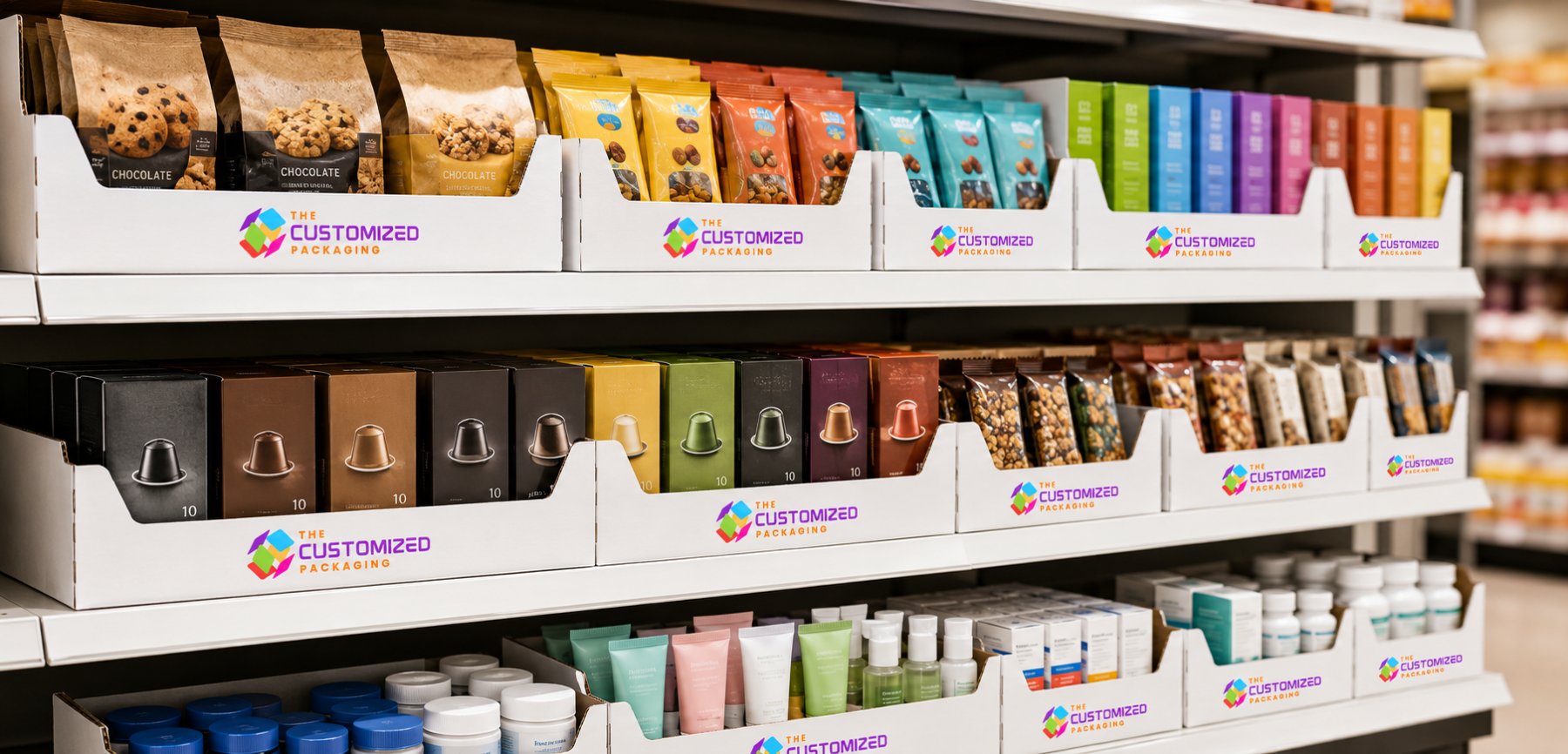
Shelf-ready packaging arrives with products already arranged inside.
Store employees remove a perforated front, top, or outer cover and place the remaining tray directly on the shelf.
This can reduce the time required to unpack, organize, and face every product individually.
Custom shelf-ready corrugated display boxes also help preserve the intended product arrangement across several retail locations.
The display must work in both its closed and open conditions.
During shipping, the removable panel protects the merchandise and contributes to structural strength.
After removal, the remaining tray must retain the products and continue displaying the logo.
The tear-away section should remain secure during transportation but remove cleanly without tools or excessive force.
A poorly designed perforation can open prematurely or leave a damaged retail edge.
Gravity-Feed Displays Keep Products Moving Forward
Continuous Product Flow Supports Front-Facing Visibility
Products placed inside deep trays can disappear toward the back as customers remove the front units.
Gravity-feed displays use an angled base, internal ramp, or sloped channel to move the next item toward the opening.
This keeps the display active and reduces the need for retail employees to pull products forward manually.
Custom gravity-feed corrugated display boxes can work well for protein bars, granola bars, candy, sachets, pods, packets, pouches, and small cartons.
Product movement depends on weight, shape, wrapper texture, internal width, ramp angle, and opening design.
Glossy wrappers may slide more easily than matte paper packaging.
Lightweight sachets may overlap or fail to move.
Rounded products can rotate when the lane is too wide.
A prototype should be loaded and emptied repeatedly before wholesale production.
Tiered Displays Make Product Comparison Easier
Different Heights Expose More of the Assortment
Tiered displays position products at several levels.
This prevents the first row from hiding the merchandise behind it.
Cosmetic bottles, serum cartons, skincare products, small boxes, stationery, accessories, samples, and healthcare products can benefit from this presentation.
The height difference should reveal the product name or recognizable package area.
The back row should remain easy to reach.
The tiered insert must support the packed weight without bending.
The complete display should remain stable when products are removed unevenly.
Tiered packaging can create a more premium appearance, but it may require additional material, tooling, folding, and assembly.
PDQ Displays Help Products Become Prominent Faster
Quick Store Setup Supports Promotional Campaigns
PDQ display packaging is developed for fast retail placement.
Products may arrive already loaded inside the display.
Retail employees remove a cover, open a panel, or place the complete unit on the shelf or counter.
This helps brands launch promotions, seasonal products, limited editions, and new merchandise more consistently.
A custom PDQ display box should be easy to open without knives or complicated instructions.
The permanent display panels should carry the main branding.
The temporary shipping cover should protect the products without becoming essential to the final presentation.
Simple opening instructions can help retail teams create the intended display correctly.
Floor Displays Create Larger Retail Presence
Freestanding Packaging Can Establish a Dedicated Selling Area
Floor-standing corrugated displays provide more space for inventory, graphics, and customer interaction.
They can be placed inside aisles, store entrances, end caps, seasonal sections, and promotional zones.
Floor displays may include shelves, product trays, hooks, compartments, or dump-bin areas.
They are useful for snacks, beverages, cosmetics, toys, accessories, household products, seasonal merchandise, and promotional campaigns.
The structure should be designed around the complete packed weight.
The base must remain stable as customers remove products from different shelves or sides.
The center of gravity, display height, shelf load, distribution method, assembly process, and retail-floor requirements should all be considered.
Large graphics may improve visibility, but structural safety must remain the priority.
Sidekick and Power-Wing Displays Use Vertical Store Space
Products Can Be Added Without Replacing Main Shelf Inventory
Sidekick displays attach to shelf sides, end caps, rails, or retail fixtures.
They can hold candy, sachets, batteries, cables, healthcare products, stationery, and small tools.
This format provides additional product exposure without occupying a complete shelf.
The hanging panel and attachment points must support the full packed weight.
The display should remain close to the fixture and should not create an obstruction.
Retail chains may use specific hooks, dimensions, load limits, and fixture systems.
These requirements should be confirmed before structural development.
Peg-Hook Displays Organize Carded Merchandise
Hanging Products Can Remain Visible and Easy to Compare
Carded products such as cables, batteries, tools, craft supplies, automotive parts, and small accessories can be arranged on peg hooks.
A corrugated display provides a branded back panel and structural support around the hooks.
The products can be organized by type, size, compatibility, or price.
The back panel must resist bending under the load.
Hook spacing should prevent packages from overlapping excessively.
The display should remain stable when one side becomes empty before the other.
Heavier merchandise may require B-flute, double-layer panels, or additional reinforcement.
Dump-Bin Displays Encourage Browsing
Open Containers Can Support High-Volume Product Sales
Dump bins hold loose or individually wrapped products inside an open structure.
They work well for toys, snacks, accessories, clearance items, seasonal merchandise, and promotional goods.
Customers can browse the products directly.
The side walls must resist outward pressure.
A false bottom can keep merchandise near the top as inventory decreases.
The exterior panels can carry large branding, promotional pricing, product benefits, or campaign graphics.
The bin should not be so deep that customers struggle to reach the remaining products.
Product and Display Style Comparison
| Product category | Recommended display style | Why it supports prominence | Key testing requirement |
|---|---|---|---|
| Snack bars and protein bars | Gravity-feed or countertop display | Keeps products near the customer and supports impulse purchases | Wrapper friction and lane width |
| Tea and coffee sachets | Divided countertop or shelf-ready display | Organizes blends and keeps packets upright | Compartment width and packet height |
| Cosmetics and skincare | Tiered or premium countertop display | Shows several formulas and supports high-quality graphics | Product access and display stability |
| Healthcare products | Shelf-ready or divided display | Keeps sizes and categories clear | Label visibility and product retention |
| Electronics accessories | Peg-hook, tiered, or countertop display | Supports compatibility comparison | Hook strength and barcode access |
| Hardware parts | Reinforced compartment or peg-hook display | Separates product sizes and part types | Packed weight and board strength |
| Candy and small snacks | Gravity-feed, countertop, or dump bin | Creates strong impulse visibility | Product flow and front-wall height |
| Promotional samples | Countertop or PDQ display | Supports product trial and awareness | Offer clarity and inventory control |
| Seasonal merchandise | Floor display, sidekick, or dump bin | Creates a dedicated campaign area | Stability and leftover packaging risk |
| Toys and collectibles | Countertop, floor display, or dump bin | Encourages browsing and visual excitement | Customer access and structural safety |
| Stationery | Compartment, countertop, or peg-hook display | Organizes categories and product sizes | Restocking and product-facing direction |
| Beauty sachets | Tiered or divided display | Helps customers compare formulas | Divider fit and front-panel visibility |
The final display style should be selected after testing the actual products inside the intended retail space.
Custom Printing Strengthens Product Prominence
Graphics Help Customers Understand the Merchandise Quickly
Structural visibility attracts attention, while printing communicates meaning.
A customer may notice the display because of its height or color, but the printed message explains what the product is and why it matters.
Custom printed corrugated display boxes can include the logo, product name, primary benefit, flavor, formula, product image, QR code, social-media handle, promotional price, usage guidance, barcode, ingredients, and sustainability information.
The display should use a clear visual hierarchy.
The brand name should be recognizable.
The product category should be easy to identify.
The main benefit should remain brief and readable.
Secondary information can appear on the side or back panels.
Too much text can weaken the selling message.
Logo Placement Should Remain Visible at Every Inventory Level
Branding Should Not Disappear Behind Products
The logo may appear on the header, front wall, side panels, back panel, shelves, or inserts.
Its position should reflect the customer’s viewing angle.
A countertop display may use a large header logo and a smaller logo on the front retaining wall.
A floor display may require branding on several sides.
A shelf-ready tray should retain the logo after the tear-away panel is removed.
The products should not cover the logo when the display is fully loaded.
Interior patterns or a branded back panel can help the display remain attractive when inventory becomes low.
Brand Colors Can Increase Recognition
Consistent Visual Identity Connects Several Product Variations
Customers may recognize a color palette before they read the company name.
Consistent use of purple, orange, green, blue, pink, black, white, or another signature palette can connect several display structures and product lines.
Different accent colors can identify flavors, formulas, sizes, or categories while preserving the master brand identity.
The display and product packaging should complement one another.
Highly colorful products may need a more controlled display background.
Minimal product packaging may benefit from stronger graphics on the outer display.
The final colors should be tested on the selected corrugated surface.
Kraft Display Boxes Create a Natural or Practical Appearance
Brown Corrugated Board Supports Minimal Branding
Kraft corrugated displays are popular for organic-style foods, tea, coffee, handmade goods, natural cosmetics, hardware, office products, and industrial merchandise.
The brown surface creates a warm, natural, or practical appearance.
One-color flexographic printing may provide a cost-effective branded solution.
Dark purple, black, green, orange, red, and navy can create strong contrast.
Light colors and photographs may appear muted.
White ink can increase contrast but may require additional production stages.
A printed sample helps confirm how the artwork will appear before a wholesale order.
White Corrugated Displays Support Brighter Graphics
A Clean Surface Helps Detailed Artwork Stand Out
White corrugated material provides a brighter printing surface.
It is commonly used for cosmetics, healthcare products, electronics, toys, premium foods, and retail campaigns.
Photographs, gradients, pastel colors, illustrations, and detailed logos generally reproduce more clearly on white board.
White-top linerboard can provide a white exterior with a kraft interior.
White material may show scuffs, dust, and handling marks more easily than natural kraft.
Coatings and laminations may improve appearance but can affect price and recyclability.
E-Flute Corrugated Displays for Refined Retail Packaging
Fine Fluting Supports Printing and Accurate Folding
E flute provides useful rigidity with a relatively thin profile.
It is commonly selected for countertop displays, shelf-ready packaging, cosmetics, food displays, and small retail structures.
The surface supports cleaner printing than many thicker shipping flutes.
E flute also allows precise cutouts, folds, headers, and perforations.
The material still needs to match the packed weight and display size.
Large floor units or heavy products may require B flute, C flute, reinforced structures, or double-wall board.
Stronger Flutes for Heavy or Large Displays
Material Strength Should Match the Real Load
B flute provides greater thickness and puncture resistance than E flute.
It can support heavy food products, hardware items, larger shelf-ready cartons, and shipping-and-display packaging.
C flute is often used for larger shipping structures.
Double-wall board can support heavy floor displays and industrial merchandise.
Stronger materials increase thickness, cost, shipping volume, and storage requirements.
The display should not be over-engineered without a clear performance need.
The manufacturer should review packed weight, shelf load, stacking, openings, humidity, transportation, and retail use before recommending the material.
Digital Printing Supports Low-MOQ Retail Displays
Short Runs Allow Brands to Test Products and Campaigns
Digital printing can create full-color displays without conventional printing plates.
It supports prototypes, product launches, seasonal promotions, regional campaigns, several artwork variations, and lower order quantities.
A business can test the structure, retail placement, customer response, and branding before ordering a larger quantity.
The same dieline may support several flavors or product formulas with different printed graphics.
The unit price may be higher than flexographic production at larger volumes.
However, the lower initial setup can reduce inventory risk.
Flexographic Printing Supports Wholesale Display Boxes
Larger Quantities Can Improve Unit Economics
Flexographic printing applies ink directly to the corrugated material using custom printing plates.
It works well for logos, text, patterns, product codes, barcodes, and limited-color graphics.
One-color or two-color printing can create effective kraft displays at an economical wholesale price.
Each color may require a separate plate.
The setup cost becomes easier to spread across larger production quantities.
Detailed photographs and gradients may require digital or lithographic printing.
Litho-Laminated Displays Create Premium Graphics
High-Resolution Printing Can Strengthen Shelf Presence
Litho-laminated packaging uses a separately printed sheet applied to corrugated board.
This process supports photography, gradients, small typography, detailed illustrations, and precise brand colors.
It is often used for cosmetics, toys, electronics, specialty foods, healthcare products, and national retail campaigns.
The additional printing, lamination, die-cutting, and converting stages can increase the price, lead time, and MOQ.
The premium appearance should support the product’s retail positioning.
Headers Function as Built-In Retail Signage
Vertical Branding Can Be Seen from a Greater Distance
A header panel raises the logo or product message above the merchandise.
It can make a display visible behind nearby products, equipment, or shelf edges.
The header should communicate the brand, product name, primary benefit, or promotional message.
It should avoid excessive small text.
A tall header creates more visibility but also adds structural load.
The base width, material thickness, braces, product weight, and center of gravity should be considered together.
Custom Inserts Keep Products Properly Positioned
Internal Support Protects the Intended Presentation
Products can shift during transportation and lose their intended facing direction.
Custom inserts, rails, partitions, dividers, shelves, and cutouts can control movement.
A bottle insert can keep containers upright.
A divider can separate flavors.
A tier can raise rear products.
A gravity-feed ramp can move inventory forward.
A side guide can prevent cartons from rotating.
The insert should solve a practical problem without creating unnecessary material, tooling, or assembly.
The product should fit securely but remain easy to remove.
Product-Facing Direction Influences Customer Recognition
The Most Important Package Panel Should Face Forward
Retail products often contain one side that communicates the product most effectively.
This may include the flavor, formula, compatibility, product name, image, or benefit.
The display should keep this panel visible.
Accurate dimensions and inserts help prevent rotation.
The complete display should be tested after transportation simulation because products may shift even when they are carefully loaded initially.
A display that arrives with products facing sideways loses much of its selling value.
Retail Placement Determines Whether Prominence Converts into Sales
The Display Should Appear Where the Product Is Relevant
Strong packaging may underperform when it is placed in the wrong location.
Snack bars can perform near beverages, café counters, gym receptions, or checkout lanes.
Tea products can be displayed near mugs, kettles, and hot-drink areas.
Cosmetic samples can appear beside full-size products.
Batteries can be positioned near electronics and toys.
Hardware accessories can sit beside compatible tools.
The display should support the customer’s immediate need or shopping context.
Retail placement and packaging design should therefore be planned together.
Corrugated Displays Can Support Cross-Selling
Related Products Can Increase the Total Purchase
Displays can introduce complementary products beside the customer’s original purchase.
Coffee pods can be positioned near coffee machines.
Serums can appear near cleansers and moisturizers.
Charging cables can be displayed near mobile accessories.
Condiment packets can appear beside prepared foods.
Small hardware parts can be located near tools.
Printed imagery, short messages, and compatibility information can explain the relationship.
Cross-selling works best when the connection is useful and immediately understandable.
QR Codes Extend the Display Beyond the Store
Printed Packaging Can Connect Customers to Digital Information
A QR code can direct customers to product demonstrations, reviews, ingredient details, compatibility guides, subscriptions, loyalty programs, promotional offers, and online ordering.
It should appear on a flat printed panel with sufficient contrast and blank space.
The code should not cross a fold, cutout, perforation, or heavily textured surface.
Businesses should test it using several devices.
The destination should remain active for the entire display campaign.
A short message can explain what customers will receive after scanning.
Display Capacity Should Match Product Sales Speed
Larger Displays Are Not Always More Effective
A large display may hold more inventory and reduce restocking frequency.
However, it may look empty or neglected when the product sells slowly.
A smaller unit that is replenished regularly can create a stronger retail presentation.
Capacity should reflect store traffic, expected sales, campaign duration, shelf life, staff availability, and available space.
The display should remain visually effective as inventory decreases.
Gravity-feed ramps, false bottoms, tiers, and raised platforms can keep products prominent.
Physical Samples Confirm Real Display Performance
Digital Mockups Cannot Test Stability or Access
A three-dimensional rendering can show the expected graphics, but it cannot confirm whether the products fit, move, or remain accessible.
A physical sample allows the business to evaluate assembly, retail fit, product facing, customer access, restocking, and stability.
The display should be tested when full, partially empty, and nearly empty.
Gravity-feed products should be removed repeatedly.
Tiered structures should be evaluated with uneven inventory.
Headers should remain upright.
Tear-away panels should open cleanly.
Barcodes and QR codes should be tested before wholesale manufacturing.
Shipping-and-Display Packaging Protects the Presentation
Retail Prominence Begins During Distribution
A display cannot become prominent when it arrives crushed, scuffed, or disorganized.
Shipping-and-display packaging must protect the structure and products during transportation.
The display may travel inside an outer carton, use a removable cover, or convert from a closed case.
The distribution method should account for vibration, compression, pallet pressure, handling, humidity, and stacking.
Products should not shift out of position.
Printed surfaces may need additional protection.
The closed shipping structure and open retail structure should both be tested.
Wholesale Custom Corrugated Display Boxes
Bulk Production Supports Consistent Retail Presentation
Businesses supplying multiple stores, franchises, distributors, pharmacies, salons, cafés, or national campaigns may benefit from wholesale custom corrugated display boxes.
A larger production run can maintain consistent dimensions, board grades, colors, logo placement, openings, headers, inserts, and product arrangement.
The cost of dielines, cutting dies, printing plates, color setup, and machine preparation can be distributed across more units.
Before ordering in bulk, businesses should confirm the final sample, expected monthly use, storage space, campaign duration, product changes, and artwork life.
The lowest unit price does not always provide the best overall value when excessive packaging remains unused.
Minimum Order Quantities for Custom Displays
Printing and Structure Affect Production Minimums
The MOQ depends on the display dimensions, corrugated grade, printing method, inserts, tooling, finishing, and manufacturer capabilities.
Digital printing may support lower quantities for product launches, seasonal promotions, or market testing.
Flexographic printing may become more economical for medium and large orders.
Litho-laminated graphics, premium finishes, custom hooks, shelves, and complex floor displays may require higher quantities.
Businesses searching for custom corrugated display boxes no minimum may need to compare structural prototypes, short-run digital printing, stock displays with custom labels, and fully custom manufacturing.
Factors That Influence Display Box Pricing
The Complete Specification Determines the Quote
The price of custom corrugated display boxes depends on dimensions, flute profile, board grade, printing, colors, coverage, openings, inserts, headers, shelves, hooks, finishing, tooling, quantity, packing, and freight.
A small one-color kraft countertop tray usually costs less than a multi-level, litho-laminated floor display.
A gravity-feed structure may require a custom ramp and additional testing.
A tiered display uses more components than a simple open tray.
Foil, embossing, spot UV, lamination, windows, and specialty coatings add production processes.
Flat-packed displays usually cost less to ship than pre-assembled units.
Businesses should compare complete delivered specifications rather than advertised starting prices.
How to Request an Accurate Custom Display Quote
Complete Product and Retail Information Reduces Delays
Businesses ready to request pricing should provide the product length, width, height, weight, package shape, quantity per display, packed weight, product orientation, retail location, available footprint, material preference, printing requirements, inserts, order quantity, and delivery ZIP code.
The supplier should also understand the shipping format, retailer requirements, campaign timing, assembly process, and restocking plan.
Physical product samples can improve structural accuracy.
A dieline should be prepared before the final artwork.
A physical prototype should be approved before bulk production.
How to Choose a Corrugated Display Box Supplier
Structural Knowledge and Retail Experience Should Work Together
A professional custom corrugated display box manufacturer should understand distribution, printing, assembly, product access, merchandising, and retail placement.
The supplier should ask detailed questions rather than recommend one standard structure for every product.
Businesses should request the board specification, flute profile, dieline, digital proof, structural sample, printed sample, MOQ, tooling cost, production lead time, packing method, and freight.
The manufacturer should explain why the proposed display style, material, opening, insert, and printing method are appropriate.
The lowest quotation may not provide the best total value when the display is unstable, oversized, difficult to assemble, or poorly suited to the product.
Buy Custom Corrugated Display Boxes Online
Detailed Specifications Produce Better Packaging Results
Businesses ready to buy custom corrugated display boxes online should provide complete product and retail information.
The manufacturer can then recommend a countertop display, shelf-ready tray, gravity-feed box, tiered display, PDQ carton, sidekick unit, peg-hook display, dump bin, or floor-standing structure.
The final quotation should identify dimensions, material, flute, printing, inserts, tooling, finishing, quantity, assembly, packing, production time, and freight.
A physical sample should be tested before wholesale production.
Businesses comparing custom corrugated display box manufacturers in the USA should compare identical specifications rather than general prices.
Custom Corrugated Display Boxes Across the USA
Retail Display Packaging for Businesses Nationwide
At The Customized Packaging, we provide custom corrugated display boxes for snack brands, food companies, cosmetic businesses, healthcare suppliers, pharmacies, electronics companies, hardware brands, stationery businesses, toy companies, manufacturers, distributors, wholesalers, retailers, and ecommerce companies throughout the USA.
We manufacture countertop displays, shelf-ready packaging, gravity-feed boxes, tiered units, PDQ cartons, floor-standing displays, peg-hook packaging, sidekick displays, dump bins, kraft displays, white corrugated boxes, custom inserts, and full-color printed retail displays with logo.
Businesses searching for custom corrugated display boxes near me, corrugated display box manufacturer USA, wholesale retail display boxes, custom point-of-sale display supplier, custom printed display boxes with logo, or order corrugated display boxes online can request packaging developed around their products and retail environment.
We support businesses in New York, New Jersey, California, Texas, Florida, Illinois, Pennsylvania, Ohio, Georgia, North Carolina, Washington, Massachusetts, Virginia, Michigan, Arizona, Tennessee, Indiana, Missouri, Maryland, Wisconsin, Colorado, Minnesota, Nevada, Oregon, Kentucky, Utah, and other locations throughout the United States.
Want to Estimate Your Custom Display Packaging Cost?
Try the Custom Box Packaging Cost Calculator
Businesses planning retail display packaging can use the Custom Box Packaging Cost Calculator to develop an initial estimate based on dimensions, box style, material, printing, finishing, inserts, and quantity.
The calculator can help estimate countertop display boxes, shelf-ready cartons, gravity-feed packaging, tiered displays, PDQ boxes, sidekick units, floor displays, kraft packaging, white corrugated boxes, full-color printed displays, and custom inserts.
The final price may change according to the flute profile, board strength, packed weight, header, shelves, ramps, dividers, hooks, print coverage, tooling, premium finishes, assembly, order volume, freight, and delivery destination.
After reviewing the estimate, businesses can request a detailed custom corrugated display box quote based on their complete retail and distribution requirements.
Why Choose The Customized Packaging?
Retail Displays Designed to Move Products from Packed to Prominent
At The Customized Packaging, we create custom corrugated display boxes that help products remain protected during distribution and become visible, organized, and customer-facing inside stores.
We provide kraft corrugated board, white material, white-top liners, E flute, F flute, B flute, C flute, double-wall construction, digital printing, flexographic printing, litho-laminated graphics, custom headers, shelves, dividers, ramps, hooks, tear-away panels, digital proofs, physical samples, and wholesale pricing.
Our packaging supports snacks, sachets, cosmetics, healthcare products, electronics accessories, hardware, stationery, toys, promotional merchandise, and other retail goods.
As a professional custom box manufacturer and retail packaging supplier, we develop every display around the product dimensions, packed weight, customer access, retail space, branding, transportation, order quantity, and delivery destination.
Businesses remain responsible for confirming that selected materials, inks, coatings, adhesives, hooks, inserts, labeling, environmental claims, and product-contact components meet the requirements applicable to their products and markets.
Final Thoughts
The Right Display Makes Products Easier to Notice, Compare, and Buy
Custom corrugated display boxes help products move from being packed for transportation to becoming prominent inside retail environments.
Countertop displays can create impulse-purchase opportunities. Shelf-ready cartons can reduce retail setup time. Gravity-feed boxes can keep products close to the customer. Tiered displays can expose several product rows. PDQ boxes can support faster promotional launches. Floor, sidekick, peg-hook, and dump-bin structures can use different areas of the store.
The best structure begins with the product, customer, retail space, distribution method, and sales objective.
Custom printing transforms the display into a communication platform. Logos, brand colors, product benefits, QR codes, imagery, and promotional messages help customers understand the merchandise more quickly.
Inserts, shelves, dividers, ramps, hooks, and openings should solve real presentation, access, or protection requirements.
Physical sampling remains essential because the display must perform while shipping, opening, stocking, selling, restocking, and becoming empty.
Whether you need countertop displays, shelf-ready packaging, gravity-feed boxes, tiered cosmetic displays, PDQ cartons, floor-standing units, peg-hook packaging, wholesale corrugated display boxes, or custom printed retail packaging with logo, the correct display can make products easier to see, easier to understand, and more likely to sell.
For complete information about display styles, materials, flute profiles, printing, inserts, retail placement, pricing, and wholesale ordering, read our main pillar article titled “Custom Corrugated Display Boxes: How Smart Retail Packaging Turns Browsers into Buyers.”
At The Customized Packaging, we create corrugated retail displays that are built to protect, structured to present, and designed to move products from packed to prominent throughout the USA.
