

Custom Size Corrugated Boxes: Pricing, Materials, and Ordering Guide
Every product has different dimensions, weight, shape, fragility, and shipping requirements. A standard stock carton may be convenient, but it is rarely designed around one specific product. When the box is too large, the contents may move during transportation, require excessive cushioning, and increase dimensional shipping charges. When the box is too small, it may place pressure on the product, damage inserts, or become difficult to close securely.
This is why businesses use custom size corrugated boxes for ecommerce orders, retail distribution, subscription products, apparel, cosmetics, electronics, candles, glass jars, food products, industrial parts, and other products requiring accurate packaging dimensions. Custom sizing allows the box to be developed around the complete packed product rather than forcing the product into a limited stock-box selection.
A custom-sized box can help reduce unnecessary empty space, improve product stability, simplify warehouse packing, lower the amount of void fill required, and create a cleaner customer presentation. Businesses can also choose the corrugated flute, wall construction, board surface, box style, printing method, inserts, dividers, and finishing according to the product and shipping environment.
The price of custom corrugated packaging depends on more than length, width, and depth. Material strength, box style, printing coverage, quantity, tooling, inserts, coatings, freight, and production complexity all influence the final quotation. Understanding these factors helps businesses compare suppliers and select packaging that offers suitable protection without unnecessary cost.
Businesses ready to buy custom size corrugated boxes should provide accurate internal dimensions, packed product weight, shipping details, artwork, quantity, and insert requirements. Complete information allows the packaging manufacturer to recommend the right structure and provide a more reliable estimate.
At The Customized Packaging, we create custom-sized shipping cartons, corrugated mailer boxes, product packaging, subscription boxes, retail displays, double-wall boxes, custom inserts, dividers, corrugated boxes with logo, wholesale packaging, and bulk custom boxes for businesses throughout the USA.
For more comprehensive information about corrugated construction, flute profiles, box strength, printing, inserts, wholesale production, sustainability, and packaging costs, read our main pillar blog titled “Custom Corrugated Boxes: The Complete Guide to Strong, Printed, and Wholesale Packaging.”
What Are Custom Size Corrugated Boxes?
Boxes Manufactured Around Exact Product Dimensions
Custom size corrugated boxes are manufactured according to specific length, width, and depth measurements rather than a limited range of standard carton sizes.
The box can be developed around one product, several products, a subscription collection, a retail display, a shipping bundle, or an industrial component. The dimensions may also account for inserts, dividers, protective bags, tissue paper, manuals, accessories, and cushioning materials.
Custom sizing provides greater control over how the product sits inside the carton. A closer fit can reduce movement and make the package look more organized when customers open it.
The box does not need to touch the product tightly. Fragile items may require controlled clearance around the contents so cushioning and inserts can absorb impact.
Custom dimensions should therefore be based on the complete packaging system rather than the product dimensions alone.
Why Standard Box Sizes May Not Fit Your Product
Stock Cartons Are Designed for General Use
Stock shipping boxes are produced in common dimensions so they can serve many businesses and products. This makes them useful for temporary needs, irregular shipments, and companies sending different items every day.
However, stock cartons may create excessive empty space around products with unusual dimensions. Long, narrow, shallow, round, fragile, or multi-component items may be especially difficult to fit inside standard boxes.
An oversized carton may require additional paper, foam, air pillows, or crinkle fill to prevent movement. It may also occupy more carrier space and increase dimensional shipping charges.
A small carton can compress the product, distort retail packaging, damage delicate components, or leave insufficient room for protective inserts.
A custom corrugated box manufacturer can develop a structure around the product’s actual requirements instead of choosing the closest available stock size.
Benefits of Right-Sized Corrugated Packaging
Better Dimensions Can Improve Protection and Efficiency
Right-sized packaging can help reduce product movement during handling and delivery. The product remains more stable because it has less space to slide, rotate, or strike the box walls.
Custom sizing may reduce the amount of void fill required, improving packing speed and lowering material consumption.
Smaller package dimensions may also reduce dimensional shipping weight, although final carrier charges depend on the package, service, destination, and carrier rules.
Warehouse teams can pack products more consistently when the carton is designed for a specific item. Employees do not need to test several stock sizes or add different amounts of cushioning to each order.
Customers also receive a cleaner presentation. The product appears deliberately arranged rather than placed inside an unnecessarily large shipping box.
How to Measure a Product for a Custom Corrugated Box
Measure the Complete Packed Arrangement
Businesses asking how to measure a corrugated box should begin with the complete packed product rather than the bare item.
Place the product together with any protective sleeve, insert, divider, tissue paper, accessories, manuals, cables, product cards, or cushioning that will be included in the final package.
Measure the longest side, the shorter side, and the total height of this complete arrangement. These measurements help establish the required internal length, width, and depth.
Fragile products may need additional clearance for cushioning. Heavy products may require stronger base pads or side supports that increase the internal space.
The product should fit securely but remain easy for warehouse employees to pack and customers to remove.
Before approving production, test the dimensions with a physical prototype. A measurement that appears correct on paper may behave differently after the board is folded and the insert is installed.
Internal Dimensions Versus External Dimensions
Confirm Which Measurements the Supplier Uses
Corrugated boxes can be described using internal or external dimensions.
Internal dimensions represent the usable space inside the assembled box. These measurements are usually the most important when determining whether the product will fit.
External dimensions include the thickness of the corrugated board and describe the overall outside size of the carton.
The difference may become more noticeable when thick double-wall or triple-wall material is used. A box with correct external measurements may provide less internal space than expected.
Businesses should ask whether the quotation and dieline are based on internal or external dimensions before approving an order.
Clear measurement communication helps prevent boxes that are too small, oversized, or incompatible with inserts.
Custom Corrugated Box Measurement Guide
| Measurement consideration | What should be measured | Why it matters |
|---|---|---|
| Product length | The longest side of the packed product | Helps determine the internal length |
| Product width | The shorter side across the product | Establishes the internal width |
| Product height | The complete height including accessories or lids | Determines the box depth |
| Insert thickness | Base, side, top, and divider material | Adds to the space required around the product |
| Protective wrapping | Tissue, sleeves, paper cushioning, or bags | Prevents the final box from fitting too tightly |
| Multiple-product arrangement | Complete layout of every product inside the box | Helps prevent collision and unused space |
| Product weight | Total weight of all contents and packaging components | Influences flute, wall construction, and closures |
| Removal clearance | Space needed to lift the product comfortably | Improves packing and customer usability |
| Shipping label area | Flat exterior panel needed for labels | Prevents artwork or folds from interfering with delivery |
| Pallet dimensions | Available pallet length and width | Helps improve stacking and distribution efficiency |
Providing these details helps the supplier develop a more accurate packaging structure.
How Much Do Custom Size Corrugated Boxes Cost?
Pricing Depends on the Complete Packaging Specification
Businesses frequently ask how much custom corrugated boxes cost, but there is no single price that applies to every box.
The dimensions affect how much board is required. Large boxes generally use more material and occupy more freight and storage space than smaller cartons.
The flute profile and wall construction also influence pricing. Lightweight single-wall packaging usually costs less than reinforced double-wall or triple-wall boxes.
Box style is another factor. A regular slotted carton may require less complex cutting and assembly than a detailed mailer, display box, telescope carton, or custom die-cut structure.
Printing, inserts, coatings, quantity, tooling, shipping destination, and production complexity also affect the final quotation.
Businesses should provide complete specifications when requesting a custom corrugated box price estimate. A low quote based only on approximate dimensions may change once material, printing, inserts, and freight are added.
Main Factors Affecting Custom Corrugated Box Pricing
| Pricing factor | How it influences cost | Cost-planning consideration |
|---|---|---|
| Box dimensions | Larger boxes require more corrugated board | Reduce unnecessary empty space without compromising protection |
| Flute profile | Different flute thicknesses use different material structures | Select flute based on performance rather than appearance alone |
| Wall construction | Double-wall and triple-wall board use additional layers | Use stronger material only when product and shipping risks require it |
| Box style | Complex die-cut structures require more setup and production steps | Compare practical shipping cartons with premium mailer structures |
| Printing method | Flexographic, digital, and lithographic printing carry different costs | Match the printing process to artwork and quantity |
| Printing coverage | Interior and full-surface artwork use more ink and production time | Keep nonessential panels simple when controlling cost |
| Custom inserts | Dividers, trays, and supports add materials and cutting | Use inserts where they reduce movement and damage |
| Order quantity | Larger production runs may reduce the unit price | Balance unit savings against storage and total investment |
| Tooling and setup | Dies, plates, dielines, and preparation may create initial charges | Ask whether these costs repeat on future orders |
| Finishing | Foil, embossing, laminations, and coatings add production stages | Select finishes that support the actual brand position |
| Freight and delivery | Large flat-packed boxes still occupy shipping space | Compare the complete delivered price rather than production alone |
| Production timeline | Rush orders may affect scheduling and cost | Plan packaging inventory before reaching a critical level |
The lowest-cost specification is not always the best value. Packaging should be evaluated according to protection, shipping efficiency, packing labor, damage reduction, and customer experience.
Choosing the Right Corrugated Material
Material Strength Should Match the Product
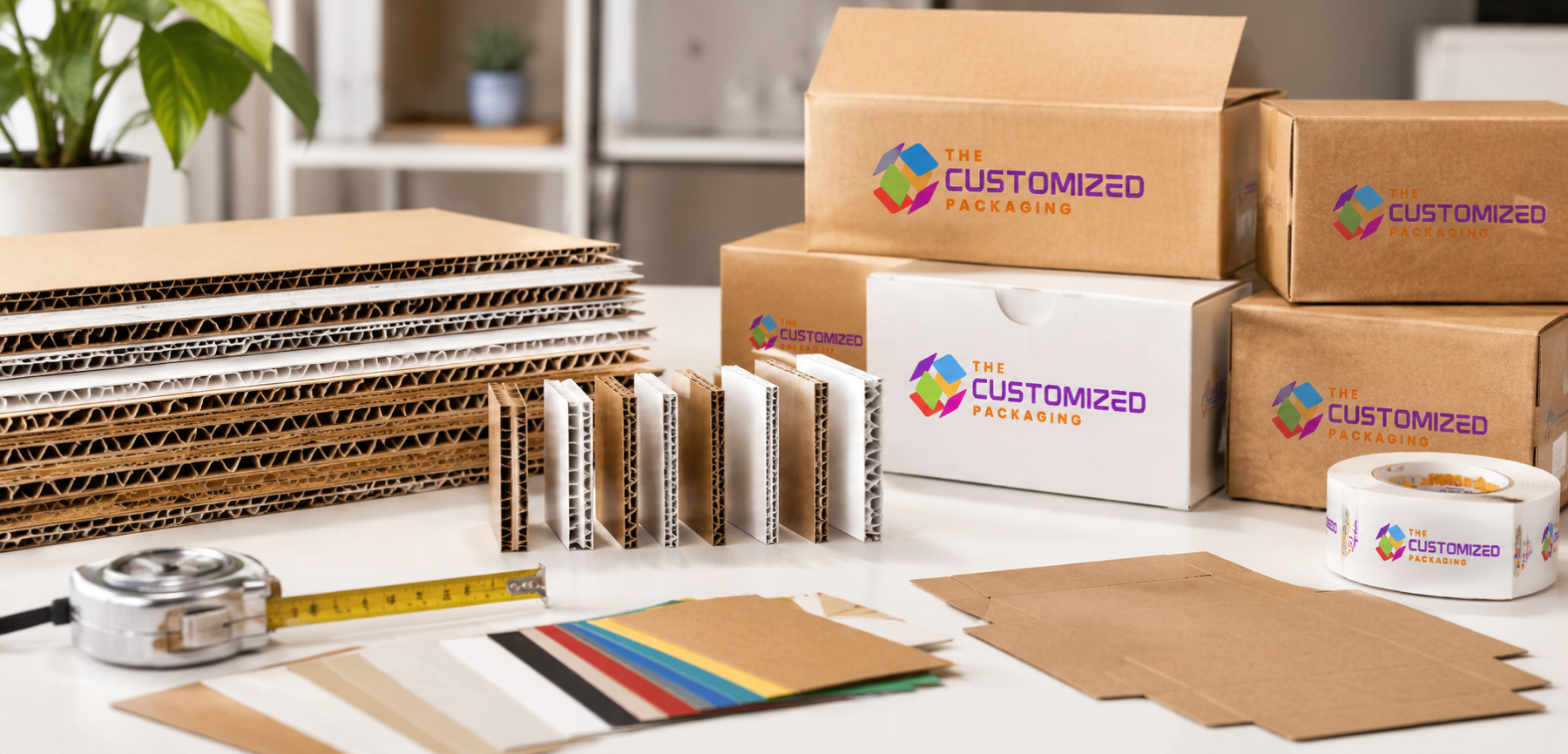
Corrugated material contains liner sheets and a fluted medium that creates cushioning and structural support.
The right material depends on the product weight, dimensions, fragility, shipping distance, stacking conditions, and storage environment.
Lightweight ecommerce products may perform well inside single-wall E-flute mailers. General shipping products may use B or C flute depending on their weight and handling requirements.
Heavy products may require double-wall corrugated board. Extremely heavy industrial products may need triple-wall material or an engineered packaging system.
A thicker board is not automatically the best option. Heavy material can increase cost, storage volume, and freight without providing meaningful benefits for a lightweight product.
Businesses should request a material recommendation from an experienced custom corrugated packaging supplier and confirm it through physical testing.
Single-Wall Corrugated Boxes
Practical Material for Lightweight and General Products
Single-wall corrugated board contains one fluted layer between two liner sheets.
It is commonly used for clothing, books, cosmetics, skincare, accessories, food products, small electronics, retail inventory, and subscription items.
Single-wall material can provide suitable protection when the product weight, box dimensions, insert design, and shipping conditions are appropriate.
E flute may create a thin and smooth surface for printed ecommerce packaging. B and C flute can provide stronger shipping performance for general products.
Single-wall boxes should still be tested with the actual contents. A lightweight product with fragile components may require inserts even when the outer carton does not need double-wall construction.
Double-Wall Corrugated Boxes
Greater Support for Heavy and Stackable Products
Double-wall board contains two fluted layers and additional liners.
This construction can provide greater resistance to compression, punctures, stacking pressure, and repeated handling.
It is commonly used for automotive parts, appliances, heavy electronics, bottles, tools, industrial products, and multi-unit shipments.
Double-wall material may also be useful for large boxes with wide panels that need greater structural stability.
The additional layers increase the material cost and package weight, so businesses should confirm that the product requires this level of protection.
Triple-Wall Corrugated Boxes
Engineered Packaging for Demanding Industrial Shipments
Triple-wall corrugated board contains three fluted layers and additional liners.
It is used for machinery, commercial equipment, large automotive components, industrial products, export shipments, and very heavy items.
The complete package may also require reinforced bottoms, heavy-duty closures, corner supports, internal braces, strapping, and palletization.
Triple-wall packaging should be developed and tested with the actual product. It should not be selected only because the item appears large.
Kraft Corrugated Boxes
Natural Packaging with Practical Printing Options
Kraft corrugated board provides a brown, natural surface that works well for ecommerce, food, apparel, handmade products, industrial shipments, and brands seeking a simple presentation.
A one-color or two-color logo can create strong branding without covering the complete box.
Dark inks generally create stronger contrast on kraft board. Light and pastel colors may appear differently because the brown surface affects the final result.
Custom kraft corrugated boxes may also support paper-based branding, but businesses should avoid broad environmental claims unless every packaging component supports them.
White Corrugated Boxes
A Bright Surface for Full-Color Printing
White corrugated board provides a clean background for colorful artwork, gradients, photographs, product graphics, and detailed logos.
It is commonly used for cosmetics, electronics, subscription packaging, healthcare products, gifts, candles, apparel, and premium ecommerce orders.
White board can create a more retail-style appearance than natural kraft material.
The surface may show dirt or handling marks more easily during delivery, so the shipping environment and customer expectations should be considered.
Choosing the Right Box Style
Structure Affects Protection, Assembly, and Presentation
Custom dimensions can be applied to several corrugated box styles.
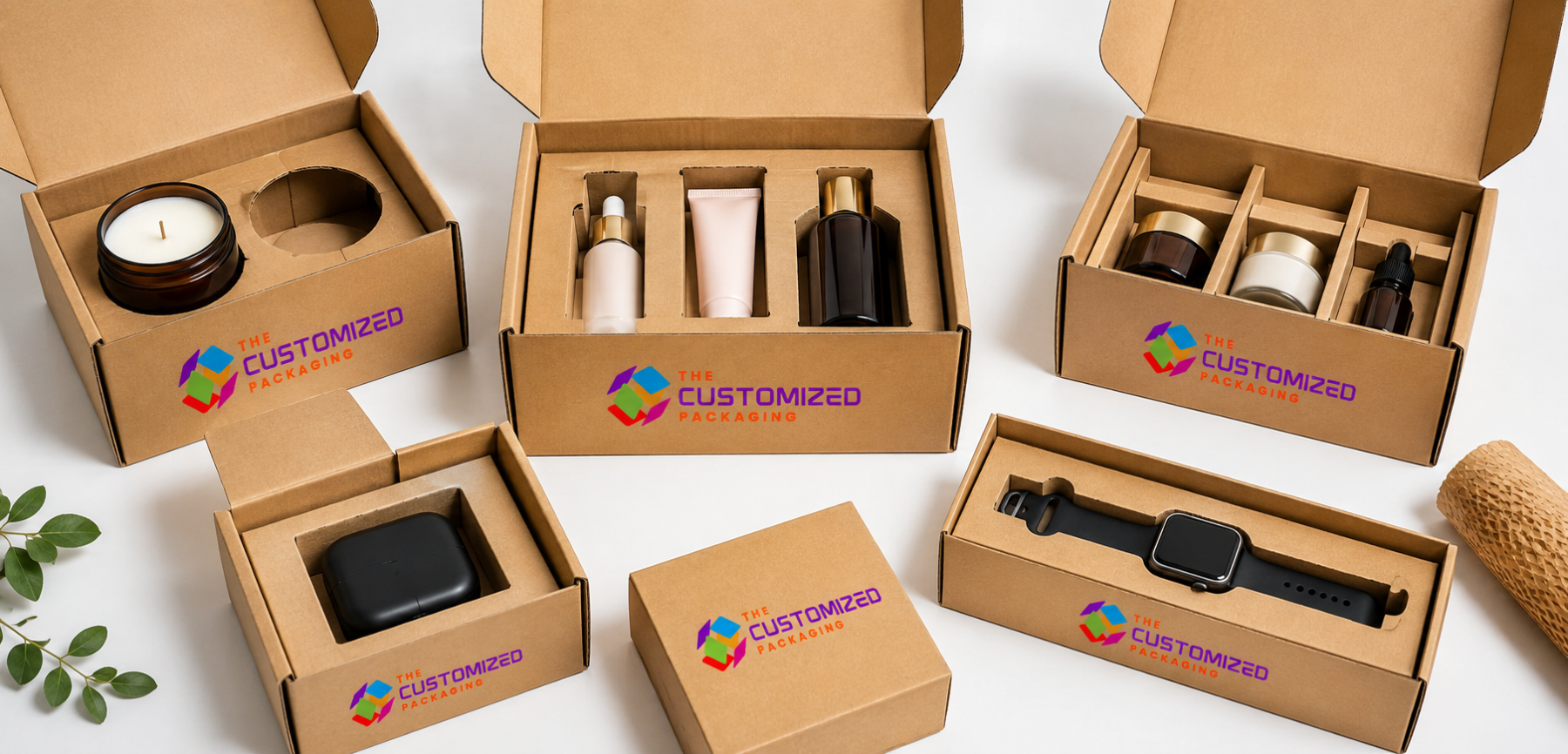
Regular slotted cartons are practical for warehousing, wholesale distribution, manufacturing, and general shipping. Corrugated mailer boxes provide a hinged lid and stronger customer presentation for ecommerce and subscriptions.
Product boxes can include fitted inserts and custom compartments. Retail display boxes may ship products and convert into countertop or shelf displays.
Telescope boxes use separate top and bottom sections and can work well for large, framed, long, or adjustable-depth products.
The best structure should match the product, packing process, shipping conditions, and customer experience.
Custom Size Corrugated Mailer Boxes
Accurate Mailer Dimensions Improve Ecommerce Presentation
Custom size corrugated mailer boxes are popular with ecommerce and subscription brands because they combine shipping protection with an organized opening experience.
The hinged lid, locking tabs, and side walls create a strong structure that can often assemble without external tape.
Custom sizing helps prevent clothing, cosmetics, books, candles, electronics, and accessories from moving excessively inside the mailer.
The outside can carry the logo and shipping information, while the inside can include a pattern, thank-you message, QR code, discount offer, product guide, or social media invitation.
The mailer must be tested after the product and inserts are added. A structure that closes correctly while empty may become too tight after packing.
Custom Size Regular Shipping Cartons
Reliable Boxes for Fulfillment and Wholesale Distribution
Regular slotted cartons are widely used for ecommerce fulfillment, manufacturing, retail distribution, food products, household goods, apparel, books, and wholesale inventory.
The top and bottom flaps meet near the center and are normally sealed using packaging tape, water-activated tape, staples where suitable, or another appropriate closure.
Custom dimensions allow businesses to fit the carton around a specific product or product quantity.
These boxes can be printed with logos, barcodes, product codes, orientation arrows, quantities, and handling instructions.
They are generally supplied flat, helping businesses store larger quantities before assembly.
Custom Size Product Boxes
Product-Specific Packaging Reduces Movement
Custom corrugated product boxes are developed around an individual product or coordinated set.
They may include inserts, trays, partitions, sleeves, windows, compartments, or top and bottom pads.
Product boxes are useful for glass jars, bottles, candles, cosmetics, electronics, tools, accessories, food containers, and automotive components.
A product-specific box can improve presentation and reduce movement, but it should still provide enough space for cushioning where necessary.
Custom Size Retail Display Boxes
Shipping Packaging Can Support Merchandising
Retail-ready corrugated packaging may contain several products during shipping and convert into a shelf or countertop display after arrival.
Custom corrugated display boxes can be sized according to the number and dimensions of the individual product units.
The display may include a branded header, front lip, product dividers, tear-away panels, or printed side walls.
Accurate dimensions help keep the products upright and prevent the display from looking incomplete or overcrowded.
The design should preserve access to barcodes, product names, warnings, and labels.
Add Custom Inserts for Better Product Fit
Internal Structures Improve Protection and Organization
A custom-sized outer carton can reduce empty space, but some products still need internal support.
Custom corrugated inserts can hold items in fixed positions and prevent them from rotating, colliding, scratching, or striking the box walls.
Inserts may include folded trays, dividers, corner supports, base pads, top pads, and compartments.
Corrugated inserts are useful for heavy products, while folded paperboard or molded pulp may support lighter items.
The insert should be designed together with the outer carton. Small dimensional differences can create excessive pressure or allow the product to move.
Corrugated Dividers for Multiple Products
Individual Compartments Reduce Product Contact
Products such as bottles, jars, candles, cosmetics, food containers, and components may need separate compartments.
Corrugated dividers create individual cells inside the box, helping prevent products from striking one another.
The divider height and thickness should match the product dimensions and total packed weight.
Heavy glass products may also require base pads and top supports.
Businesses ordering custom size shipping boxes with dividers should provide the exact number and arrangement of items inside each carton.
How Printing Influences Custom Box Pricing
Simple and Full-Color Designs Use Different Processes
Custom box printing can range from a one-color logo to full-color artwork covering the interior and exterior.
Flexographic printing can be economical for larger orders and simple designs. It is commonly used for logos, product codes, handling instructions, and shipping symbols.
Digital printing supports detailed, colorful, and variable artwork without traditional printing plates. It is suitable for ecommerce mailers, short runs, product launches, and seasonal packaging.
Lithographic lamination provides smooth graphics and premium finishes for retail products, electronics, cosmetics, and luxury packaging.
Businesses should choose a printing method according to the artwork, quantity, box style, and budget.
Custom Size Corrugated Boxes with Logo
Branding Can Turn a Shipping Carton into a Customer Touchpoint
Custom size corrugated boxes with logo combine accurate product fit with stronger brand recognition.
The logo may appear on the top, front, side panels, inside lid, insert, or printed sealing tape.
A simple exterior logo may be enough for shipping and distribution cartons. Customer-facing mailers may use brand colors, interior printing, QR codes, slogans, and thank-you messages.
Artwork should leave sufficient space for carrier labels, barcodes, handling instructions, and warehouse information.
Consistent logo placement helps customers recognize future shipments and gives the brand a more professional appearance.
Minimum Order Quantities for Custom Size Boxes
Production Volume Influences Unit Pricing
Many custom packaging suppliers require minimum order quantities because production involves dielines, tooling, machine setup, artwork preparation, printing plates, and material purchasing.
Digital printing may support lower quantities, although the unit price can be higher.
Flexographic printing often becomes more economical as the quantity increases because the plate and setup costs are spread across more boxes.
Businesses searching for custom size corrugated boxes no minimum may find prototype or short-run services, but these options should not be compared directly with wholesale unit pricing.
New brands can begin with a smaller quantity to test product fit and customer response before ordering in bulk.
Wholesale Custom Size Corrugated Boxes
Bulk Production Can Reduce Unit Costs
Businesses with stable products and recurring packaging needs may benefit from custom size corrugated boxes wholesale.
Larger production runs may reduce the unit cost and help maintain consistent dimensions, materials, printing, inserts, and finishes.
Wholesale packaging is useful for ecommerce fulfillment, subscriptions, retail distribution, manufacturing, food shipping, cosmetics, apparel, electronics, candles, and industrial products.
Before ordering in bulk, businesses should confirm monthly usage, storage capacity, product dimensions, artwork stability, and expected design changes.
A physical sample should be approved before the complete production quantity begins.
How to Request an Accurate Corrugated Box Quote
Complete Details Help Prevent Pricing Changes
Businesses requesting a custom size corrugated box quote should provide the internal dimensions, packed product weight, box style, flute preference, wall construction, printing requirements, insert details, quantity, and delivery destination.
The supplier may also request product photographs, drawings, samples, or information about the shipping method.
The quotation should identify whether tooling, dies, printing plates, prototypes, inserts, finishes, freight, and delivery are included.
Businesses should compare the complete delivered specification rather than the lowest starting price.
A quote for a plain single-wall carton cannot be compared directly with a printed double-wall box containing a fitted insert.
Questions to Ask Before Ordering Custom Size Boxes
| Question | Why it matters |
|---|---|
| Are the dimensions internal or external? | Prevents product-fit and measurement problems |
| Which flute profile is recommended? | Confirms that the board matches product weight and shipping risk |
| Do I need single-wall or double-wall material? | Helps avoid weak or unnecessarily expensive packaging |
| Can you provide a physical prototype? | Allows testing of product fit, closure, assembly, and strength |
| Which printing method will be used? | Helps confirm expected quality, color, and pricing |
| Can you manufacture the inserts and dividers? | Simplifies development of the complete packaging system |
| What is the minimum order quantity? | Helps compare short-run and wholesale options |
| Are dies, plates, and tooling included? | Prevents unexpected setup charges |
| Does the quote include freight? | Helps calculate the actual delivered cost |
| What is the production lead time? | Supports packaging inventory and launch planning |
| Can future orders match the original specifications? | Protects consistency across repeat production |
| Can multiple products use the same box? | May reduce packaging inventory through shared structures |
Clear answers help businesses compare suppliers and avoid production problems.
Request a Sample Before Full Production
Physical Testing Confirms the Complete Packaging System
A digital proof shows artwork and general structure, but it cannot confirm physical fit, board strength, insert pressure, assembly time, or shipping performance.
Before placing a large order, request a prototype and pack it with the actual product, inserts, accessories, manuals, tissue paper, and cushioning.
Check whether the product moves, the lid closes correctly, the flaps align, and the insert remains stable.
Review the logo placement, print colors, QR codes, barcode readability, shipping-label area, and opening experience.
Fragile and heavy products may also require drop, vibration, compression, or transit testing.
A physical sample can identify problems before they affect an entire wholesale order.
Avoid Oversized Packaging
Extra Space Can Increase More Than Material Cost
Oversized packaging uses more board and may require additional cushioning.
It can increase dimensional shipping volume, warehouse storage, packing time, and freight costs.
Large empty spaces also allow products to gain momentum before striking the carton walls.
Businesses should not reduce the box size so aggressively that the product loses impact protection. The objective is controlled spacing rather than the smallest possible carton.
A packaging supplier should balance product fit, cushioning, protection, and carrier efficiency.
Avoid Boxes That Fit Too Tightly
Insufficient Space Can Damage Products and Inserts
A tight box may compress the product, crush retail cartons, bend accessories, or place pressure on fragile components.
The carton may also be difficult to assemble or close consistently.
Tight dimensions can create additional problems when corrugated thickness, manufacturing tolerances, or product variations are not considered.
Customers may struggle to remove the product without damaging the packaging.
A physical prototype helps confirm that the box provides secure support and reasonable removal clearance.
Custom Sizing Can Reduce Fulfillment Time
Repeatable Packaging Supports Faster Warehouse Work
When one box is designed for one product or order combination, warehouse employees can follow a consistent packing process.
They do not need to compare stock cartons or calculate how much void fill to add for every order.
Custom inserts can guide product placement and ensure that accessories, manuals, and cards appear in the correct positions.
A repeatable process can reduce packing errors and improve the appearance of every delivery.
Businesses should consider packing labor when comparing custom packaging costs. A slightly more expensive box may provide better total value if it reduces assembly and packing time.
Custom Boxes for Ecommerce Brands
Accurate Dimensions Support Shipping and Presentation
Ecommerce businesses need boxes that protect products through warehouses, sorting facilities, delivery vehicles, and repeated handling.
Custom size ecommerce boxes can be developed around individual products, bundles, subscriptions, gift sets, and promotional kits.
A right-sized mailer may reduce movement and create a cleaner unboxing experience.
Printed return instructions, tear strips, resealable closures, and interior branding can improve customer convenience.
Businesses should also consider whether the original packaging can support returns and exchanges.
Custom Boxes for Subscription Brands
Flexible Interior Design Supports Changing Product Collections
Subscription companies may use one custom-sized outer box across several monthly or seasonal collections.
The internal arrangement can change through inserts, dividers, tissue paper, and product cards.
The box should provide enough flexibility for changing product assortments without creating excessive empty space.
Using one consistent outer structure may simplify wholesale ordering and packaging inventory.
The dimensions should be tested with several likely product combinations before large-scale production.
Custom Boxes for Apparel and Fashion Products
Right-Sized Packaging Protects Presentation
Clothing, shoes, hats, ties, accessories, and handbags may not break easily, but they can become compressed, wrinkled, stained, or poorly presented.
Custom corrugated apparel boxes can be sized around folded garments, tissue paper, accessories, and product cards.
A suitable box reduces movement and can lower shipping volume compared with oversized stock cartons.
Interior printing, branded tissue, stickers, and thank-you cards can create a more premium experience.
Custom Boxes for Cosmetics and Skincare
Accurate Fit Helps Protect Containers
Cosmetic jars, skincare bottles, tubes, perfumes, and beauty tools may require fitted compartments.
Custom-sized boxes can hold the products securely and prevent glass or plastic containers from colliding during delivery.
A white corrugated mailer with full-color printing may create a premium presentation, while a kraft carton can support a natural visual identity.
Fragile products should be tested with the final insert and cushioning system.
Custom Boxes for Electronics
Devices and Accessories Need Organized Protection
Electronics packaging may include a main device, cables, power adapters, manuals, stands, and small accessories.
A custom corrugated electronics box can create a separate location for each component.
Fitted inserts prevent movement and protect finished surfaces.
The outer carton may display the model number, product features, barcode, QR code, handling symbols, and customer-support information.
Some electronics may also require static-control or moisture-protection materials in addition to corrugated packaging.
Custom Boxes for Candles and Glass Products
Inserts and Dividers Help Prevent Breakage
Glass candle jars, ceramic vessels, bottles, and decorative containers require controlled internal movement.
Custom-sized cartons can include base supports, top pads, dividers, corner protection, and individual compartments.
The box should provide enough space for impact protection without allowing the product to move freely.
Multi-product shipments should separate individual glass items to reduce product-to-product contact.
Custom Boxes for Industrial Products
Heavy Components Need Engineered Dimensions
Industrial parts, tools, automotive components, hardware, and equipment may require double-wall or triple-wall packaging.
Custom dimensions help distribute product weight and position heavy components away from weak areas.
Reinforced bases, edge guards, pads, and internal braces may be required.
Printed part numbers, handling instructions, orientation arrows, and quantities can support warehouse identification.
Sustainable Advantages of Accurate Box Sizing
Better Dimensions Can Reduce Unnecessary Material
Right-sized packaging may use less corrugated board than oversized stock cartons.
It can also reduce the amount of loose cushioning required and may improve shipping-space efficiency.
Businesses may choose kraft board, recycled-content materials, paper inserts, and water-based inks where appropriate.
Sustainability claims should reflect the complete packaging system, including tape, labels, laminations, coatings, windows, and inserts.
Accurate material information and disposal guidance create greater trust than vague environmental claims.
Custom Size Corrugated Boxes Across the USA
Packaging Manufactured for Businesses Nationwide
At The Customized Packaging, we provide custom size corrugated boxes for ecommerce companies, retailers, manufacturers, subscription brands, food businesses, apparel sellers, cosmetic companies, electronics brands, candle businesses, and industrial suppliers throughout the USA.
We create custom shipping cartons, corrugated mailer boxes, product packaging, subscription boxes, retail displays, kraft corrugated boxes, white corrugated packaging, double-wall cartons, custom inserts, dividers, and wholesale custom boxes.
Businesses searching for custom size corrugated boxes near me, custom corrugated box manufacturer USA, custom shipping box supplier, order custom size boxes online, or custom corrugated boxes wholesale can request packaging developed around their actual products and shipping requirements.
We support businesses in New York, New Jersey, California, Texas, Florida, Illinois, Pennsylvania, Ohio, Georgia, North Carolina, Washington, Massachusetts, Virginia, Michigan, Arizona, Tennessee, Indiana, Missouri, Maryland, Wisconsin, Colorado, Minnesota, Nevada, Oregon, Kentucky, Utah, and other locations across the United States.
Want to Estimate Your Custom Size Box Cost?
Try the Custom Box Packaging Cost Calculator
Want to estimate the cost of your packaging before requesting a detailed quotation? Try our Custom Box Packaging Cost Calculator to calculate an initial estimate based on box style, dimensions, material, printing, finishing, inserts, and quantity.
The calculator can help businesses plan custom shipping cartons, ecommerce mailers, subscription boxes, product packaging, display cartons, double-wall boxes, inserts, dividers, and wholesale custom size corrugated boxes.
The initial estimate may change according to the final flute profile, wall construction, board grade, print coverage, insert design, order quantity, tooling, freight, and delivery destination.
After reviewing the estimate, businesses can request a detailed custom corrugated box quote based on their complete packaging specifications.
Why Choose The Customized Packaging for Custom Size Corrugated Boxes?
Packaging Designed Around Your Exact Product
At The Customized Packaging, we help businesses create custom size corrugated boxes that improve product fit, reduce unnecessary empty space, support efficient fulfillment, and strengthen customer presentation.
We provide regular shipping cartons, ecommerce mailer boxes, product boxes, subscription packaging, retail displays, kraft corrugated cartons, white printed boxes, double-wall packaging, inserts, dividers, wholesale custom boxes, and bulk custom packaging.
Our services include custom dimensions, structural design support, flute and board recommendations, logo printing, full-color printing, interior printing, protective inserts, digital proofs, physical samples, and wholesale pricing.
As a professional custom corrugated box manufacturer and packaging supplier, we develop cartons around the product dimensions, packed weight, fragility, shipping method, branding, order quantity, and delivery destination.
Businesses remain responsible for confirming that the selected materials, strength, inserts, coatings, printing, labeling, product-contact suitability, and packaging use meet the requirements applicable to their products and markets.
Final Thoughts
Accurate Box Sizing Improves Protection, Pricing, and Efficiency
Custom size corrugated boxes allow businesses to develop packaging around the complete product instead of relying on unsuitable stock dimensions.
Accurate sizing can reduce movement, unnecessary void fill, dimensional shipping volume, packing time, and material waste while creating a more professional presentation.
The final price depends on box dimensions, flute profile, wall construction, style, printing, inserts, quantity, tooling, and freight. Businesses should compare the complete delivered specification rather than focusing only on the advertised unit price.
Physical samples help confirm internal fit, closure, material strength, inserts, artwork, and customer usability before wholesale production begins.
Whether you need custom size shipping boxes, ecommerce mailers, product cartons, subscription packaging, display boxes, double-wall cartons, corrugated boxes with logo, custom inserts, or custom size corrugated boxes wholesale, the right measurements and materials can improve protection and total packaging value.
For more comprehensive information, read our main pillar blog titled “Custom Corrugated Boxes: The Complete Guide to Strong, Printed, and Wholesale Packaging.”
At The Customized Packaging, we create custom corrugated packaging that is built to fit, designed to protect, and developed to help businesses pack, ship, and grow throughout the USA.
