

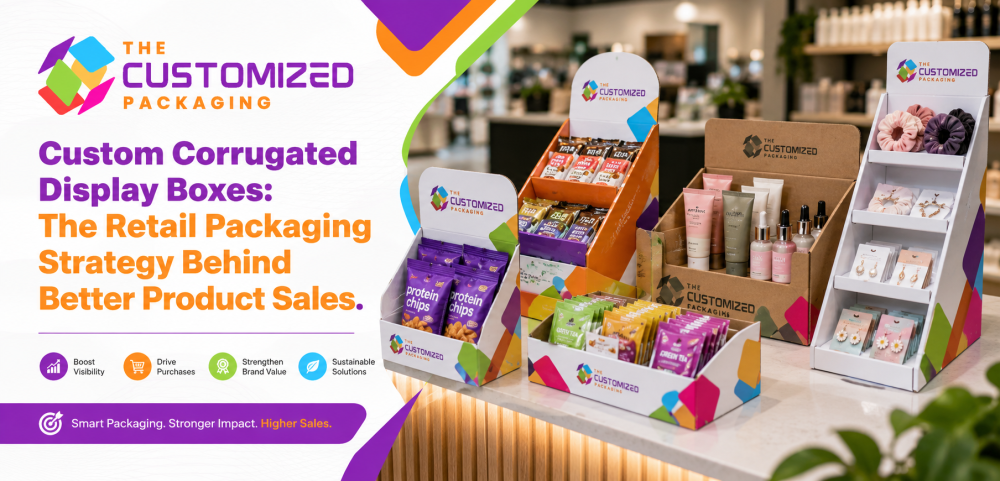
Custom Corrugated Display Boxes: The Retail Packaging Strategy Behind Better Product Sales
Retail packaging affects much more than product protection. Inside a store, packaging influences how quickly customers notice an item, understand its purpose, compare it with alternatives, and decide whether it deserves a place in their shopping cart. A product may offer excellent quality, competitive pricing, and strong customer value, but it can still underperform when it is hidden on a crowded shelf, displayed inconsistently, or difficult to access.
Custom corrugated display boxes provide brands with a practical retail packaging strategy that brings product protection, merchandising, organization, customer access, and branding into one coordinated structure.
Instead of placing individual products loosely on shelves or counters, businesses can use countertop displays, shelf-ready trays, gravity-feed boxes, tiered displays, PDQ cartons, floor-standing units, dump bins, sidekick displays, and custom compartments to create a defined selling area around their merchandise.
These structures can hold snack bars, candy, tea sachets, coffee products, cosmetics, skincare items, healthcare products, electronics accessories, batteries, stationery, toys, hardware components, automotive accessories, promotional samples, and many other retail goods.
A well-designed display box can guide customer attention toward the product. The raised header may communicate the brand and main benefit. The front opening can make products easier to see and remove. Dividers can separate flavors, formulas, colors, sizes, or product types. A gravity-feed ramp can keep the next item near the front. A tiered insert can prevent products in the back from becoming hidden.
Corrugated construction also provides the rigidity required for transportation, store setup, restocking, and repeated customer interaction. Kraft, white, white-top, E-flute, F-flute, B-flute, recycled, digitally printed, flexographic, and litho-laminated options allow businesses to balance structural performance, visual presentation, budget, and wholesale quantity.
Custom printed corrugated display boxes with logo can include the company name, product category, key benefits, flavor, formula, price promotion, QR code, website, social-media handle, barcode, instructions, ingredients, warnings, and environmental guidance.
The strongest retail packaging strategy does not treat the display as decoration added after the product is developed. It considers the display structure, individual product packaging, store environment, customer behavior, distribution method, sales goal, and brand identity as one complete system.
At The Customized Packaging, we manufacture custom corrugated display boxes, countertop displays, shelf-ready cartons, gravity-feed packaging, PDQ boxes, tiered units, floor displays, branded retail packaging, custom inserts, wholesale corrugated display boxes, and bulk printed displays for businesses throughout the USA.
For a broader explanation of display-box styles, corrugated materials, flute profiles, printing, inserts, structural testing, pricing, and wholesale production, read our main pillar article titled “Custom Corrugated Display Boxes: How Smart Retail Packaging Turns Browsers into Buyers.”
Why Retail Packaging Should Be Treated as a Sales Strategy
Packaging Continues Selling After the Product Reaches the Store
Shipping packaging protects products during transportation, but retail display packaging continues working after delivery.
Once a product enters a grocery store, pharmacy, beauty shop, convenience store, café, electronics retailer, hardware business, or specialty shop, it begins competing for customer attention.
The customer may see several comparable products within the same category. Price, product quality, brand familiarity, packaging appearance, location, availability, and ease of selection can all influence the final decision.
A custom display gives the brand greater control over this environment.
It creates a visual boundary around the products, keeps individual units organized, communicates the main sales message, and establishes a consistent presentation across different retail locations.
The display can also reduce the effort required to understand the product. A customer should not need to remove several units or search for an employee simply to identify the available flavors, formulas, sizes, or benefits.
A successful retail packaging strategy makes the product easier to notice, easier to evaluate, and easier to purchase.
How Custom Corrugated Display Boxes Support Better Product Sales
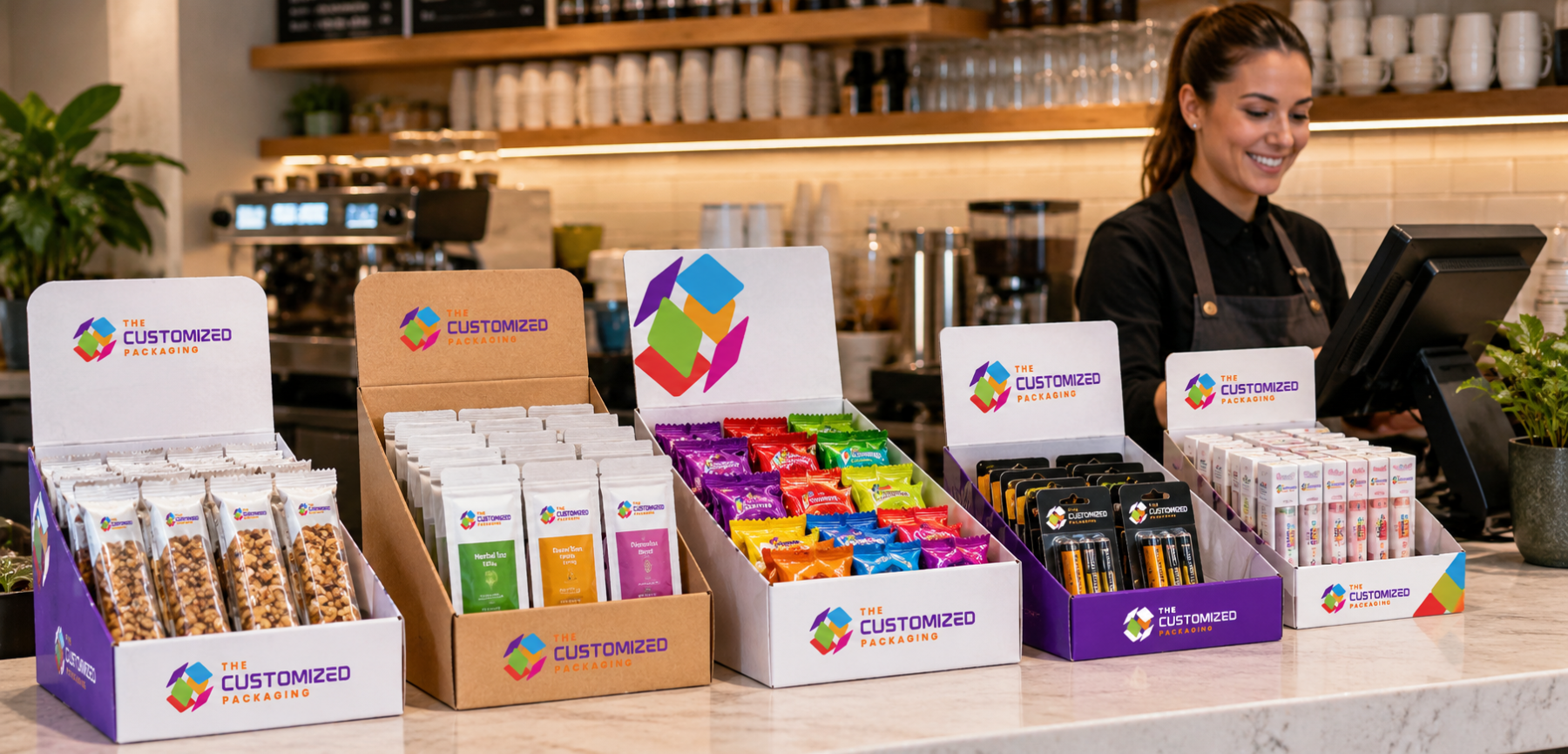
Better Sales Begin with Better Product Visibility
Customers cannot consider products they do not notice.
A low package positioned behind taller products may disappear on the shelf. Small sachets placed loosely in a basket may look unorganized. Snack bars located at the back of a deep tray may become difficult to see. Cosmetic samples without a branded structure may resemble complimentary items rather than products available for sale.
Custom retail display boxes improve visibility through printed headers, contrasting brand colors, elevated platforms, tiered sections, open fronts, and controlled product arrangement.
A raised header can remain visible above the individual products. A tiered insert can expose the second and third rows. A gravity-feed system can keep products close to the customer. A divided countertop display can present several options within one organized footprint.
The display should not simply be larger than necessary. It should use the available retail space intelligently.
Product Organization Can Influence Perceived Value
Neat Presentation Helps Merchandise Look More Intentional
The same product can create a different impression depending on how it is presented.
Products scattered inside an oversized tray may appear neglected or low value. Units arranged neatly inside a custom-fitted display can look more professional and easier to trust.
Dividers, compartments, inserts, shelves, and ramps help maintain product order.
Snack flavors can remain separated. Cosmetic formulas can be grouped by skin concern. Hardware parts can be organized by size. Electronics accessories can be divided according to device compatibility.
This organization can improve the customer experience and support retail staff.
Employees can monitor inventory more easily, identify which variation requires restocking, and maintain a consistent presentation throughout the sales period.
Customer Access Is Part of the Sales Experience
Products Should Be Easy to Reach Without Disturbing the Display
A display may attract attention, but customers can still abandon the purchase when the product is difficult to remove.
The front opening should be large enough for comfortable access. The retaining wall should hold products without hiding them. Dividers should separate products without restricting the customer’s hand.
For gravity-feed packaging, the next unit should move into position after the first product is removed.
For tiered displays, the rear row should remain reachable.
For peg-hook displays, products should slide from the hook without pulling the complete structure forward.
For dump bins, the container should not be so deep that customers struggle to reach the remaining merchandise.
Good access reduces friction between interest and purchase.
Retail Packaging Strategy Components
| Strategic component | How it influences the customer | How it supports the business |
|---|---|---|
| Product visibility | Makes merchandise easier to notice | Helps products compete in crowded retail environments |
| Clear branding | Helps customers identify and remember the brand | Creates consistent presentation across locations |
| Product organization | Makes flavors, formulas, and sizes easier to compare | Reduces shelf disorder and restocking errors |
| Convenient access | Allows customers to remove products confidently | Supports faster product selection |
| Informative printing | Explains the product, benefit, and usage | Reduces dependence on retail staff |
| Appropriate placement | Connects the product with the customer’s immediate need | Supports impulse purchases and cross-selling |
| Retail-ready structure | Creates a professional presentation | Reduces setup and stocking time |
| Custom sizing | Prevents products from leaning or disappearing | Improves space and inventory efficiency |
| Structural stability | Keeps the display secure during customer interaction | Reduces damage and replacement costs |
| Inventory visibility | Makes remaining quantities easier to evaluate | Helps staff plan replenishment |
| Consistent presentation | Creates a familiar buying experience | Protects brand standards across multiple stores |
| Wholesale production | Maintains reliable display quality | Can improve unit pricing and supply planning |
The retail strategy should balance all of these components rather than focusing only on appearance.
Countertop Displays Support Impulse Purchases
Checkout Areas Provide High-Value Selling Space
Customers near a checkout counter are already prepared to complete a transaction.
This makes checkout areas valuable for compact products that are affordable, convenient, attractive, or easy to understand.
A custom corrugated countertop display box can present snack bars, candy, tea sachets, cosmetic samples, gift cards, charging cables, batteries, promotional products, and travel-size items within a limited footprint.
The display can use a raised header to communicate the brand and main benefit without occupying additional counter width.
A front opening or low retaining wall allows customers to see the individual products.
The display should remain compact enough to avoid interfering with payment terminals, receipts, shopping bags, food preparation, or staff movement.
Product selection should feel natural rather than forced.
Shelf-Ready Packaging Supports Retail Efficiency
Faster Stocking Can Improve Product Availability
A product cannot generate sales when it remains inside a stockroom or unopened shipping carton.
Shelf-ready packaging helps retailers move products from delivery to the sales floor more efficiently.
The carton arrives with the merchandise already arranged inside. Store employees remove a perforated section, outer cover, or shipping panel and place the remaining display directly on the shelf.
This can reduce the time required to unload, arrange, and face individual units.
Custom shelf-ready corrugated display boxes also give the brand more control over product order, facing direction, and visual presentation.
The remaining tray should retain the products and display the logo after the removable panel is discarded.
The dimensions must fit the retailer’s shelf width, depth, and height.
A damaged or difficult tear-away section can delay setup and weaken the presentation, making physical testing important.
Gravity-Feed Displays Maintain Front-Facing Inventory
Product Flow Keeps the Display Active
Customers are less likely to notice products that remain at the back of a deep shelf or tray.
Gravity-feed displays use an angled base, internal ramp, or controlled lane to move products toward a lower front opening.
When one item is removed, the next product moves forward.
This structure can work well for snack bars, packets, coffee pods, small cartons, sachets, and other uniform products.
The product weight, wrapper material, surface friction, ramp angle, lane width, and opening size affect performance.
A glossy wrapper may slide smoothly, while a paper-based or matte wrapper may create more resistance. Flexible packages may overlap, while rigid cartons may rotate when the lane is too wide.
The actual production item should be tested before ordering wholesale gravity-feed display boxes.
Tiered Display Boxes Improve Product Comparison
Elevated Rows Keep More Products Visible
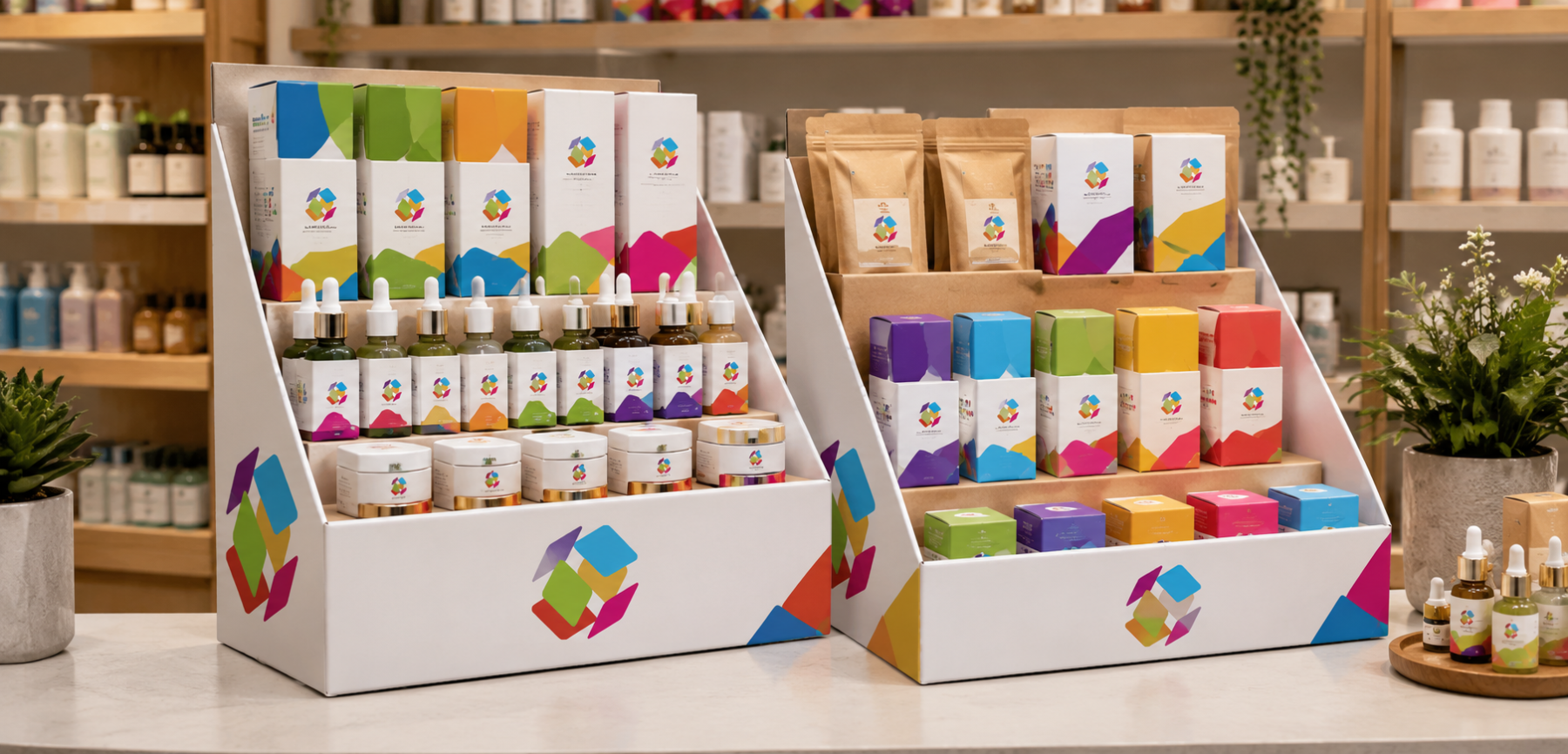
Tiered displays raise products at different heights.
This helps customers see products in the second and third rows instead of only the front units.
Cosmetics, skincare bottles, small boxes, accessories, stationery, healthcare products, and promotional samples can benefit from this arrangement.
The tiers may be integrated into the box or supplied as a separate corrugated insert.
The height difference should reveal the product name or important label without making the rear units difficult to reach.
The insert must support the packed weight and remain stable when products are removed unevenly.
Tiered displays are especially useful when visual comparison is part of the buying decision.
PDQ Displays Create Faster Promotional Setup
Prepacked Displays Help Brands Control Presentation
PDQ display boxes are developed for quick store setup.
Products may arrive already loaded inside the retail unit. Employees remove the outer cover, open a front panel, or place the complete display in position.
This approach is useful for seasonal campaigns, product launches, limited-time promotions, beauty products, snacks, supplements, accessories, and promotional merchandise.
The display should be simple enough for staff to open without tools or extensive instructions.
The branding should remain visible after temporary shipping sections are removed.
A prepacked display can also reduce inconsistencies between retail locations because the product arrangement is established before distribution.
Floor-Standing Displays Build Larger Brand Presence
Freestanding Structures Can Create Dedicated Selling Areas
Floor displays are positioned in aisles, entrances, promotional zones, end caps, and seasonal sections.
They can hold more products than countertop or shelf displays and create a larger branded area.
Floor-standing displays may include shelves, trays, hooks, compartments, or dump-bin sections.
They can support food products, beverages, toys, cosmetics, household goods, seasonal products, accessories, and promotional merchandise.
The structure must remain stable throughout the sales cycle.
The base, packed weight, height, center of gravity, customer access, shelf load, assembly, and transportation method should all be evaluated.
A display that becomes unbalanced as products are removed can create safety and presentation problems.
Sidekick Displays Use Additional Retail Fixture Space
Vertical Placement Can Expand Product Exposure
Sidekick and power-wing displays attach to existing retail shelves, end caps, rails, or fixture sides.
They provide additional product space without replacing the main shelf inventory.
This format works well for packets, candy, cables, batteries, personal-care products, small tools, stationery, and automotive accessories.
The hanging section must support the full packed weight.
The display should remain close to the fixture and avoid extending into customer walkways.
Retailer-specific fixture dimensions should be confirmed before the dieline is created.
The printed header and product arrangement should face the customer’s expected direction of travel.
Dump-Bin Displays Encourage Product Browsing
Open Structures Suit High-Volume Merchandise
Dump bins are open corrugated containers designed for customers to browse.
They are frequently used for toys, clearance merchandise, seasonal products, individually wrapped snacks, apparel accessories, and promotional items.
The side walls must resist outward pressure from the contents.
A false bottom can raise products so they remain accessible as inventory decreases.
The exterior panels can carry the brand name, promotional message, product benefits, and pricing.
The bin should be deep enough to contain the merchandise but not so deep that the remaining products become difficult to reach.
Peg-Hook Displays Organize Hanging Products
Carded Merchandise Becomes Easier to Compare
Charging cables, batteries, tools, craft supplies, stationery, automotive parts, and hardware accessories are often packed on hanging cards.
A custom corrugated peg-hook display can organize these products according to model, size, type, compatibility, or price.
The back panel must support the hook load.
Product spacing should prevent packages from overlapping excessively.
The header can communicate technical information, compatibility, or product benefits.
The display should remain stable when customers remove products from one side before the other.
Dense or heavy merchandise may require reinforced board or double-layer construction.
Match the Display Style to the Sales Goal
Different Retail Objectives Require Different Structures
Businesses should begin by defining what the display is expected to accomplish.
A countertop display may be designed to encourage an additional impulse purchase.
A shelf-ready carton may focus on reducing stocking labor and maintaining product alignment.
A gravity-feed display may keep one familiar product continuously available.
A tiered display may support comparison between several formulas or styles.
A floor display may create awareness for a seasonal campaign or new product launch.
A dump bin may encourage browsing through high-volume merchandise.
The best structure is not always the most complex or visually dramatic option. It is the structure that supports the product, retailer, customer, and sales goal most effectively.
Product Category and Display Strategy Comparison
| Product category | Recommended display direction | Strategic sales benefit | Important design consideration |
|---|---|---|---|
| Snack bars and protein bars | Gravity-feed or countertop display | Supports impulse purchases and keeps products visible | Wrapper friction and flavor organization |
| Tea and coffee sachets | Divided countertop or shelf-ready display | Helps customers compare blends and flavors | Compartment width and packet height |
| Cosmetics and skincare | Tiered or premium countertop display | Supports formula comparison and high-quality branding | Product visibility and print quality |
| Healthcare products | Shelf-ready or divided display | Keeps sizes and product types clearly organized | Instructions, warnings, and labeling |
| Electronics accessories | Peg-hook, tiered, or countertop display | Organizes compatibility and product features | Product security and barcode access |
| Hardware components | Reinforced compartment or peg-hook display | Separates sizes, types, and part numbers | Packed weight and structural strength |
| Toys and collectibles | Countertop, floor display, or dump bin | Creates excitement and encourages browsing | Stability, access, and product safety |
| Promotional samples | Countertop or PDQ display | Supports trial and product discovery | Clear offer and QR-code placement |
| Seasonal merchandise | Floor display, sidekick, or dump bin | Creates dedicated promotional visibility | Campaign duration and leftover inventory |
| Small food packets | Shelf-ready or gravity-feed display | Reduces stocking effort and maintains front-facing inventory | Product movement and food-use requirements |
| Stationery products | Countertop, compartment, or peg-hook display | Improves product selection and organization | Category labels and restocking |
| Beauty sachets | Tiered or divided countertop display | Makes formulas and benefits easier to compare | Front-wall height and premium presentation |
The final recommendation should be confirmed through a physical sample using the actual products.
Packaging and Product Design Should Work Together
The Display Should Complement the Individual Package
The corrugated display and individual product packaging should appear as parts of the same brand system.
A display that uses completely different colors, typography, or imagery can weaken recognition.
The outer structure should frame the products rather than compete with them.
When product wrappers are already colorful, the display may use a more controlled background with clear branding.
When individual packages are minimal, the display can add stronger color, imagery, and product education.
The product’s most recognizable panel should face customers.
Snack flavors, cosmetic formulas, compatibility information, product names, or package windows should remain visible.
Accurate inserts and internal dimensions help prevent products from rotating during transportation.
Logo Placement Should Reflect Customer Viewing Angles
The Main Branding Must Remain Visible When the Display Is Full
The logo may appear on the header, front retaining wall, side panels, back panel, shelves, or inserts.
The best location depends on the display style and retail placement.
A countertop display viewed from the front may use a large header logo and a smaller front-panel logo.
A floor display may require branding on several sides.
A shelf-ready tray should carry the logo on the remaining permanent panel rather than only on the removed shipping cover.
Products should not cover the logo when the display is fully loaded.
The design should also remain recognizable when inventory becomes low.
Brand Colors Can Improve Recognition
Color Creates Continuity Across Product Variations
Customers may recognize a familiar color palette before reading the company name.
Brands can use a consistent master color while assigning secondary colors to different product variations.
A snack company may use one dominant brand color and separate flavor accents.
A skincare company may use calming colors for sensitive-skin products and brighter colors for energizing formulas.
An electronics business may use category colors for cables, chargers, adapters, and accessories.
The display should remain consistent enough to feel like one product family.
Artwork should be tested on the selected material because kraft, white, and coated surfaces reproduce colors differently.
Kraft Corrugated Displays Support Minimal Branding
Natural Brown Board Can Communicate Simplicity and Practicality
Kraft display packaging is suitable for natural foods, coffee, tea, handmade goods, organic-style cosmetics, hardware, office supplies, and industrial products.
The brown surface can create a warm, handmade, or practical appearance.
One-color flexographic printing may provide an economical wholesale solution.
Black, dark purple, green, orange, red, and navy can create strong contrast.
Light colors may appear muted.
White ink can create stronger contrast but may require additional printing passes.
The business should review a printed sample before approving a large run.
White Corrugated Displays Support Detailed Printing
Bright Material Provides a Clean Retail Surface
White corrugated material is frequently used for cosmetics, healthcare products, electronics, premium foods, toys, and consumer goods.
It provides a brighter background for photographs, gradients, pastel colors, illustrations, and detailed typography.
White-top linerboard can combine a clean exterior with a kraft interior.
The material may show dirt and scuffing more easily than natural kraft.
Coatings and laminations can improve appearance, although they may increase cost and affect recyclability.
The complete retail and distribution environment should be considered when selecting the finish.
E-Flute for Premium Retail Display Boxes
Fine Fluting Supports Accurate Folding and Printing
E flute provides a relatively thin corrugated profile with useful rigidity.
It is widely used for countertop displays, shelf-ready packaging, cosmetic displays, food displays, and small retail units.
The smoother surface supports cleaner graphics than many thicker shipping flutes.
E flute also supports precise folds, cutouts, header shapes, and perforations.
The display design should still account for product weight and opening size.
Large floor displays and heavy merchandise may require a stronger material.
B-Flute and Stronger Board for Heavy Merchandise
Packed Weight Should Determine Structural Strength
B flute provides greater thickness and puncture resistance than E flute.
It can support larger shelf-ready cases, hardware products, heavier food items, warehouse displays, and shipping-and-display cartons.
C flute and double-wall board may be used for large floor displays or industrial applications.
Stronger materials increase cost, thickness, storage requirements, and freight volume.
The business should avoid selecting heavy board simply because it feels more protective.
The manufacturer should recommend a flute based on packed weight, shelf load, distribution, moisture, opening design, and expected use.
Custom Printing Turns Displays into Communication Tools
Printed Packaging Can Explain the Product Without Retail Assistance
Retail employees may not have time to explain every product.
Printed corrugated displays can communicate essential information directly to customers.
The header may show the logo, product name, and primary benefit.
The front panel may display the flavor, formula, product category, or promotional offer.
Side panels can carry instructions, ingredients, specifications, website information, social-media handles, QR codes, barcodes, and environmental guidance.
The information hierarchy should remain clear.
The display should not attempt to print every available message on the customer-facing front panel.
Customers should understand the main product and benefit within a few seconds.
Digital Printing for Low-MOQ Retail Programs
Short Runs Allow Brands to Test Display Performance
Digital printing can create full-color artwork without conventional printing plates.
It works well for prototypes, short retail programs, seasonal campaigns, regional testing, product launches, and several artwork variations.
Businesses can test the display structure, retail placement, customer reaction, and branding before committing to a larger wholesale order.
A company may use the same dieline for several flavors or formulas while changing the graphics.
The unit cost may be higher than flexographic printing at very large quantities.
However, the lower setup requirements can reduce initial investment and packaging inventory risk.
Flexographic Printing for Wholesale Corrugated Displays
Larger Quantities Can Improve Printing Efficiency
Flexographic printing applies ink directly to corrugated material using custom plates.
It is suitable for logos, text, barcodes, patterns, product information, and limited-color artwork.
One-color or two-color printing can create effective kraft retail displays at a competitive wholesale cost.
Each color may require a separate plate.
The printing setup becomes easier to distribute across larger production quantities.
Highly detailed images, photographs, and smooth gradients may require digital printing or litho lamination.
Litho-Laminated Displays for Premium Retail Presentation
High-Resolution Graphics Can Improve Shelf Impact
Litho lamination involves printing artwork on a separate sheet and applying it to corrugated board.
This process supports photographs, detailed illustrations, precise colors, gradients, and smaller typography.
It is often used for cosmetics, electronics, toys, specialty foods, healthcare products, and national retail campaigns.
The process includes more production stages than direct printing.
It can increase the price, MOQ, and lead time.
The premium print quality should match the product’s retail value and competitive environment.
Header Panels Function as Retail Signage
Vertical Space Can Communicate the Main Sales Message
A header panel raises the brand or product message above the merchandise.
It can help the display remain visible from a distance or behind nearby products.
The header should display the logo, product name, primary benefit, or short promotional message.
It should not contain excessive small text.
A tall header adds visual impact but can also affect stability.
The base, material thickness, internal support, and packed product weight should be considered together.
The header may require folded braces or double-layer construction.
Inserts and Dividers Improve Merchandising
Internal Components Help Products Remain Organized
Custom inserts can hold bottles, tubes, cartons, pouches, sachets, accessories, and other products in the intended position.
Dividers can separate flavors, formulas, product types, and sizes.
Tiered inserts elevate the back rows.
Gravity-feed ramps move products toward the front.
Side rails prevent cartons from rotating.
A false bottom can keep products near the top of a dump bin.
Each insert should solve a clear merchandising or protection requirement.
Unnecessary components add material, assembly time, tooling, and cost.
Retail Placement Can Strengthen the Display Strategy
Product Relevance Matters as Much as Visual Design
Displays should be placed where customers naturally think about the product.
Snack bars can perform near beverage coolers, café registers, and gym counters.
Batteries can appear near electronics, toys, or checkout areas.
Tea sachets can be positioned near kettles, mugs, or café products.
Cosmetic samples can appear beside related full-size items.
Charging cables can be displayed near mobile accessories.
The location should create a clear relationship between the display and the customer’s immediate need.
Even a well-designed box may underperform when placed in an irrelevant or obstructed area.
Cross-Selling Can Increase Basket Value
Displays Can Introduce Complementary Products
Custom corrugated display boxes can support cross-selling by placing related products together.
Coffee pods can be displayed near coffee machines.
Skincare serums can appear near cleansers and moisturizers.
Sauce packets can be positioned near prepared foods.
Small hardware parts can be placed near compatible tools.
The display artwork can explain the relationship through imagery, compatibility details, or short product suggestions.
Cross-selling works best when the connection is obvious and helpful rather than forced.
QR Codes Extend the In-Store Experience
Limited Display Space Can Connect to More Information Online
A QR code can connect customers to product demonstrations, reviews, ingredient details, compatibility charts, subscription programs, promotional offers, online ordering, and loyalty accounts.
The code should appear on a flat panel with adequate contrast.
It should not cross a fold, cutout, perforation, or heavily textured surface.
The destination should remain active for the complete display period.
Businesses should test the QR code using several devices before production.
A short message should explain what customers will receive after scanning.
Product Capacity Should Match Sales Velocity
An Oversized Display Can Look Empty
A large display may hold more inventory and reduce restocking frequency.
However, it can appear neglected when sales are slower than expected.
A smaller display that is replenished regularly may create a stronger presentation.
Businesses should estimate store traffic, average sales, product shelf life, staff availability, and campaign duration.
The display should remain visually effective when half full.
Gravity-feed ramps, tiered inserts, raised platforms, and false bottoms can keep products visible as inventory decreases.
Retail Staff Should Be Included in Display Planning
Easy Setup and Restocking Support Long-Term Performance
A display must work for the employees who receive, open, place, and maintain it.
Complicated assembly can delay store setup.
Weak perforations can open during transportation, while difficult tear lines can damage the final display.
Restocking openings should remain accessible.
Product lanes should be easy to identify.
A replacement display may be more efficient than repeatedly refilling the same structure in some retail programs.
Physical samples should be tested by the staff or fulfillment team expected to use the packaging.
Their feedback can identify practical problems before bulk production.
Structural Testing Protects Retail Performance
A Digital Rendering Cannot Confirm Stability
A digital mockup can show the artwork and approximate structure, but it cannot confirm physical performance.
A prototype allows the business to test assembly, product fit, shelf placement, customer access, restocking, and transportation.
The display should be tested when full, partially empty, and nearly empty.
The business should evaluate whether the walls bow, the base spreads, the header leans, the products rotate, or the display tips.
Gravity-feed products should move consistently.
Tear-away panels should remove cleanly.
Barcodes and QR codes should be scanned.
Problems should be corrected before wholesale manufacturing.
Shipping-and-Display Packaging Can Reduce Handling
One Structure May Replace Separate Transport and Retail Packaging
Some corrugated displays can remain closed during shipping and convert into retail packaging after arrival.
A perforated cover, front panel, top section, or wraparound piece is removed.
The remaining structure becomes the sales display.
This approach may reduce the need for a separate shipping carton and display tray.
It can also preserve product arrangement from the packaging line to the store shelf.
The closed and open structures must both perform properly.
The package should protect products during transit and remain attractive after conversion.
Sustainability and Material Efficiency
Responsible Display Planning Begins with the Complete System
Corrugated board is widely collected through paper-recovery programs, but recyclability depends on local facilities and the condition of the packaging.
Clean, dry displays may be recyclable in many areas.
Food residue, grease, plastic hooks, window films, foam, heavy coatings, and mixed components can affect recovery.
Custom sizing can reduce unnecessary material.
Shipping-and-display structures may eliminate separate cartons and permanent plastic displays.
Flat-packed units can reduce transportation and storage volume.
Businesses should avoid broad statements such as completely sustainable, zero-waste, or fully biodegradable unless supported by the actual material specification.
Specific claims about recycled content, material reduction, responsible fiber sourcing, and component separation are generally more useful.
Wholesale Custom Corrugated Display Boxes
Bulk Manufacturing Supports Consistent Retail Execution
Businesses supplying several stores, franchises, distributors, or retail programs may benefit from wholesale custom corrugated display boxes.
Bulk production can help maintain consistent dimensions, materials, print colors, openings, headers, dividers, and product arrangement.
Larger runs may reduce the cost per unit by distributing design, tooling, printing-plate, color-setup, and machine-preparation costs across more boxes.
Before ordering in bulk, businesses should confirm the approved sample, monthly usage, storage space, campaign duration, product changes, and artwork life.
A low unit price is not valuable when excessive packaging becomes outdated or unusable.
Minimum Order Quantities
Printing and Structure Affect the Practical MOQ
The minimum order quantity depends on dimensions, board grade, flute profile, printing method, inserts, finishing, and supplier capabilities.
Digital printing may support lower quantities for launches, seasonal campaigns, and market testing.
Flexographic printing often becomes more economical for medium and large production volumes.
Litho-laminated graphics, foil, embossing, several shelves, custom hooks, and complex inserts may require higher minimums.
Businesses searching for custom corrugated display boxes no minimum may need to compare one-off structural samples, short-run digital production, stock displays with branded labels, and fully custom manufacturing.
Lower quantities generally produce a higher unit cost.
What Influences Custom Display Box Pricing?
Every Structural and Printed Feature Affects the Quote
The price of custom corrugated display boxes depends on dimensions, material, flute profile, board strength, display style, printing, inserts, finishing, tooling, order quantity, assembly, packing, and freight.
A simple one-color kraft countertop tray generally costs less than a full-color multi-tier floor display.
A gravity-feed box may require additional testing and an internal ramp.
A tiered display may use more components.
Custom shelves, hooks, dividers, windows, coatings, foil, lamination, and spot UV add production steps.
Flat-packed displays usually cost less to ship than pre-assembled units.
Businesses should compare complete delivered quotations rather than only the manufacturing unit price.
How to Request an Accurate Display Box Quote
Complete Information Reduces Revisions and Delays
Businesses ready to request pricing should provide the finished product dimensions, individual weight, quantity per display, packed weight, product orientation, retail location, available footprint, display style, material preference, printing artwork, insert requirements, order quantity, and delivery ZIP code.
The supplier should also understand the distribution method, retailer requirements, setup process, and restocking plan.
Physical product samples can improve structural accuracy.
The manufacturer should prepare a dieline showing cuts, folds, glue areas, perforations, shelves, openings, and printable panels.
A physical prototype should be approved before bulk production.
Information Needed for a Custom Display Box Order
| Ordering detail | Information to provide | Why it affects production |
|---|---|---|
| Product dimensions | Length, width, height, and finished package shape | Determines the usable internal dimensions |
| Individual weight | Weight of one product unit | Influences board and insert strength |
| Quantity per display | Total units and product variations | Determines display capacity and compartments |
| Packed display weight | Products, inserts, and structure combined | Helps select corrugated grade |
| Retail location | Counter, shelf, end cap, floor, sidekick, or checkout | Defines the structure and customer access |
| Available footprint | Maximum width, depth, and height | Prevents store-placement problems |
| Display objective | Impulse sale, comparison, promotion, stocking, or cross-selling | Guides the structural strategy |
| Product orientation | Upright, horizontal, hanging, stacked, or angled | Determines inserts and openings |
| Printing requirements | Logo, colors, photos, benefits, barcode, and QR code | Helps select the printing process |
| Insert requirements | Dividers, ramps, tiers, shelves, hooks, or false bottoms | Influences tooling, material, and assembly |
| Shipping format | Flat, assembled, prepacked, or convertible | Influences freight and store setup |
| Order quantity | Prototype, short run, and wholesale quantities | Determines printing and production efficiency |
| Delivery destination | Commercial address and ZIP code | Supports freight calculation |
| Required delivery date | Target retail launch or replenishment date | Helps plan production and transportation |
The final quotation should identify each of these specifications clearly.
How to Choose a Corrugated Display Box Manufacturer
Retail Experience and Structural Knowledge Should Work Together
A professional custom corrugated display box manufacturer should understand transportation, store setup, retail placement, product access, printing, inserts, and wholesale production.
The supplier should ask detailed questions about the product and sales environment.
Businesses should request material specifications, a dieline, digital proof, structural prototype, printed sample, MOQ, tooling charges, production lead time, packing method, and freight.
The supplier should explain why a particular flute, style, opening, insert, or printing method is recommended.
The lowest-priced option may not offer the best total value when the structure is difficult to assemble, unstable, oversized, or unsuitable for the product.
Buy Custom Corrugated Display Boxes Online
Detailed Specifications Produce More Reliable Results
Businesses ready to buy custom corrugated display boxes online should submit complete product and retail information rather than requesting only a general display style.
The supplier can then recommend countertop, shelf-ready, gravity-feed, tiered, PDQ, floor-standing, peg-hook, dump-bin, or sidekick packaging.
A physical sample should be tested before wholesale production.
The final purchase order should identify the dimensions, material, flute profile, printing, inserts, tooling, finishing, quantity, assembly, packing, freight, and delivery schedule.
Businesses searching to order custom retail display boxes online should compare suppliers using identical specifications.
Custom Corrugated Display Boxes Across the USA
Retail Packaging for Businesses Nationwide
At The Customized Packaging, we provide custom corrugated display boxes for food brands, cosmetic companies, healthcare suppliers, pharmacies, electronics businesses, hardware companies, toy brands, retailers, wholesalers, distributors, manufacturers, ecommerce companies, and promotional programs throughout the USA.
We create countertop displays, shelf-ready boxes, gravity-feed packaging, tiered units, PDQ cartons, floor displays, sidekick units, peg-hook structures, dump bins, custom inserts, kraft displays, white corrugated packaging, and full-color printed boxes with logo.
Businesses searching for custom corrugated display boxes near me, custom display box manufacturer USA, wholesale retail display packaging, custom point-of-sale display supplier, custom printed display boxes with logo, or order corrugated display boxes online can request packaging developed around their products and sales environment.
We support businesses throughout New York, New Jersey, California, Texas, Florida, Illinois, Pennsylvania, Ohio, Georgia, North Carolina, Washington, Massachusetts, Virginia, Michigan, Arizona, Tennessee, Indiana, Missouri, Maryland, Wisconsin, Colorado, Minnesota, Nevada, Oregon, Kentucky, Utah, and other locations across the United States.
Want to Estimate Your Retail Display Packaging Cost?
Try the Custom Box Packaging Cost Calculator
Businesses planning custom displays can use the Custom Box Packaging Cost Calculator to develop an initial estimate based on dimensions, box style, material, printing, finishing, inserts, and quantity.
The calculator can help plan countertop displays, shelf-ready cartons, gravity-feed boxes, tiered packaging, PDQ displays, floor-standing units, peg-hook displays, kraft retail packaging, white corrugated boxes, and full-color displays.
The final price may change according to the corrugated flute, board strength, packed weight, header, shelves, opening, ramps, dividers, hooks, printing coverage, premium finishing, tooling, assembly, order volume, freight, and delivery destination.
After reviewing the estimate, businesses can request a detailed custom corrugated display box quote based on the complete product and retail specification.
Why Choose The Customized Packaging?
Displays Developed Around Product Sales and Retail Performance
At The Customized Packaging, we help businesses create custom corrugated display boxes that combine product protection, retail organization, customer access, branding, and sales-focused presentation.
We provide kraft corrugated board, white material, white-top liners, E flute, F flute, B flute, C flute, double-wall construction, digital printing, flexographic printing, litho-laminated graphics, printed headers, tear-away panels, gravity-feed ramps, dividers, tiered inserts, shelves, hooks, physical prototypes, and wholesale pricing.
Our packaging supports snacks, sachets, cosmetics, healthcare products, electronics accessories, hardware, stationery, toys, promotional merchandise, and other retail products.
As a professional custom box manufacturer and retail packaging supplier, we develop displays according to product dimensions, weight, retail position, customer interaction, branding, distribution, order quantity, and delivery destination.
Businesses remain responsible for confirming that selected materials, inks, coatings, adhesives, hooks, inserts, labeling, environmental claims, and product-contact components meet the requirements applicable to their products and markets.
Final Thoughts
Better Product Sales Begin with Better Retail Presentation
Custom corrugated display boxes provide brands with more than a product holder. They create a coordinated retail packaging strategy that supports visibility, organization, customer access, brand communication, stocking, and sales.
Countertop displays can encourage impulse purchases. Shelf-ready packaging can reduce setup time. Gravity-feed boxes can keep products near the front. Tiered displays can improve product comparison. Floor displays can create larger promotional zones. Peg-hook, sidekick, and dump-bin structures can use retail space in different ways.
The best structure depends on the product, customer, retailer, distribution process, and sales objective.
Corrugated materials such as E flute, B flute, kraft, white-top board, and litho-laminated construction allow businesses to balance strength, printing, appearance, and price.
Custom printing turns the structure into a brand communication platform. Logos, colors, benefits, product information, QR codes, and promotional messages help customers understand the merchandise more quickly.
Inserts, dividers, shelves, ramps, hooks, and headers should solve practical retail problems rather than adding unnecessary complexity.
Physical testing remains essential before wholesale production because the display must perform during transportation, setup, stocking, customer use, and inventory depletion.
Whether you need countertop displays, shelf-ready cartons, gravity-feed packaging, tiered cosmetic displays, PDQ boxes, floor-standing units, peg-hook displays, wholesale corrugated display boxes, or custom printed retail packaging with logo, the correct strategy can make products easier to notice, evaluate, and purchase.
For complete information about display-box structures, materials, printing, branding, inserts, pricing, and wholesale manufacturing, read our main pillar article titled “Custom Corrugated Display Boxes: How Smart Retail Packaging Turns Browsers into Buyers.”
At The Customized Packaging, we create corrugated retail displays that are built to protect, structured to present, and designed to help brands improve product visibility, customer engagement, and sales throughout the USA.
