

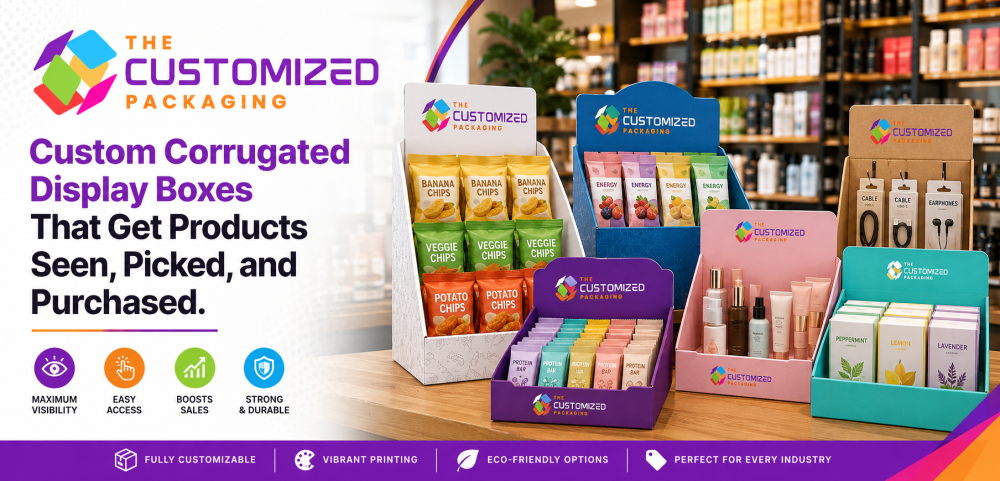
Custom Corrugated Display Boxes That Get Products Seen, Picked, and Purchased
A retail product must complete three important steps before it generates a sale. It must first be seen by the customer, then become easy and appealing to pick up, and finally provide enough confidence and value to be purchased. Products that fail at any one of these stages can remain unnoticed, untouched, or returned to the shelf.
Custom corrugated display boxes help brands connect these three stages through one coordinated retail packaging system. They create visual prominence, organize products, improve customer access, communicate product value, and support a smoother path from initial attention to final purchase.
A product may be well made, competitively priced, and professionally packaged, but it can still underperform when it is placed behind taller merchandise, stored inside a plain tray, mixed with unrelated products, or positioned too far from the front of a shelf. Small products such as snack bars, sachets, cosmetic samples, tea packets, batteries, cables, healthcare items, and promotional goods can disappear especially easily inside busy retail environments.
A well-designed display creates a defined selling area around these products.
Raised headers can attract attention from a distance. Open fronts expose the individual packages. Tiered inserts prevent rear products from becoming hidden. Gravity-feed systems keep units close to the customer. Custom compartments separate flavors, formulas, sizes, and product categories. Printed panels explain what the product is, why it matters, and what the customer should do next.
The corrugated structure also supports transportation, shelf placement, customer handling, restocking, and inventory depletion. Unlike temporary signs or loose shelf arrangements, a custom display can remain with the products throughout the retail sales cycle.
Custom printed corrugated display boxes with logo can carry the company name, product title, key benefits, promotional pricing, ingredients, compatibility information, flavor, formula, QR code, barcode, website, social-media handle, instructions, and responsible disposal guidance.
The right display does not simply make a product look attractive. It creates a deliberate retail journey that makes the merchandise easier to notice, easier to select, and easier to purchase.
At The Customized Packaging, we manufacture countertop display boxes, shelf-ready cartons, gravity-feed packaging, tiered displays, PDQ boxes, floor-standing displays, sidekick units, peg-hook structures, custom inserts, branded headers, wholesale corrugated display boxes, and bulk retail packaging for businesses throughout the USA.
For broader guidance about display structures, materials, flute profiles, printing, inserts, retail positioning, structural testing, pricing, and wholesale production, read our main pillar article titled “Custom Corrugated Display Boxes: How Smart Retail Packaging Turns Browsers into Buyers.”
The Seen, Picked, and Purchased Retail Journey
Each Stage Requires a Different Packaging Response
Customers rarely move directly from seeing a product to buying it without any evaluation.
First, the product must become visible among competing items. This is the “seen” stage.
Next, the customer must feel interested enough to approach, inspect, touch, compare, or remove the product from the display. This is the “picked” stage.
Finally, the packaging must communicate enough clarity, relevance, quality, and trust to support the decision to purchase. This is the “purchased” stage.
A strong corrugated display supports all three moments.
Visibility may come from a raised header, contrasting color, unusual structure, open front, tiered layout, or strategic shelf placement.
Product interaction may be improved through accessible openings, low retaining walls, finger notches, gravity-feed lanes, and clearly labeled compartments.
Purchase confidence may come from organized presentation, recognizable branding, benefit-focused printing, product information, QR codes, promotional messages, and a professional overall appearance.
The display should therefore be designed as part of the sales process rather than as a container added after the product packaging is complete.
Why Products Struggle to Get Seen in Stores
Retail Environments Contain Constant Visual Competition
Retail shelves are crowded with logos, colors, photographs, claims, price tags, promotions, and different packaging shapes.
Customers may only give each section a brief glance before deciding where to focus.
Products can lose attention when they sit below the natural viewing level, remain behind other packages, use low-contrast colors, or become scattered across a wide shelf.
A plain brown tray may organize merchandise, but it may not communicate that the products belong to a distinctive brand.
Small products can be especially difficult to notice because their individual packaging offers limited graphic space. A group of small sachets or bars may look visually weak when each unit is presented separately.
A custom corrugated retail display box groups these products into one larger branded presentation.
The combined logo, header, front panel, side walls, and product arrangement create a more visible unit than the individual products could create alone.
How Display Boxes Get Products Seen
Height, Color, Structure, and Placement Guide Customer Attention
Visibility can be created structurally and graphically.
A header panel raises the brand name above the products.
A tiered insert exposes rows that would otherwise remain hidden.
An angled tray points the products toward the customer.
A low front wall reveals more of each package.
A sidekick display places products along a high-traffic fixture edge.
A floor display creates a dedicated retail zone that does not depend on standard shelf positioning.
Color also affects visibility.
A white display can create a clean contrast against a dark shelf. A purple or orange display can stand apart from neutral packaging. A kraft box can communicate an artisan or natural style when surrounded by glossy retail cartons.
The best design does not simply use the brightest possible color. It uses contrast, scale, structure, and brand consistency to attract the right customers without creating visual confusion.
Product Visibility Features and Their Retail Impact
| Display feature | How it gets products seen | How it encourages selection | Best suited for |
|---|---|---|---|
| Raised header panel | Places the logo and main message above the merchandise | Helps customers identify the product before approaching | Countertop, shelf-ready, PDQ, and floor displays |
| Open front | Exposes more of the individual packaging | Makes products appear accessible and easy to remove | Snacks, sachets, cosmetics, and small cartons |
| Tiered insert | Keeps products in rear rows visible | Helps customers compare several variations | Cosmetics, skincare, electronics, and stationery |
| Gravity-feed ramp | Keeps the next unit close to the front | Supports fast one-at-a-time removal | Bars, packets, pods, pouches, and small boxes |
| Custom compartments | Creates visual order across multiple variations | Makes flavors, formulas, and sizes easier to compare | Tea, cosmetics, healthcare, and accessories |
| Contrasting brand colors | Separates the display from nearby products | Strengthens brand recognition and product-family connection | Competitive shelf and checkout environments |
| Angled presentation | Directs the product face toward the customer | Improves readability and handling | Countertop and shelf display packaging |
| Side-panel graphics | Increases visibility from several approach angles | Encourages engagement before the customer reaches the front | End caps, floor displays, and checkout counters |
| Product-facing inserts | Keeps the strongest package panel visible | Reduces customer effort when identifying the product | Products with important flavor, formula, or compatibility information |
| Floor-standing structure | Creates a dedicated product area away from crowded shelves | Encourages customers to stop and browse | Seasonal campaigns, promotions, and high-volume merchandise |
| Sidekick display | Uses vertical fixture space beside the main shelf | Places smaller products in the customer’s walking path | Candy, sachets, cables, batteries, and healthcare items |
| Printed promotional panel | Highlights a benefit, launch, offer, or product category | Gives customers a reason to investigate the merchandise | Product launches, limited-time offers, and impulse products |
The final structure should be tested in the actual retail environment whenever possible.
Product Facing Turns Visibility into Recognition
The Most Important Package Panel Should Face the Customer
Visibility is not useful when customers see the wrong side of the product.
Every retail package has one panel that communicates the product most clearly. It may show the product name, flavor, formula, image, size, compatibility, or primary benefit.
The display should keep this panel facing the aisle.
Products can rotate during loading, transportation, handling, and customer use. An oversized compartment may allow small cartons to lean sideways. A gravity-feed lane that is too wide may allow products to turn. Flexible pouches may fold or overlap.
Custom rails, dividers, inserts, side guides, and accurate internal dimensions help maintain orientation.
The display should be evaluated after realistic transport and handling rather than only immediately after careful manual loading.
A product that arrives facing backward or sideways loses much of the benefit created by the printed display.
Why Customers Pick Up Certain Products
Accessibility and Curiosity Encourage Interaction
A customer may notice a product but still avoid touching it.
The product may appear difficult to remove, tightly packed, unstable, expensive, confusing, or intended only for display.
A successful structure signals that the merchandise is available and easy to select.
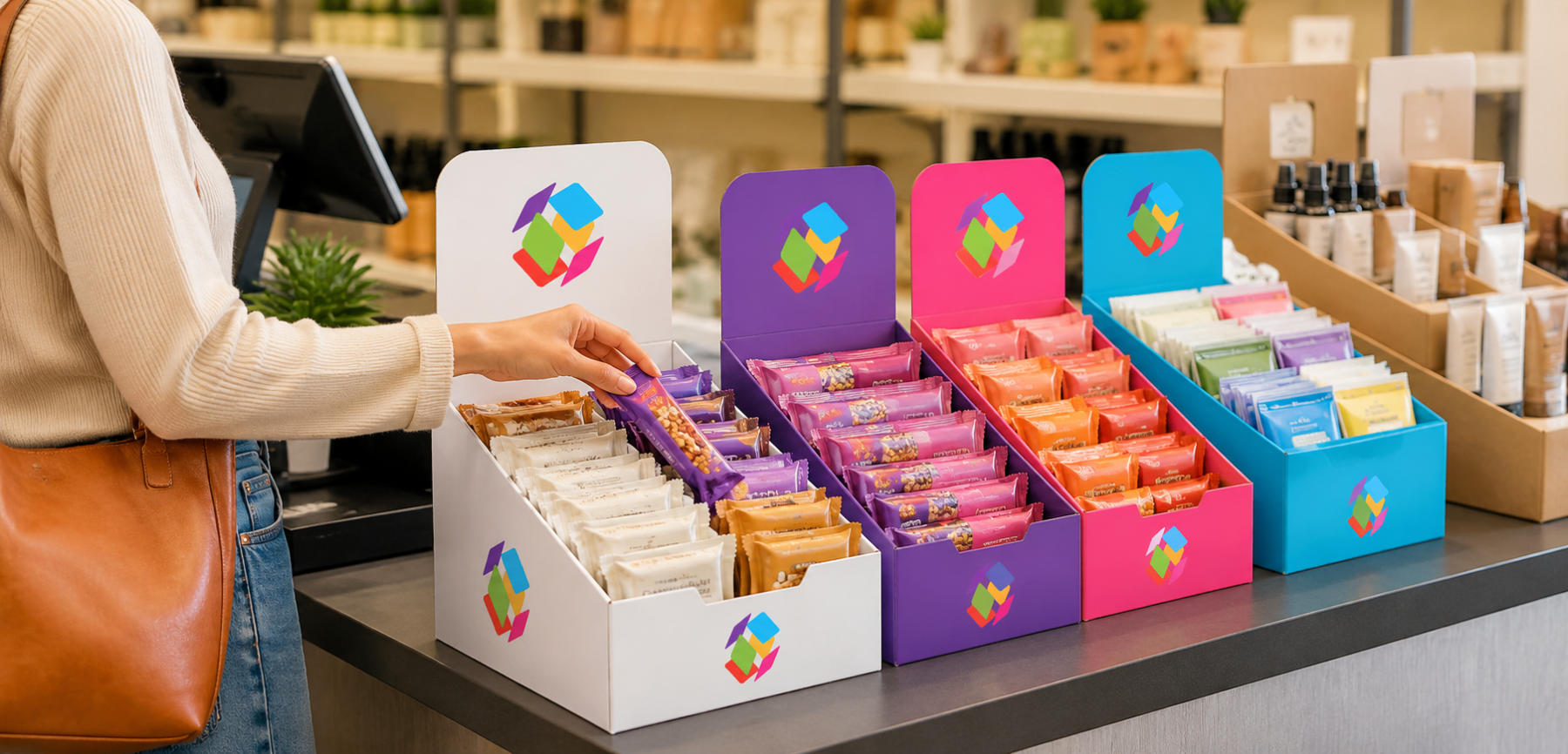
An open front reduces the visual barrier between customer and product.
A finger notch helps customers grip flat sachets or small cartons.
A low retaining wall shows that units can be removed without disturbing the complete arrangement.
Tiered rows make the back products reachable.
A gravity-feed opening positions the next item directly at the selection point.
The display should not require customers to lift a lid, reach deeply into a tray, remove several products, or ask an employee simply to inspect one item.
Making products easier to pick up supports closer evaluation and can move the customer toward purchase.
Open-Front Display Boxes Encourage Product Interaction
A Clear Opening Reduces the Barrier to Selection
Open-front display boxes are widely used for snacks, cosmetics, tea sachets, coffee packets, small healthcare products, electronics accessories, stationery, and promotional goods.
The opening should reveal enough of the product for recognition while retaining the merchandise securely.
A front wall that is too high can hide the product name and make the display look closed.
A wall that is too low can allow products to fall forward.
The side walls should guide the products without making the opening feel narrow.
Curved openings may create a softer and more decorative presentation. Rectangular cutouts provide broad visibility. Finger notches can improve access for flat products.
The frame around the opening must remain wide enough to support the display structure.
Gravity-Feed Displays Place the Product in the Customer’s Hand Path
The Next Unit Moves into Position Automatically
A gravity-feed display uses product weight and an angled internal structure to move merchandise toward a lower front opening.
The system may include a folded corrugated ramp, separate angled insert, side rails, or divided product lanes.
When the first product is removed, the next unit slides or rolls into place.
This makes selection quick and intuitive.
Custom gravity-feed corrugated display boxes can work effectively for snack bars, granola bars, candy, coffee pods, packets, sachets, small cartons, and other consistently shaped products.
The product must move reliably.
Wrapper texture, product weight, package stiffness, sealed edges, lane width, ramp angle, and opening size all influence performance.
Smooth wrappers may slide quickly. Matte or paper-based packaging may create friction. Lightweight sachets may remain at the back. Rounded products may rotate. Heavy items may place excessive pressure on the front unit.
Physical testing is therefore essential before wholesale production.
Tiered Displays Encourage Customers to Compare
Visible Choices Increase the Likelihood of Product Interaction
Customers are more likely to pick up products when they can see the available variations.
A flat tray may allow the first row to hide the products behind it.
A tiered display raises each rear row, exposing more of the product assortment.
This structure works well for skincare formulas, cosmetics, small bottles, tubes, electronics accessories, health products, stationery, gift items, and promotional samples.
Each tier should reveal the most important area of the package.
The rear products should remain easy to reach.
The insert should support the packed weight and resist bending.
Tiered displays can help customers compare color, formula, size, scent, compatibility, or product function without repeatedly removing products from the box.
Custom Compartments Make Selection Easier
Clear Categories Reduce Decision-Making Effort
A display containing several product variations can become confusing when everything is mixed together.
Dividers and compartments create a visual system.
Tea sachets may be organized into green, herbal, black, and fruit blends.
Skincare products may be divided into hydrating, brightening, calming, and exfoliating formulas.
Snack bars may be separated into chocolate, fruit, nut, and protein varieties.
Charging accessories may be organized by connector type or device compatibility.
Hardware products may be divided by part size or application.
Small printed labels or color-coded sections can help customers understand the assortment.
The compartments should remain wide enough for easy removal and restocking. Excessively tight dividers can damage flexible packaging or create frustration.
Product Organization Influences Purchase Confidence
Neat Presentation Can Make Merchandise Feel More Reliable
Customers often use visual order as a signal of quality.
Products that are leaning, mixed, crushed, or scattered may appear poorly managed even when the items themselves are undamaged.
A fitted and organized display creates a more professional impression.
Custom inserts keep bottles upright. Dividers separate product variations. Rails prevent cartons from rotating. Raised platforms keep products visible. False bottoms maintain presentation inside dump bins.
This organized structure can increase trust by showing that the brand has considered the complete retail experience.
It can also help retail employees maintain the display more effectively.
Low inventory becomes easier to identify. Incorrectly placed products stand out. Restocking can be completed by category rather than through repeated sorting.
How Printed Displays Help Products Get Purchased
Packaging Must Communicate More Than the Brand Name
A customer who picks up a product still needs enough information and confidence to buy it.
The individual package may provide ingredients, instructions, technical details, or legal information, but the outer display can communicate the broader sales message.
The header can explain the product category and main benefit.
The front panel can reinforce the logo and product name.
Side panels can show use cases, compatibility, flavor options, formula guidance, social proof, or a QR code.
A promotional area can display a price offer, product launch, bundle, or limited-time message.
The display should focus on the most important reason to purchase.
Too much text can make the packaging difficult to understand.
The customer-facing design should establish a clear sequence: brand, product, benefit, choice, and action.
Visual Hierarchy Moves Customers Toward Purchase
Important Information Should Be Read in the Right Order
A customer may only look at the display for a few seconds.
The most important message should therefore receive the strongest visual emphasis.
The company logo should establish recognition.
The product name should explain what is being sold.
The main benefit should provide a reason to care.
The visible products should confirm what the customer will receive.
The call to action or promotional message should encourage the next step.
Secondary details such as ingredients, directions, website information, disposal guidance, and company contact details can appear on less prominent panels.
When every element uses the same size, color, or visual weight, the design becomes difficult to scan.
A clear hierarchy makes the display look more professional and supports faster customer decisions.
Display Packaging and the Individual Product Must Work Together
The Outer Structure Should Frame Rather Than Compete
A display box and the individual packages inside it should appear as one brand system.
When the wrappers are already colorful and detailed, the display may use cleaner blocks of brand color and a simple header.
When the individual products use minimal artwork, the display can provide stronger imagery, product education, and visual impact.
The colors, typography, logo style, and product imagery should feel connected.
The opening should reveal the strongest part of the individual packaging.
The outer display should not cover important flavor, formula, size, or compatibility information.
A coordinated design can make several individual units appear more valuable as a complete product family.
Seen, Picked, and Purchased Packaging Strategy
| Retail stage | Customer question | Packaging objective | Useful display features |
|---|---|---|---|
| Seen | What is this product, and why did I notice it? | Create contrast, visibility, and brand recognition | Raised headers, strong colors, open fronts, tiered layouts, side graphics |
| Approached | Is this product relevant to me? | Communicate the product category and primary benefit | Clear product names, benefit-focused printing, product imagery, category organization |
| Picked | Can I remove and inspect it easily? | Reduce barriers to physical interaction | Finger cutouts, low front walls, gravity-feed openings, reachable tiers |
| Compared | Which version should I choose? | Organize product options clearly | Dividers, labeled compartments, color coding, tiered assortments |
| Trusted | Does this product appear professional and reliable? | Maintain order, consistency, and quality presentation | Fitted inserts, accurate printing, stable structure, clean product facing |
| Understood | Do I know what it does and how to use it? | Provide essential information without clutter | Printed benefits, instructions, icons, QR codes, side-panel details |
| Valued | Is it worth the price? | Support product positioning and perceived quality | Premium printing, organized presentation, relevant finishes, strong branding |
| Purchased | Should I add it to my cart now? | Provide a clear reason and easy final action | Promotional messages, availability cues, impulse placement, calls to action |
| Remembered | Will I recognize this brand later? | Reinforce brand identity after purchase | Consistent logo, colors, structure, social handles, website, QR code |
The complete display should support the journey rather than focusing only on the first moment of attention.
Countertop Displays Convert Attention into Impulse Purchases
Checkout Areas Place Products Near Active Buyers
Customers at a checkout counter have already decided to complete a transaction.
A relevant, affordable, convenient, or attractive product can become an additional purchase when it is presented clearly.
Custom corrugated countertop display boxes can hold snack bars, candy, tea packets, cosmetic samples, batteries, charging cables, gift cards, travel products, healthcare items, and promotional merchandise.
The display should remain compact enough to avoid blocking payment equipment, receipts, bags, food preparation areas, or staff movement.
A raised header can use vertical space for branding.
The front panel can communicate a short benefit or offer.
The product should remain easy to remove with one hand.
The display must remain stable as inventory decreases because a narrow base with a tall header may become unbalanced.
Shelf-Ready Packaging Gets Products Selling Faster
Easier Retail Setup Can Improve Product Availability
Products cannot be seen or purchased while they remain inside a stockroom.
Shelf-ready packaging allows products to move more efficiently from delivery to the sales area.
The carton arrives with the products already arranged.
Retail employees remove a perforated front, top, or outer cover and place the remaining tray directly on the shelf.
This reduces the need to unpack and face every unit separately.
Custom shelf-ready corrugated display boxes can preserve product order, orientation, and branding across several retail locations.
The tear-away section should remain secure during transportation but remove cleanly in the store.
After removal, the permanent display should retain the logo and product information.
The box should fit the available shelf width, height, and depth without interfering with neighboring merchandise or retailer price labels.
PDQ Displays Support Quick Product Launches
Prepacked Displays Reduce Setup and Presentation Errors
PDQ display packaging is designed for rapid retail placement.
Products may arrive already loaded inside the final display.
Employees remove a protective cover, open a panel, or place the complete display on the counter or shelf.
This format is useful for seasonal promotions, new products, limited editions, snacks, beauty products, healthcare items, and accessories.
The display should not require complicated tools or instructions.
The permanent branding should remain after temporary shipping sections are removed.
A prepacked custom PDQ display box gives the brand greater control over product spacing, facing, and arrangement before distribution.
Floor Displays Create High-Visibility Product Zones
Freestanding Structures Can Interrupt the Customer Journey
Floor-standing corrugated displays can be positioned inside aisles, entrances, end caps, seasonal departments, and promotional zones.
They provide more graphic space and product capacity than countertop or shelf displays.
The structure may include shelves, hooks, trays, compartments, or dump-bin sections.
Floor displays can hold snacks, beverages, toys, cosmetics, household products, apparel accessories, promotional goods, and seasonal merchandise.
The base, center of gravity, total packed weight, shelf load, customer access, and store requirements must be evaluated carefully.
The display should remain stable even when customers remove products unevenly.
A large graphic panel may attract attention, but structural safety and convenient product access remain essential.
Sidekick Displays Place Products in High-Traffic Paths
Vertical Fixtures Can Create Additional Product Exposure
Sidekick and power-wing displays attach to shelves, end caps, rails, or retailer fixtures.
They allow brands to use vertical space without replacing a complete shelf section.
This style works well for packets, candy, batteries, cables, healthcare products, stationery, and small tools.
The hanging section must support the complete product load.
The display should remain close to the fixture and should not extend into the customer walkway.
The logo and product opening should face the direction from which customers approach.
Retailers may have specific dimensions, attachment systems, and loading requirements that should be confirmed before manufacturing.
Peg-Hook Displays Encourage Browsing and Comparison
Carded Products Remain Visible and Organized
Charging cables, batteries, hardware, tools, craft supplies, stationery, and automotive accessories are often sold on hanging cards.
A corrugated peg-hook display gives these products a branded structure.
Products can be organized by size, price, compatibility, model, or use.
The back panel must support the hook load without bending.
Hooks should be spaced so packages remain visible rather than overlapping heavily.
The structure should remain stable when customers remove products from one side before the other.
Dense products may require B-flute board, reinforced panels, or double-layer construction.
Dump-Bin Displays Encourage Product Discovery
Open Merchandising Works for High-Volume and Promotional Goods
Dump bins are open corrugated containers used for toys, snacks, apparel accessories, seasonal products, clearance merchandise, and promotional items.
Customers can browse the products directly.
The side walls should resist outward pressure.
The container should remain deep enough to hold the merchandise but shallow enough for comfortable access.
A false bottom can raise the products as inventory decreases.
Large exterior panels provide space for promotional pricing, campaign artwork, product benefits, and brand recognition.
The merchandise should remain organized enough to feel intentional rather than neglected.
Display Strategy by Product Category
Different Products Need Different Paths to Purchase
Snack bars and candy often benefit from quick visibility and one-handed removal, making countertop and gravity-feed displays useful.
Tea and coffee sachets require organized compartments that allow customers to compare blends.
Cosmetics and skincare products may need tiered presentation, premium graphics, and formula-based organization.
Healthcare packaging should prioritize clear labeling, product separation, and trustworthy presentation.
Electronics accessories require compatibility information, secure product retention, and accessible barcodes.
Hardware items need stronger materials because the total display weight can become significant.
Toys and collectibles may benefit from colorful countertop, dump-bin, or floor-standing displays that encourage browsing.
The display style should reflect how customers naturally evaluate and purchase the product.
Kraft Corrugated Display Boxes for Natural Brand Positioning
Brown Board Creates a Practical and Artisan Appearance
Kraft corrugated material works well for natural foods, tea, coffee, handmade goods, organic-style cosmetics, stationery, hardware, and industrial products.
The brown surface can communicate simplicity, warmth, sustainability, or practicality.
One-color flexographic printing can create an economical wholesale display.
Black, dark purple, green, orange, red, and navy typically create strong contrast.
Pastel colors and photographs may appear muted because the brown surface affects the final result.
White ink or an underbase may improve contrast but can add production cost.
A printed sample should be reviewed before a large production run.
White Corrugated Display Boxes for Clean Retail Presentation
Bright Surfaces Support Detailed and Colorful Artwork
White corrugated material creates a cleaner background for cosmetics, healthcare products, electronics, premium food, toys, and promotional campaigns.
Full-color graphics, photographs, gradients, pastel shades, and detailed logos generally appear more clearly on white board.
White-top linerboard may provide a bright exterior with a kraft interior.
White packaging may show scuffs, dirt, and handling marks more easily than natural kraft.
Coatings or laminations can improve appearance and durability, although they may affect pricing, material recovery, and disposal instructions.
E-Flute Displays for Refined Retail Packaging
Fine Corrugation Supports Accurate Printing and Folding
E flute is commonly selected for countertop displays, shelf-ready trays, cosmetics, food packaging, and small retail structures.
Its relatively thin profile provides useful rigidity while supporting cleaner printing and detailed die-cutting.
E flute can create precise openings, headers, perforations, and folds.
The correct material still depends on the packed weight and display size.
Large structures and heavy products may require B flute, C flute, reinforced panels, or double-wall construction.
B-Flute and Heavy-Duty Corrugated Displays
Structural Strength Should Match the Product Load
B flute provides greater thickness and puncture resistance than E flute.
It can support hardware, larger food products, heavy shelf-ready cases, workplace dispensers, and shipping-and-display cartons.
C flute and double-wall board may be considered for large floor displays and industrial merchandise.
Stronger material increases thickness, cost, storage volume, and freight requirements.
The display should not be over-engineered without a real need.
A professional supplier should review the packed weight, opening size, shelf load, shipping conditions, humidity, and customer interaction before recommending the board grade.
Digital Printing for Low-MOQ Display Boxes
Short Runs Allow Brands to Test Retail Performance
Digital printing produces full-color artwork without conventional printing plates.
It is useful for prototypes, launches, seasonal campaigns, regional tests, multiple artwork versions, and low-minimum orders.
A brand may use one structural dieline for several flavors, formulas, or products with different graphics.
This allows the business to test product visibility, retail placement, and customer response before committing to a large wholesale quantity.
The unit price may remain higher than flexographic printing at larger volumes.
However, the lower setup requirement can reduce initial inventory risk.
Flexographic Printing for Wholesale Corrugated Displays
Larger Orders Can Reduce the Unit Impact of Setup Costs
Flexographic printing applies ink directly to corrugated board using printing plates.
It works well for logos, text, barcodes, patterns, product codes, and limited-color graphics.
One-color and two-color printing can create effective kraft displays at competitive wholesale pricing.
Each printed color may require a separate plate.
The setup cost becomes easier to distribute across medium and large production quantities.
Detailed photography and smooth gradients may require digital printing or litho lamination.
Litho-Laminated Display Boxes for Premium Product Positioning
High-Resolution Graphics Can Strengthen Purchase Confidence
Lithographic printing is produced on a separate sheet and laminated to corrugated board.
This process supports detailed photography, gradients, fine typography, illustrations, and accurate brand colors.
Litho-laminated displays are often used for cosmetics, electronics, toys, premium food, healthcare products, and national retail programs.
The additional printing, lamination, die-cutting, and converting stages can increase the MOQ, cost, and lead time.
The premium graphic quality should support the product’s price and retail position.
Premium Finishes Can Increase Perceived Value
Selected Details Should Reinforce the Brand Position
Foil stamping, spot UV, embossing, debossing, matte lamination, gloss lamination, and soft-touch finishes may be added to selected display designs.
Foil can highlight the logo or product name.
Spot UV creates contrast between glossy and matte surfaces.
Embossing and debossing add tactile dimension.
Premium finishing can support luxury food, cosmetics, electronics, gifts, and special promotions.
These processes add tooling, production time, cost, and material complexity.
Finishes should be used on important areas rather than across every surface.
QR Codes Can Support the Final Purchase Decision
Physical Displays Can Connect Customers to More Information
Retail packaging has limited space.
A QR code can connect customers to product demonstrations, ingredient details, reviews, compatibility guides, subscriptions, loyalty programs, promotional offers, and online ordering.
The code should appear on a flat panel with adequate contrast and blank space.
It should not cross folds, cutouts, perforations, or heavily textured surfaces.
Businesses should test the code on several devices before manufacturing.
The destination should remain active for the complete display period.
A short message can explain what the customer will find after scanning.
Cross-Selling Displays Increase Product Relevance
Complementary Placement Can Improve Basket Value
A display can become more effective when it appears beside a related product.
Snack bars can be positioned near beverages or café counters.
Coffee pods can be displayed near coffee machines.
Skincare serums can appear beside cleansers and moisturizers.
Charging cables can be placed near mobile devices and accessories.
Batteries can be displayed near electronics and toys.
Small hardware parts can appear beside compatible tools.
Printed imagery, compatibility information, or a short suggestion can explain the connection.
The relationship should be useful and immediately understandable.
Product Capacity Should Match Sales Speed
More Inventory Does Not Always Improve Presentation
A large display may reduce the need for frequent restocking, but it can look empty when the product sells slowly.
A smaller display that is replenished regularly may create a more active and organized appearance.
Capacity should reflect customer traffic, expected sales, product shelf life, retail space, staff availability, and campaign duration.
The display should still look intentional when partially empty.
Gravity-feed ramps keep products near the front.
Tiered inserts maintain visibility.
False bottoms keep dump-bin products near the top.
A branded back panel can make an empty section appear less unfinished.
Physical Testing Protects the Retail Journey
Digital Renderings Cannot Confirm Customer Interaction
A digital mockup can show artwork and approximate structure, but it cannot fully demonstrate product fit, stability, access, and movement.
A physical prototype allows the business to test loading, shipping, store placement, product removal, restocking, and inventory depletion.
The display should be evaluated while full, half full, and nearly empty.
Products should remain correctly faced.
Gravity-feed units should move consistently.
Headers should remain upright.
Walls should not spread or bow.
Openings should remain comfortable to use.
Barcodes and QR codes should scan correctly.
Any issue should be corrected before wholesale manufacturing.
Shipping-and-Display Packaging Maintains Presentation
Product Visibility Begins Before the Box Reaches the Store
A retail display cannot perform when it arrives crushed, scuffed, bent, or disorganized.
The transportation format should protect the structure and products.
The display may travel inside an outer carton, use a protective cover, or convert from a closed shipping case.
Products should remain in the intended position during vibration, compression, handling, and pallet movement.
Perforations should remain closed until store setup.
Printed surfaces may require protective packing.
The closed shipping format and open retail format should both be tested.
Wholesale Custom Corrugated Display Boxes
Bulk Production Helps Maintain Retail Consistency
Businesses supplying several stores, franchises, distributors, pharmacies, cafés, salons, or national retail programs may benefit from wholesale custom corrugated display boxes.
Larger production quantities can maintain consistent dimensions, materials, colors, openings, headers, inserts, and logo placement.
The cost of cutting dies, printing plates, structural development, color setup, and machine preparation can be spread across more units.
Before placing a bulk order, businesses should confirm monthly usage, product changes, campaign duration, artwork life, storage capacity, and retail requirements.
A lower unit price does not create value when excess packaging becomes outdated or unusable.
Minimum Order Quantities for Custom Displays
Material and Printing Determine the Practical MOQ
Minimum order quantities vary according to box dimensions, flute profile, printing, inserts, finishing, tooling, and supplier capabilities.
Digital printing can support lower quantities for prototypes, launches, and seasonal campaigns.
Flexographic printing becomes more economical at medium and larger volumes.
Litho-laminated graphics, foil, embossing, shelves, hooks, and complex floor displays may require higher minimums.
Businesses searching for custom corrugated display boxes no minimum may need to compare one-off prototypes, digital short runs, stock displays with custom labels, and fully customized production.
What Influences the Cost of Corrugated Display Boxes?
Every Structural and Printed Feature Affects Pricing
The cost of custom corrugated display boxes depends on dimensions, material, flute profile, board strength, display style, printing method, number of colors, coverage, inserts, headers, ramps, shelves, hooks, finishing, tooling, quantity, assembly, packing, and freight.
A simple kraft countertop tray with one-color printing generally costs less than a litho-laminated, multi-tier floor display.
Gravity-feed boxes may require ramps and product-flow testing.
Tiered displays use additional components.
Premium finishes and specialty coatings add production stages.
Flat-packed displays generally cost less to ship than pre-assembled units.
Businesses should compare complete delivered quotations instead of relying on advertised starting prices.
How to Request an Accurate Display Box Quote
Complete Product Information Reduces Delays and Revisions
Businesses requesting pricing should provide the product dimensions, individual weight, quantity per display, packed weight, product orientation, retail position, available space, preferred display style, material, printing artwork, inserts, order quantity, and delivery ZIP code.
The supplier should also understand the shipping format, assembly process, retailer requirements, campaign timing, and restocking plan.
A physical product sample can improve structural accuracy.
The manufacturer should prepare a dieline before final artwork approval.
A physical prototype should be tested before bulk production.
How to Choose a Corrugated Display Box Manufacturer
Structural Knowledge Should Support Retail Selling
A professional custom corrugated display box manufacturer should understand product protection, transportation, printing, retail setup, customer interaction, restocking, and wholesale production.
The supplier should ask detailed questions about the actual product and sales environment.
Businesses should request the material specification, flute profile, dieline, digital proof, physical sample, printing method, MOQ, tooling charges, lead time, packing method, and freight.
The manufacturer should explain why the proposed structure, opening, insert, and material are appropriate.
The cheapest box may not provide the best value when it is difficult to assemble, unstable, oversized, or unable to keep products visible.
Buy Custom Corrugated Display Boxes Online
Detailed Specifications Lead to Better Packaging
Businesses ready to buy custom corrugated display boxes online should provide complete product, retail, and distribution information.
The supplier can then recommend a countertop display, shelf-ready tray, gravity-feed box, tiered unit, PDQ carton, peg-hook display, sidekick structure, dump bin, or floor-standing display.
The final quotation should identify the dimensions, board grade, flute, printing, inserts, tooling, finishing, quantity, assembly, packing, production time, and freight.
A physical sample should be approved before wholesale production.
Businesses comparing custom corrugated display box manufacturers in the USA should compare identical specifications rather than general pricing.
Custom Corrugated Display Boxes Across the USA
Retail Packaging for Businesses Nationwide
At The Customized Packaging, we provide custom corrugated display boxes for snack brands, food companies, cosmetic businesses, healthcare suppliers, pharmacies, electronics brands, hardware companies, stationery businesses, toy manufacturers, distributors, wholesalers, retailers, promotional programs, and ecommerce companies throughout the USA.
We manufacture countertop displays, shelf-ready cartons, gravity-feed boxes, tiered displays, PDQ packaging, floor-standing units, sidekick structures, peg-hook displays, dump bins, kraft packaging, white corrugated boxes, custom inserts, and full-color printed retail displays with logo.
Businesses searching for custom corrugated display boxes near me, corrugated display box manufacturer USA, wholesale retail display packaging, custom point-of-sale display supplier, custom printed display boxes with logo, or order corrugated displays online can request packaging developed around their products and retail requirements.
We support businesses throughout New York, New Jersey, California, Texas, Florida, Illinois, Pennsylvania, Ohio, Georgia, North Carolina, Washington, Massachusetts, Virginia, Michigan, Arizona, Tennessee, Indiana, Missouri, Maryland, Wisconsin, Colorado, Minnesota, Nevada, Oregon, Kentucky, Utah, and other locations across the United States.
Want to Estimate Your Retail Display Packaging Cost?
Try the Custom Box Packaging Cost Calculator
Businesses planning retail displays can use the Custom Box Packaging Cost Calculator to develop an initial estimate based on dimensions, display style, material, printing, finishing, inserts, and quantity.
The calculator can help estimate countertop display boxes, shelf-ready packaging, gravity-feed displays, tiered units, PDQ cartons, floor-standing displays, sidekick boxes, peg-hook packaging, kraft displays, white corrugated boxes, full-color displays, and custom inserts.
The final price may change according to the flute profile, board strength, packed weight, header, ramps, shelves, dividers, hooks, print coverage, tooling, finishing, assembly, order volume, freight, and delivery destination.
After reviewing the estimate, businesses can request a detailed custom corrugated display box quote based on their complete product and retail specifications.
Why Choose The Customized Packaging?
Displays Developed to Get Products Seen, Picked, and Purchased
At The Customized Packaging, we create custom corrugated display boxes that help products attract attention, remain organized, support customer interaction, and encourage confident purchasing.
We provide kraft corrugated board, white material, white-top liners, E flute, F flute, B flute, C flute, double-wall construction, digital printing, flexographic printing, litho-laminated graphics, custom headers, tear-away panels, dividers, gravity-feed ramps, tiered inserts, shelves, hooks, digital proofs, physical samples, and wholesale pricing.
Our packaging supports snacks, sachets, cosmetics, healthcare products, electronics accessories, hardware, stationery, toys, promotional goods, and other retail merchandise.
As a professional custom box manufacturer and retail packaging supplier, we develop every display around product dimensions, packed weight, customer access, retail space, branding, distribution, order quantity, and delivery destination.
Businesses remain responsible for confirming that selected materials, inks, coatings, adhesives, hooks, inserts, labeling, environmental claims, and product-contact components meet the requirements applicable to their products and markets.
Final Thoughts
Retail Success Begins with Visibility and Ends with an Easy Purchase
Custom corrugated display boxes help brands guide products through the complete retail journey from being seen to being picked and finally purchased.
Raised headers and strong brand colors help products attract attention. Open fronts, gravity-feed openings, tiered rows, and custom compartments encourage customer interaction. Organized presentation, printed benefits, clear branding, QR codes, and product information help build purchase confidence.
Countertop displays can support impulse sales. Shelf-ready packaging can move products into stores more efficiently. Gravity-feed boxes can keep inventory near the customer. Tiered displays can improve product comparison. PDQ packaging can simplify promotional setup. Floor, sidekick, peg-hook, and dump-bin structures can use different retail spaces effectively.
The best structure begins with the actual product, customer behavior, store environment, shelf dimensions, distribution process, and sales objective.
The display should remain effective when full, partially empty, and nearly depleted.
Physical testing remains essential before wholesale production because packaging must survive transportation, setup, customer handling, restocking, and repeated product removal.
Whether you need snack displays, cosmetic countertop boxes, shelf-ready cartons, gravity-feed packaging, tiered healthcare displays, PDQ boxes, floor-standing units, wholesale corrugated display boxes, or custom printed retail packaging with logo, the correct structure can make products easier to notice, easier to choose, and easier to purchase.
For complete guidance about display styles, corrugated materials, printing, branding, retail placement, inserts, pricing, and wholesale manufacturing, read our main pillar article titled “Custom Corrugated Display Boxes: How Smart Retail Packaging Turns Browsers into Buyers.”
At The Customized Packaging, we create corrugated retail displays that are built to protect, structured to attract, and designed to get products seen, picked, and purchased throughout the USA.
