

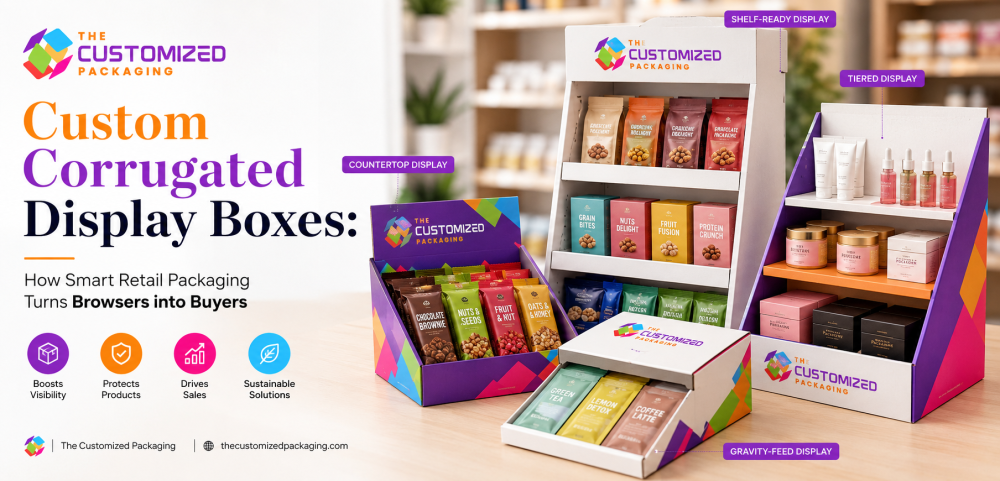
Custom Corrugated Display Boxes: How Smart Retail Packaging Turns Browsers into Buyers
Retail packaging has only a few seconds to attract attention, communicate value, and encourage a customer to move closer to the product. In a crowded store, customers may pass dozens of similar items before deciding which one deserves consideration. Products that remain hidden inside plain cartons, loosely arranged on shelves, or poorly presented at checkout counters can easily disappear into the surrounding retail environment.
Custom corrugated display boxes help businesses turn ordinary retail space into a structured selling opportunity. These boxes combine product organization, shipping protection, brand communication, and retail presentation within one practical packaging system.
A corrugated display box may sit on a checkout counter, retail shelf, end cap, floor area, promotional table, pharmacy counter, café register, trade-show booth, salon reception desk, grocery aisle, warehouse pickup area, or ecommerce unboxing station. Depending on the design, it can hold snack bars, sachets, cosmetics, skincare products, candy, coffee pods, tea packets, electronics accessories, healthcare items, stationery, toys, hardware components, promotional samples, and many other small or medium-sized products.
Custom printed corrugated display boxes with logo can communicate the brand name, product category, primary benefit, flavor, formula, price message, promotional offer, QR code, social-media handle, ingredients, instructions, barcode, sustainability information, and ordering details.
The most effective display boxes do not simply hold products. They guide customer attention. They make the product easier to identify, compare, reach, and understand. This can reduce hesitation and help turn casual browsers into active buyers.
At The Customized Packaging, we manufacture custom corrugated display boxes, countertop displays, shelf-ready packaging, point-of-sale displays, gravity-feed boxes, dispenser packaging, retail-ready cartons, floor displays, printed display boxes with logo, custom inserts, wholesale corrugated display boxes, and bulk retail packaging for businesses throughout the USA.
This complete guide explains corrugated display-box styles, materials, flute profiles, structural design, printing, branding, retail placement, product organization, inserts, sustainability, pricing, wholesale ordering, supplier selection, sampling, and online purchasing.
What Are Custom Corrugated Display Boxes?
Packaging Designed to Protect Products and Present Them for Sale
A corrugated display box is a structured packaging unit manufactured from fluted board and designed to present one or more products in a customer-facing environment.
The box may arrive at the retailer already assembled, be supplied flat for later setup, or travel as a closed shipping carton that converts into a display after a perforated panel is removed.
The products remain organized within the box while the visible panels communicate the brand and product message.
Corrugated display packaging can serve several functions at the same time. It may protect products during transportation, keep them arranged during storage, simplify retail stocking, create a branded shelf presence, and provide customers with direct access.
A successful display box should remain stable when full, partially empty, and nearly depleted.
The product should not fall forward, disappear behind the front panel, become difficult to remove, or cause the structure to tip as inventory changes.
The display must therefore be designed around the actual product dimensions, weight, quantity, orientation, retail position, and customer interaction.
Why Smart Retail Packaging Influences Buying Decisions
Customers Often Judge the Product Before Reading the Details
Retail decisions frequently begin with visual impressions.
Customers notice colors, shapes, product arrangement, packaging quality, and brand consistency before they read detailed product information.
A well-designed display can make a group of small products appear more organized, valuable, and trustworthy.
A plain carton may suggest storage. A custom printed display suggests that the products are intentionally presented for purchase.
This distinction matters in crowded retail environments.
A branded display can separate one product family from competing items, helping customers understand that the products belong together.
The display can also reduce decision-making effort. Clear flavor labels, formula sections, product benefits, pricing areas, and organized compartments make products easier to compare.
When customers quickly understand what is available, they are more likely to consider purchasing.
How Corrugated Display Boxes Turn Browsers into Buyers
Visibility, Organization, and Access Work Together
A display box supports sales when it solves several retail problems at once.
First, it raises product visibility. A header panel, printed front wall, branded side panel, or elevated tray can move the product into the customer’s line of sight.
Second, it improves organization. Dividers, compartments, ramps, and tiered sections keep products facing forward and prevent them from looking scattered.
Third, it improves access. Open fronts and product cutouts allow customers to remove one item without disturbing the complete display.
Fourth, it communicates value. Printed graphics explain the product and reinforce the brand.
Fifth, it supports retail operations. Staff can restock the display, monitor inventory, and move the packaging more efficiently.
These advantages help the packaging support both the customer experience and the retailer’s workflow.
Main Benefits of Custom Corrugated Display Packaging
One Structure Can Support Shipping, Selling, and Branding
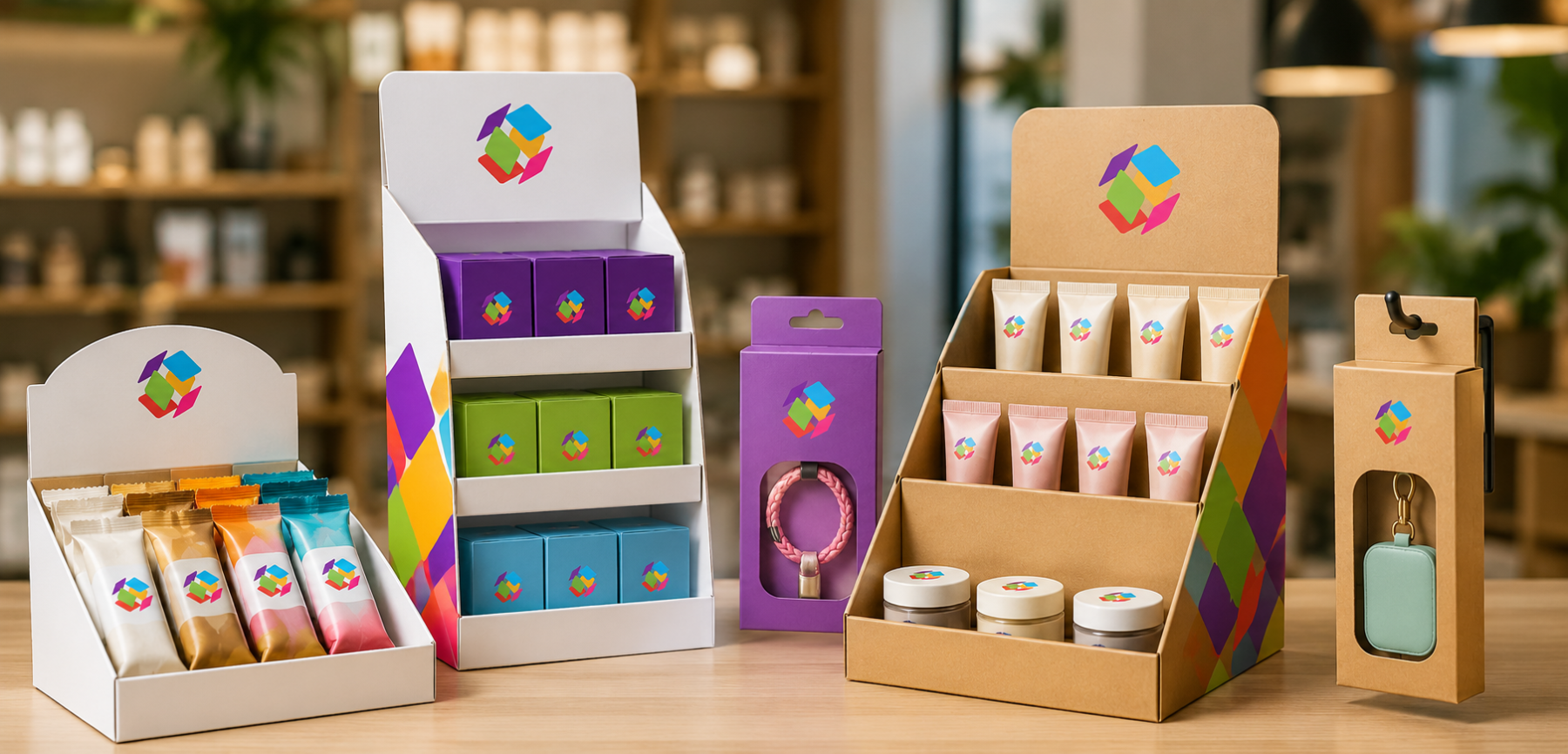
Businesses often use separate cartons for transportation, trays for shelf placement, and signs for promotion.
A well-designed custom corrugated retail display box can combine these functions.
The package may ship products securely and then convert into a countertop, shelf, or floor display.
This can reduce product handling and create more consistent presentation across several stores.
Custom sizing also helps prevent products from leaning, sliding, or becoming hidden.
Printed panels remain visible after individual products are removed, allowing the display to continue promoting the brand throughout the sales period.
Wholesale manufacturing can help businesses maintain the same dimensions, materials, opening style, print colors, logo placement, and product arrangement across multiple locations.
Popular Types of Custom Corrugated Display Boxes
The Best Style Depends on the Product and Retail Location
Corrugated display packaging is available in several structures.
The correct style depends on where the box will be placed, how customers will access the products, how the packaging will be transported, and how much space is available.
A compact countertop display may work well near a register, while a floor display can support larger products and higher inventory quantities.
Shelf-ready boxes can reduce stocking time, and gravity-feed displays can keep products moving toward the front.
The structural design should begin with the product and retail environment rather than with appearance alone.
Corrugated Display Box Style Comparison
| Display-box style | How it presents products | Best suited for | Main structural consideration |
|---|---|---|---|
| Countertop display box | Holds products in an open tray or divided compartments | Snacks, cosmetics, sachets, accessories, samples | Base must remain stable as products are removed |
| Shelf-ready display box | Converts from a closed shipping carton into an open shelf tray | Grocery, pharmacy, food, beauty, and consumer products | Tear-away panel must remain secure during transit |
| Gravity-feed display box | Moves products toward a lower front opening | Snack bars, packets, pods, small cartons | Product friction and ramp angle must be tested |
| Tiered display box | Presents products at several heights | Cosmetics, small boxes, tubes, and accessories | Rear products must remain visible and accessible |
| Floor display box | Creates a larger freestanding retail presentation | Seasonal items, promotions, larger products, bulk goods | Base, height, and load-bearing capacity are critical |
| PDQ display box | Provides quick product setup at the point of sale | High-volume retail and promotional campaigns | Structure should be easy for store staff to open |
| Sidekick or power-wing display | Hangs from a shelf, end cap, or display fixture | Packets, accessories, candy, healthcare products | Hanging section requires reinforcement |
| Dump-bin display | Holds loose or individually packed products in an open bin | Toys, snacks, promotional products, clearance items | Walls must support product pressure |
| Peg-hook display box | Supports products hanging from hooks or rails | Tools, cables, accessories, hardware, carded items | Back panel and hook areas require strength |
| Custom compartment display | Separates products by flavor, formula, color, or size | Tea, cosmetics, snacks, samples, accessories | Dividers must fit products accurately |
| Window display box | Uses a transparent panel to show enclosed products | Cosmetics, gifts, food products, premium merchandise | Window size should not weaken the structure |
| Shipping-and-display carton | Protects products in transit and becomes the retail display | Multi-location retail programs and wholesale distribution | Closed and open performance must both be tested |
A physical sample helps confirm whether the selected style fits the intended shelf, counter, or floor area.
Countertop Corrugated Display Boxes
Compact Displays Can Support Impulse Purchases
Countertop displays are positioned near registers, reception areas, café counters, pharmacy desks, salon checkouts, hotel lobbies, trade-show tables, and service areas.
These locations are valuable because customers are already preparing to make a purchase or interact with staff.
A custom corrugated countertop display box can organize snack bars, cosmetic samples, tea sachets, gift cards, batteries, small electronics, promotional products, and accessories within a limited footprint.
The display may include a raised header panel for branding and product benefits.
The front wall should remain low enough to show the products but high enough to keep them contained.
Dividers can separate flavors, formulas, colors, or sizes.
The display should not block checkout equipment, customer movement, receipts, bags, or staff work areas.
Shelf-Ready Corrugated Display Boxes
Retailers Can Move Products from Shipping Case to Shelf More Quickly
Shelf-ready packaging is designed to reduce retail handling.
The carton arrives with products already arranged inside.
Retail employees remove a perforated front, top, or side section and place the remaining tray directly on the shelf.
This can reduce the need to unpack and arrange every product separately.
Custom shelf-ready corrugated display boxes are commonly used for snacks, beverages, health products, cosmetics, pet supplies, household products, pouches, packets, and small retail cartons.
The tear-away section should remove cleanly without damaging the visible display.
The remaining tray must retain the products and continue showing the logo, product name, and important information.
The box dimensions should match the shelf depth, width, and height.
Corrugated Display Boxes for Snacks and Food Products
Organized Displays Can Support Quick Selection
Snack bars, protein bars, candy, cookies, nuts, dried fruit, tea sachets, coffee packets, condiment pouches, and individually wrapped food products can be presented inside corrugated display packaging.
Gravity-feed systems can work for uniform bars.
Divided countertop boxes can separate flavors.
Shelf-ready cartons can reduce grocery stocking time.
Printed displays can communicate flavor, ingredients, dietary claims, product benefits, quantity, barcode, and promotional offers.
Businesses should confirm that the board, inks, coatings, adhesives, inserts, and product-contact components match the intended food-packaging application.
Individually wrapped products normally remain separated from the corrugated display, but the complete packaging specification should still be reviewed.
Corrugated Display Boxes for Cosmetics and Beauty Products
Premium Presentation Can Support Product Discovery
Cosmetics depend heavily on appearance and brand positioning.
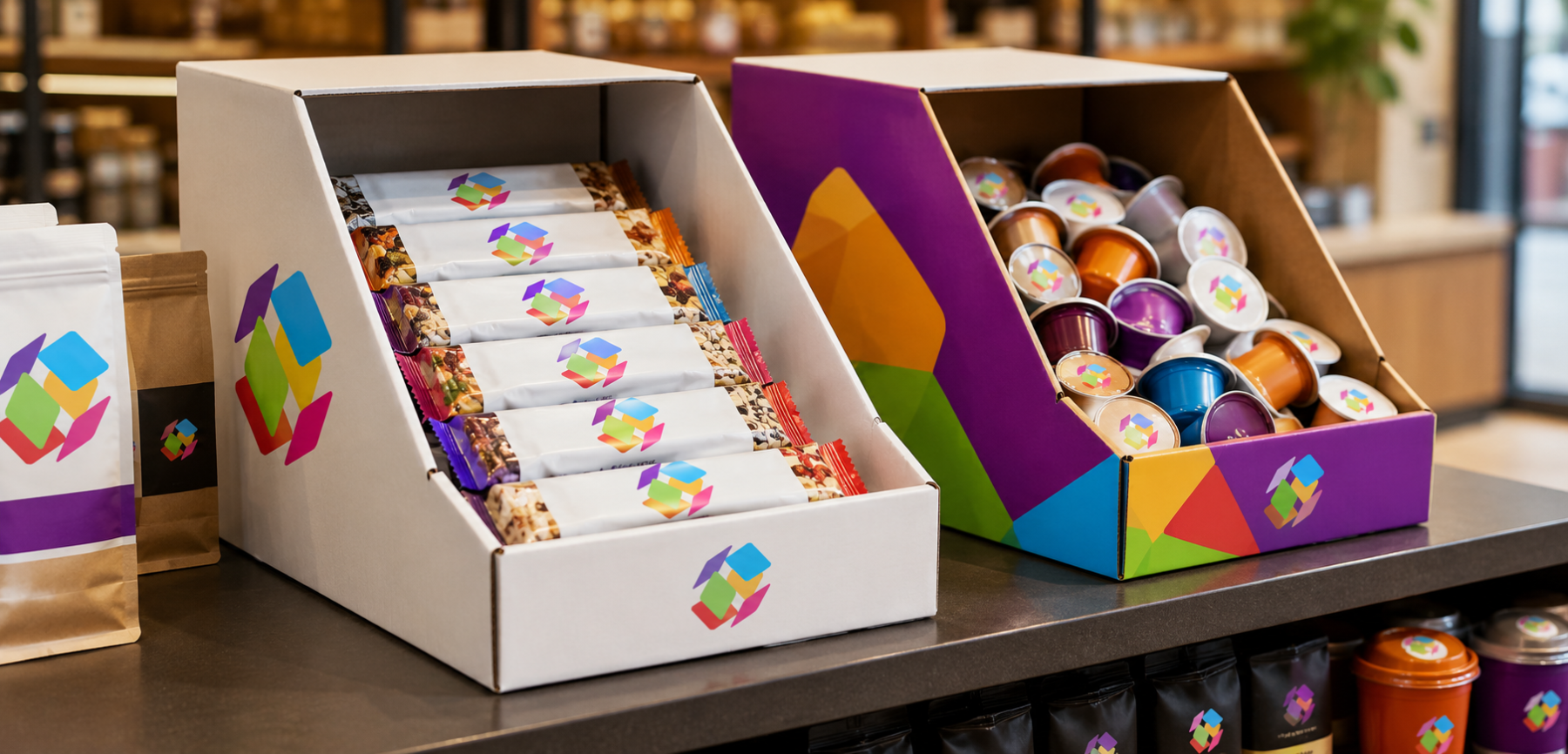
Skincare sachets, face masks, lip products, serum bottles, small cartons, beauty tools, lashes, samples, and travel-size products can be arranged inside custom cosmetic display boxes.
White corrugated board, E flute, litho-laminated graphics, soft-touch finishes, foil, spot UV, and detailed artwork can create a premium retail appearance.
Tiered inserts can raise products at different heights.
Dividers can organize shades, formulas, fragrances, or skin concerns.
A tall header can explain the product benefit or display model photography.
The product should remain easy to remove without damaging its individual packaging.
Corrugated Displays for Healthcare and Pharmacy Products
Clear Identification Supports Customer and Staff Use
Pharmacies, clinics, healthcare retailers, dental offices, and medical suppliers may use displays for masks, wipes, test products, small healthcare items, personal-care products, and individually packed supplies.
The packaging may need to display product sizes, quantities, warnings, usage information, barcodes, and restocking codes.
White corrugated material can create a clean appearance.
Color coding can separate product sizes or categories.
The business remains responsible for confirming the labeling and packaging requirements that apply to its specific healthcare products.
A standard retail display should not be assumed suitable for every regulated or sterile application.
Corrugated Display Boxes for Electronics Accessories
Small Products Benefit from Clear Product Organization
Cables, chargers, adapters, batteries, memory cards, headphones, mobile accessories, and small electronic products can become difficult to browse when they are mixed together.
Custom compartments, peg hooks, dividers, and tiered displays can organize products by compatibility, model, color, or type.
The header can communicate technical features.
Barcodes and product codes should remain accessible.
Higher-value products may require staff-controlled placement or security features.
The display must support the packed weight, especially when holding batteries, adapters, or dense electronic components.
Corrugated Display Packaging for Hardware and Industrial Products
Stronger Materials Can Support Heavy Small Items
Fasteners, screws, connectors, blades, fittings, cable ties, small tools, automotive parts, and workshop supplies may be displayed or dispensed from corrugated structures.
Although each component may be small, the total packed weight can be significant.
B flute, C flute, reinforced board, or double-wall construction may be required.
The base should remain flat and stable.
Front walls and dividers should resist pressure from the contents.
Industrial displays may use simple one-color printing for part numbers, product sizes, reorder codes, and branding.
Corrugated Displays for Toys and Promotional Products
Colorful Packaging Can Increase Product Excitement
Small toys, collectibles, game accessories, seasonal items, promotional gifts, and novelty products can benefit from brightly printed corrugated displays.
Dump bins, countertop trays, tiered units, and floor-standing displays can create dedicated product areas.
Custom-shaped headers and openings can reinforce a theme.
The display should remain safe, stable, and easy for customers to browse.
Products aimed at children may require additional review of materials, inks, structural edges, labeling, and applicable market requirements.
How Corrugated Material Supports Retail Display Performance
Fluted Construction Adds Rigidity Without Excessive Weight
Corrugated board includes one or more fluted paper layers between flat liners.
The fluted structure creates air columns that improve rigidity, compression resistance, and cushioning.
This makes corrugated material suitable for display boxes that must survive transportation and remain presentable at retail.
The material can support raised headers, shelves, trays, dividers, openings, and larger structures.
Performance depends on the flute profile, liner grade, recycled content, moisture exposure, print surface, box dimensions, and structural design.
The correct material should be selected according to the packed weight and retail use rather than appearance alone.
E-Flute Corrugated Display Boxes
Fine Fluting Supports Retail Printing and Accurate Folding
E flute is widely used for countertop displays, shelf-ready packaging, cosmetic boxes, food displays, and premium retail packaging.
Its relatively thin profile provides rigidity while maintaining a cleaner printing surface than thicker shipping flutes.
E flute supports precise die-cut openings, folds, headers, and small structural details.
It can work well for snacks, sachets, cosmetics, electronics accessories, pharmacy items, and small retail products.
Large floor displays or heavy merchandise may require a stronger flute or reinforced design.
F-Flute Corrugated Displays
Thin Material Supports Compact Retail Structures
F flute is thinner than E flute and can create a refined surface for detailed printing.
It may be used for small countertop displays, cosmetics, promotional packaging, and compact retail units.
The thin profile can help maximize internal space.
However, it may not provide sufficient strength for large, tall, or heavy displays.
A physical sample should confirm whether the material remains stable during customer use.
B-Flute Corrugated Display Boxes
Stronger Board Supports Heavier Products and Shelf-Ready Cases
B flute offers greater puncture resistance and a thicker profile than E flute.
It can support hardware products, heavier food items, larger shelf-ready cases, warehouse displays, and shipping-and-display cartons.
B flute may also provide stronger side walls for dump bins and floor displays.
The print surface may be less refined than a fine microflute, but high-quality branding remains possible through flexographic printing, white-top liner, digital printing, or litho lamination.
Digital Printing for Short Runs and Multiple Designs
Low-MOQ Production Can Support Product Testing
Digital printing can reproduce full-color graphics without conventional printing plates.
It is useful for prototypes, product launches, seasonal campaigns, regional programs, several product variations, and low-minimum orders.
A business can use one structural design while printing different artwork for multiple flavors or formulas.
This allows brands to test the display before committing to a large wholesale quantity.
The unit price may be higher than flexography for very large runs, but the lower setup requirements can reduce initial inventory risk.
Litho-Laminated Corrugated Display Boxes
Premium Graphics Can Strengthen Retail Presence
Lithographic printing produces high-resolution artwork on a separate sheet that is laminated to the corrugated board.
This process supports photographs, gradients, detailed illustrations, small text, and precise colors.
Litho-laminated display boxes are commonly used for cosmetics, electronics, premium food products, healthcare items, toys, and national retail campaigns.
The process involves additional material and production stages.
It may require a higher quantity and cost more than direct flexographic printing.
The premium print quality should support the product’s price position and retail environment.
Premium Finishes for Display Packaging
Selected Details Can Increase Perceived Value
Corrugated displays may include foil stamping, embossing, debossing, spot UV, matte lamination, gloss lamination, soft-touch finishes, and specialty coatings.
Foil can highlight the logo or product name.
Spot UV can create contrast between glossy and matte areas.
Embossing adds raised texture, while debossing creates a recessed effect.
Premium finishing can support cosmetics, gift products, luxury food items, and limited-edition retail campaigns.
These options add production processes, tooling, cost, and lead time.
They may also affect recyclability and material separation.
Finishes should be applied selectively rather than across every panel.
Header Panels Increase Vertical Visibility
Branding Can Rise Above the Products
A raised header uses vertical retail space without significantly increasing the base footprint.
It can display the logo, product name, main benefit, campaign message, or promotional offer.
A header may help the display remain visible behind nearby products or checkout equipment.
The header should remain proportionate to the base.
A tall lightweight header can make a narrow display unstable.
Corrugated support panels, folded braces, or double layers may be required.
The message should remain brief enough to understand from a distance.
Product Openings and Front-Wall Design
Customers Should See and Reach the Merchandise Easily
The front opening should reveal enough of the product to support recognition.
A wall that is too high may hide the merchandise.
A wall that is too low may allow products to fall forward.
Curved openings can soften the design.
Rectangular openings provide broad visibility.
Finger notches can help customers grip small cartons or flat sachets.
The opening should not create sharp edges that damage wrappers.
The structural frame around the cutout must remain wide enough to maintain strength.
Custom Inserts and Dividers
Internal Organization Improves Product Presentation
Corrugated and paperboard inserts can hold products upright, create tiers, separate flavors, prevent movement, and improve visibility.
Dividers may create several lanes within one display.
Raised platforms can keep products near the top.
Cutout inserts can hold tubes, bottles, cartons, or accessories.
The insert should control the product without making restocking difficult.
It should not use unnecessary material or create excessive assembly steps.
The display, insert, and product should be tested together before wholesale production.
Tiered Inserts for Product Visibility
Rear Products Can Remain Visible Above the Front Row
Tiered inserts are useful when several product rows must be presented within one display.
Cosmetics, skincare, electronic accessories, small cartons, and promotional products can benefit from elevated rear sections.
The height difference should reveal product labels without making the back row difficult to access.
Each tier must support the product weight.
The display should remain stable even when one side becomes empty before the other.
A printed or contrasting insert can strengthen the visual presentation.
Gravity-Feed Ramps and Channels
Internal Angles Control Product Movement
Gravity-feed displays may use folded ramps, rails, or separate inserts.
The ramp angle influences how products move.
Smooth wrappers may slide quickly, while textured pouches may require a steeper angle.
Side guides prevent products from rotating.
The opening should retain the next unit.
A prototype should be filled and emptied repeatedly to confirm product flow.
Retail humidity, storage time, and wrapper changes may affect performance.
Product Measurement for Custom Display Boxes
Accurate Dimensions Improve Fit and Retail Efficiency
The manufacturer needs the individual product length, width, thickness, weight, and package shape.
Flexible products should be measured in their filled condition.
The total quantity per display should be confirmed.
The available shelf, counter, or floor dimensions are equally important.
A box that fits the products but does not fit the retail location will not perform correctly.
The specification should also include loading direction, customer access, stacking, shipping orientation, and restocking method.
Display Packaging Measurement Guide
| Measurement or requirement | Information to provide | Why it matters |
|---|---|---|
| Product length, width, and thickness | Finished packaged dimensions | Determines the internal display size |
| Individual product weight | Weight of one retail unit | Helps select board grade and insert strength |
| Quantity per display | Total units and product variations | Determines capacity and compartment layout |
| Packed display weight | Products, inserts, and box combined | Influences corrugated flute and base design |
| Product orientation | Upright, horizontal, stacked, hanging, or angled | Defines the display structure |
| Retail location | Counter, shelf, end cap, floor, sidekick, or trade show | Determines size and customer access |
| Available footprint | Maximum width, depth, and height | Prevents placement problems |
| Viewing direction | Front, side, above, or multiple angles | Guides branding and opening placement |
| Shipping method | Parcel, pallet, local delivery, or retail distribution | Influences protection and closure |
| Restocking method | Front, top, back, or replacement display | Affects staff efficiency |
| Printing requirements | Logo, colors, photography, QR code, barcode, and text | Helps select the print process |
| Order quantity | Prototype, short run, or wholesale volume | Influences production method and pricing |
| Delivery destination | City, state, and ZIP code | Supports freight calculation |
| Storage conditions | Dry, humid, refrigerated, or warehouse environment | Helps evaluate material performance |
A physical sample should be approved before manufacturing a large quantity.
Retail Placement and Customer Line of Sight
Location Can Determine Whether the Display Attracts Attention
A strong display can underperform when placed in the wrong location.
Counter displays should remain visible without interfering with checkout activity.
Shelf-ready displays should fit the shelf depth and face customers directly.
Floor displays should not obstruct aisles or create instability.
Sidekick displays should remain within the approved fixture area.
The display should be positioned near related products when possible.
Snack displays may perform well near beverages.
Skincare samples may work near beauty counters.
Charging cables can be placed near electronics service areas.
Product relevance and placement can strengthen the selling effect of the packaging.
Using Corrugated Displays for Cross-Selling
Related Products Can Encourage Additional Purchases
Custom display boxes can present products near complementary items.
Tea sachets can appear near mugs or kettles.
Snack bars can be placed near coffee or fitness products.
Cosmetic samples can appear beside full-size skincare products.
Batteries can be displayed near electronic devices.
Small hardware items can be placed beside related tools.
The display artwork can reinforce the connection through product imagery, benefits, or a short call to action.
Cross-selling works best when the relationship between the products is immediately understandable.
Impulse Purchases and Checkout Displays
Small, Accessible Products Can Create Additional Revenue
Checkout areas are valuable because customers are already in a purchasing mindset.
Affordable, useful, attractive, or convenient products can become impulse purchases when they are clearly presented.
A custom display groups the items into one branded sales unit.
The header can communicate the main benefit.
The front opening makes the product easy to reach.
A promotional price or QR code can encourage immediate action.
The display should remain compact and should not create clutter around the register.
QR Codes Extend the Retail Experience
Printed Packaging Can Connect Customers to Digital Content
A QR code can direct customers to product videos, instructions, reviews, subscription programs, loyalty accounts, ingredient details, discount offers, social-media pages, or online ordering.
The code should appear on a flat panel with sufficient contrast and blank space.
It should not cross a fold, perforation, cutout, or heavily textured area.
The destination should remain active while the display is in circulation.
The code should be tested before production.
A short explanation can tell customers what they will receive after scanning.
Barcodes and Retail Information
Operational Details Should Remain Easy to Scan
Retail displays may require UPCs, SKUs, case quantities, lot codes, product descriptions, prices, and inventory labels.
Barcodes should be placed on flat surfaces.
The corrugated texture and printing process can influence scanning performance.
A printed sample should be tested with the expected scanner.
Important retail information should remain visible after removable shipping panels are discarded.
Retailers may have specific labeling, pallet, case, and shelf-ready requirements.
Wholesale Custom Corrugated Display Boxes
Bulk Production Can Improve Consistency and Unit Pricing
Businesses using display packaging regularly may benefit from wholesale custom corrugated display boxes.
Larger production quantities can spread structural design, printing plates, cutting dies, color setup, and machine preparation across more units.
Wholesale orders can help maintain consistent dimensions, materials, graphics, openings, inserts, and assembly.
Retail chains, food brands, cosmetic companies, healthcare suppliers, electronics businesses, manufacturers, wholesalers, and ecommerce brands may use bulk display packaging.
Before ordering, businesses should confirm product dimensions, retail placement, artwork, monthly usage, storage space, and expected design changes.
A large order may reduce the unit price but increase total investment and inventory risk.
Minimum Order Quantities for Display Boxes
Structure and Printing Method Influence the MOQ
The minimum order quantity depends on the display dimensions, corrugated material, printing process, tooling, finishing, inserts, and supplier production requirements.
Digital printing can support lower quantities for product launches, test markets, seasonal campaigns, and short retail programs.
Flexographic printing often becomes more economical at medium and larger quantities.
Litho-laminated graphics, foil, embossing, spot UV, custom shelves, and multi-part inserts may require higher quantities.
Businesses searching for custom corrugated display boxes no minimum may need to compare prototypes, digitally printed short runs, stock displays with custom labels, and fully customized manufacturing.
A lower MOQ usually results in a higher unit price.
What Influences the Cost of Corrugated Display Boxes?
Dimensions, Structure, Printing, and Quantity Determine Pricing
The cost of custom corrugated display boxes depends on material usage, flute profile, board strength, style, printing, inserts, tooling, finishing, order quantity, assembly, packing, and freight.
A small one-color kraft countertop display generally costs less than a full-color floor display with several shelves.
A simple open tray may cost less than a gravity-feed or tiered structure.
White corrugated material and litho-laminated printing may cost more than natural kraft with flexographic printing.
Custom dividers, ramps, hooks, windows, shelves, foil, lamination, and coatings add production stages.
Businesses should compare complete delivered quotations rather than relying on a general starting price.
Corrugated Display Box Pricing and Ordering Factors
| Pricing factor | How it affects the quotation | Cost-planning direction |
|---|---|---|
| Display dimensions | Larger structures use more corrugated board | Match the display to the product and retail space |
| Flute profile | E, F, B, C, and double-wall materials have different costs | Select according to weight and display requirements |
| Board grade | Stronger liners and coatings may cost more | Avoid over-specification without reducing performance |
| Display style | Floor, tiered, gravity-feed, and convertible boxes require more development | Use the simplest structure that achieves the sales goal |
| Printing method | Digital, flexographic, and lithographic costs vary | Match printing to artwork and quantity |
| Number of colors | Additional flexographic colors may require more plates | Simplify artwork when controlling cost |
| Print coverage | Full exterior coverage uses more ink and production resources | Keep hidden areas simple |
| Custom insert | Adds material, tooling, and assembly | Use inserts where they improve organization or visibility |
| Shelves and tiers | Add structural components and load requirements | Confirm the number of levels genuinely needed |
| Gravity-feed ramp | Requires product-flow development and testing | Use when automatic front-facing inventory adds value |
| Hooks or hanging hardware | Add components and reinforcement | Match hardware to product weight |
| Premium finishes | Foil, lamination, embossing, and spot UV add stages | Apply finishes to selected brand areas |
| Tooling | Custom dies and plates may require initial charges | Ask whether tooling can be reused |
| Order quantity | Higher volumes may reduce the unit price | Balance savings with storage and design changes |
| Assembly and packing | Pre-assembled displays cost more to ship | Compare flat-packed and assembled options |
| Freight | Large displays occupy significant shipping volume | Request delivered pricing to the destination |
An accurate quotation requires the complete structural and printed specification.
How to Reduce Display Packaging Costs
Simpler Structures Can Still Produce Strong Retail Results
Businesses can reduce costs through accurate sizing, efficient material use, and focused artwork.
A simple rectangular header may cost less than a complex custom shape.
One-color flexographic printing may provide enough branding for kraft displays.
A common structure may support several product variations through different labels or digital artwork.
Flat-packed displays can reduce shipping volume.
Reusable cutting dies and printing plates may lower repeat-order setup costs.
A well-designed shipping-and-display carton can replace separate transport and retail packaging.
Cost reduction should not weaken the display below the level required for safe retail use.
Collapsed displays, hidden products, damaged merchandise, and difficult setup can cost more than selecting the correct material and structure.
Comparing Flat-Packed and Pre-Assembled Displays
Freight and Labor Should Be Evaluated Together
Flat-packed displays generally occupy less shipping and storage space.
Retail employees or fulfillment teams assemble them before use.
This can reduce freight but increase labor.
Pre-assembled displays save setup time and may arrive already loaded with products.
However, they occupy more transportation volume and may require additional protection.
The best choice depends on display complexity, retail labor, distribution method, and order volume.
A sample assembly test can help businesses estimate the time required for each unit.
Storage Requirements for Wholesale Display Boxes
Corrugated Packaging Should Remain Clean, Dry, and Organized
Flat displays should be stored away from water, grease, strong odors, direct sunlight, and excessive humidity.
Stacks should remain protected from crushing.
Different display styles, artwork versions, and product sizes should be labeled clearly.
Seasonal packaging should be ordered carefully because leftover inventory may become unusable after the campaign.
Businesses should calculate realistic consumption before placing a large wholesale order.
Supplier-held inventory or staged deliveries may be considered when storage space is limited.
How to Choose a Corrugated Display Box Manufacturer
Structural Engineering and Retail Experience Matter
A professional supplier should understand product weight, retail placement, customer access, transportation, printing, inserts, assembly, and wholesale manufacturing.
The manufacturer should ask about the product dimensions, quantity per display, packed weight, available footprint, sales environment, artwork, and delivery requirements.
A supplier focusing only on graphics may overlook stability and product access.
A supplier focusing only on shipping strength may create a display that looks too industrial for retail.
Businesses should request a dieline, digital proof, material specification, physical prototype, printing details, MOQ, production time, tooling charges, and delivered pricing.
Questions to Ask Before Ordering Custom Display Boxes
Complete Answers Make Supplier Comparison Easier
Businesses should ask which display style is best for the product and retail location.
They should confirm the internal and external dimensions, corrugated flute, board grade, packed-weight capacity, printing process, and insert design.
The supplier should explain how the display will be shipped, assembled, restocked, and disposed of.
Businesses should ask whether cutting dies, printing plates, prototypes, packing, and freight are included.
They should confirm whether the tooling can be reused.
For retail-ready packaging, the tear-away process should be tested.
For gravity-feed packaging, the supplier should test actual product movement.
For floor displays, load-bearing and stability should be reviewed.
Samples and Prototypes
Physical Approval Reduces Wholesale Production Risk
A blank structural sample can confirm dimensions, assembly, product fit, and retail placement.
A printed sample can confirm colors, logo size, typography, barcode scanning, and surface quality.
Complex floor displays, multi-tier structures, gravity-feed systems, shelf-ready cartons, and custom inserts should be tested before bulk manufacturing.
The display should be assembled by the employees or retail staff expected to use it.
The actual products should be loaded.
The box should be transported, placed, restocked, and partially emptied.
Any required change should be completed before the production order is approved.
Buy Custom Corrugated Display Boxes Online
Complete Specifications Support Accurate Pricing
Businesses ready to buy custom corrugated display boxes online should provide the product dimensions, weight, quantity per display, retail location, available footprint, display style, material preference, printing artwork, insert requirements, order quantity, and delivery ZIP code.
The supplier can then recommend a corrugated flute, structure, printing process, and packing method.
A dieline should be created before final artwork approval.
A physical sample should be tested before wholesale production.
The final quotation should identify the dimensions, material, printing, inserts, tooling, finishing, quantity, production time, packing, and freight.
Businesses searching to order corrugated display boxes online should compare identical specifications rather than choosing only according to advertised pricing.
Custom Corrugated Display Boxes Across the USA
Retail Display Packaging for Businesses Nationwide
At The Customized Packaging, we provide custom corrugated display boxes for snack brands, food companies, cosmetic businesses, healthcare suppliers, pharmacies, electronics companies, hardware brands, toy companies, retailers, manufacturers, ecommerce businesses, wholesalers, distributors, and promotional programs throughout the USA.
We manufacture countertop displays, shelf-ready packaging, gravity-feed boxes, tiered displays, PDQ packaging, floor displays, dump bins, peg-hook displays, sidekick units, custom inserts, kraft displays, white corrugated boxes, litho-laminated packaging, and printed retail displays with logo.
Businesses searching for custom corrugated display boxes near me, corrugated display box manufacturer USA, wholesale retail display boxes, custom point-of-sale display supplier, custom printed display boxes with logo, or order corrugated displays online can request packaging developed around their products and retail environment.
We support businesses throughout New York, New Jersey, California, Texas, Florida, Illinois, Pennsylvania, Ohio, Georgia, North Carolina, Washington, Massachusetts, Virginia, Michigan, Arizona, Tennessee, Indiana, Missouri, Maryland, Wisconsin, Colorado, Minnesota, Nevada, Oregon, Kentucky, Utah, and other locations across the United States.
Want to Estimate Your Corrugated Display Box Cost?
Try the Custom Box Packaging Cost Calculator
Businesses planning retail displays can use the Custom Box Packaging Cost Calculator to develop an initial estimate based on dimensions, style, material, printing, finishing, inserts, and quantity.
The calculator can help plan countertop display boxes, shelf-ready cartons, gravity-feed displays, tiered packaging, snack displays, cosmetic displays, PDQ boxes, floor displays, kraft corrugated packaging, white printed displays, and custom inserts.
The initial estimate may change according to the final board grade, flute profile, packed weight, display height, shelves, header, opening, printing coverage, inserts, tooling, premium finishes, order quantity, assembly, freight, and delivery destination.
After reviewing the estimate, businesses can request a detailed custom corrugated display box quote based on the complete product and retail specification.
Why Choose The Customized Packaging for Corrugated Display Boxes?
Retail Packaging Developed Around Product Visibility and Sales
At The Customized Packaging, we help businesses create custom corrugated display boxes that protect products, improve organization, simplify retail setup, increase product visibility, and strengthen branding.
We provide kraft corrugated board, white material, white-top liners, E flute, F flute, B flute, C flute, double-wall construction, digital printing, flexographic printing, litho-laminated graphics, countertop displays, shelf-ready packaging, gravity-feed ramps, tiered inserts, headers, dividers, floor displays, PDQ boxes, digital proofs, physical samples, and wholesale pricing.
Our retail packaging supports snacks, sachets, cosmetics, healthcare products, electronics accessories, hardware, stationery, toys, promotional products, and other consumer or industrial merchandise.
As a professional custom box manufacturer and retail packaging supplier, we develop each display around the product dimensions, packed weight, retail space, customer access, branding, transportation, order quantity, and delivery destination.
Businesses remain responsible for confirming that selected materials, inks, coatings, adhesives, inserts, hardware, labeling, environmental claims, and product-contact components meet the requirements applicable to their products and markets.
Final Thoughts
Smart Corrugated Displays Make Products Easier to Notice, Understand, and Buy
Custom corrugated display boxes can transform ordinary shelves, counters, and retail floor areas into organized branded selling spaces.
Countertop displays can support impulse purchases. Shelf-ready packaging can reduce retail labor. Gravity-feed boxes can keep products near the customer. Tiered structures improve visibility. Floor displays can create dedicated promotional zones. PDQ packaging can simplify store setup.
Kraft, white, recycled, E-flute, B-flute, and litho-laminated materials allow businesses to balance strength, print quality, appearance, and cost.
Custom printing turns the display into a marketing platform. Logos, brand colors, product benefits, QR codes, promotional messages, and clear typography can help customers understand the product quickly.
Inserts, dividers, shelves, ramps, and cutouts should solve practical retail problems. Every additional component should improve product access, organization, visibility, or structural performance.
Accurate product measurements, retail-space planning, physical sampling, transportation testing, and wholesale inventory planning are essential before production.
Whether you need countertop displays, shelf-ready boxes, gravity-feed packaging, tiered cosmetic displays, food-product displays, PDQ cartons, floor-standing units, wholesale corrugated display boxes, or custom printed retail packaging with logo, the right structure can help convert passive browsing into product engagement and purchasing.
At The Customized Packaging, we create corrugated display packaging that is built to protect, engineered to present, and designed to help businesses attract attention, influence buyers, and grow throughout the USA.
