

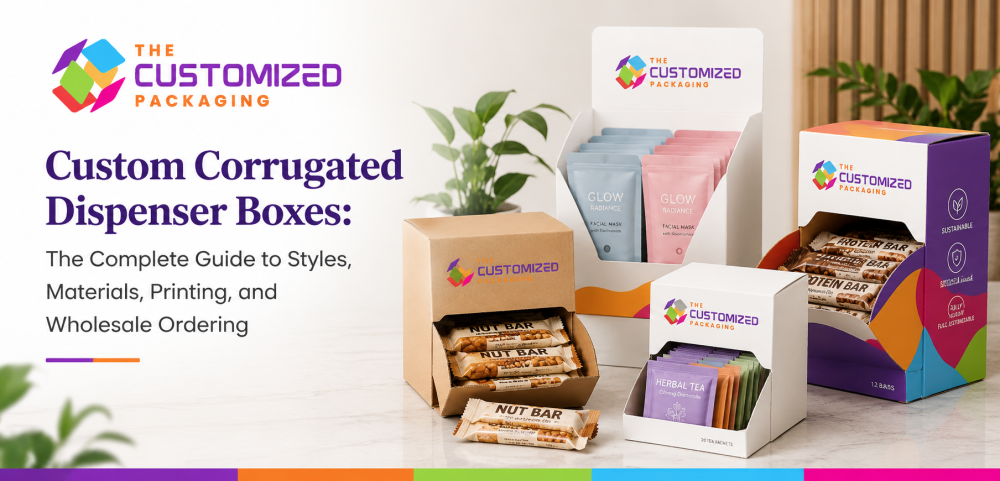
Custom Corrugated Dispenser Boxes: The Complete Guide to Styles, Materials, Printing, and Wholesale Ordering
Packaging should do more than hold a product. It should organize inventory, simplify access, support retail display, protect the contents, communicate the brand, and help customers interact with the product conveniently. Custom corrugated dispenser boxes are designed to perform all of these functions within one practical packaging structure.
A dispenser box usually includes an opening, tear-away panel, perforated section, front cutout, gravity-feed channel, or pull-out access point that allows products to be removed individually. The remaining items stay organized inside the carton while the box continues to function as a storage and display unit.
This combination makes corrugated dispenser packaging useful for retail stores, grocery aisles, pharmacies, hardware businesses, warehouses, offices, workshops, ecommerce fulfillment centers, subscription brands, cosmetic companies, food-service suppliers, automotive businesses, healthcare product companies, and industrial organizations.
Products commonly packed in dispenser boxes include sachets, packets, pouches, gloves, wipes, tissues, masks, food bars, coffee pods, tea bags, small hardware parts, screws, fasteners, cables, stationery, labels, cosmetics, medical supplies, promotional products, and other lightweight or medium-weight items that need to be removed one at a time.
Unlike standard folding cartons, custom corrugated dispenser boxes use fluted material that provides additional rigidity, cushioning, stacking support, and resistance to handling pressure. The corrugated structure can help protect products during storage, transportation, retail display, and repeated customer access.
The box can be manufactured around the product dimensions, weight, quantity, dispensing direction, shelf space, counter space, loading method, printing artwork, shipping conditions, and wholesale order quantity. This allows the packaging to serve the product rather than forcing the product into an oversized or poorly designed stock carton.
Different dispenser structures are available. Some boxes use a front tear-away panel that converts the shipping carton into a retail display. Others use a small bottom opening that allows products to move forward through gravity. Countertop dispenser boxes may include a header panel for branding, while shelf-ready cartons may be designed to open quickly without removing products individually.
The exterior panels provide space for the company logo, product name, instructions, barcode, QR code, ingredients, warnings, product quantity, contact details, promotional messages, and recycling guidance. Full-color printing can turn the carton into a visible retail marketing tool, while one-color printing can provide an economical solution for warehouses and industrial products.
At The Customized Packaging, we create custom corrugated dispenser boxes, printed retail dispenser cartons, gravity-feed boxes, countertop display dispensers, shelf-ready packaging, perforated shipping-and-display boxes, corrugated product organizers, custom inserts, branded packaging, wholesale corrugated boxes, and bulk printed packaging for businesses throughout the USA.
This complete guide explains dispenser box styles, corrugated materials, flute profiles, dimensions, perforations, openings, printing options, inserts, retail applications, sustainability considerations, wholesale ordering, supplier selection, pricing, and online purchasing.
What Are Custom Corrugated Dispenser Boxes?
Packaging That Stores, Displays, and Dispenses Products
A corrugated dispenser box is a structured carton that stores multiple product units and allows users to remove them through a controlled opening.
The opening may be visible when the box is delivered, or it may be created by removing a perforated section after the carton reaches the store, office, warehouse, or customer.
The dispenser function can be located at the front, bottom, side, or top of the carton. The correct position depends on the product shape, weight, orientation, and intended user experience.
For example, small pouches may slide forward through a lower front opening, while packets arranged vertically may be accessed through a large tear-away front panel. Gloves, tissues, wipes, and bags may be removed through a narrow oval or rectangular opening.
The box can function as primary packaging when the product is individually wrapped or as secondary packaging around several retail units.
A well-designed dispenser carton should keep the remaining products organized after one item is removed. It should not collapse, spill the contents, create sharp torn edges, or require excessive force to operate.
Why Businesses Use Corrugated Dispenser Packaging
One Box Can Perform Several Packaging Functions
Traditional packaging may require one carton for shipping, another tray for display, and separate storage containers for organization.
A properly designed corrugated dispenser box can combine these functions.
The carton may be packed at the production facility, shipped to a distributor or retailer, opened along a perforated line, and placed directly on a shelf or counter.
This reduces the need to transfer products into another display unit.
Retail employees can save time because the products remain inside the same carton. Warehouses can improve product access, offices can organize consumable supplies, and customers can remove individual units more easily.
The packaging can also support branding. Instead of hiding inside a plain shipping case, the dispenser carton can remain visible during the complete sales period.
Main Benefits of Custom Corrugated Dispenser Boxes
| Packaging benefit | How it supports the business | Suitable applications |
|---|---|---|
| Organized dispensing | Allows products to be removed individually while keeping the remaining units contained | Sachets, packets, gloves, wipes, labels, small parts |
| Shipping and display combination | Converts from a transport carton into a retail display | Grocery products, cosmetics, snacks, healthcare products |
| Improved product visibility | Printed panels and open fronts help customers identify the contents | Retail shelves, counters, trade shows |
| Reduced handling | Products do not need to be transferred into a separate display | High-volume retail and warehouse operations |
| Stronger protection | Corrugated fluting supports stacking and transportation | Heavy packets, industrial parts, subscription products |
| Custom sizing | Reduces product movement and unnecessary packaging space | Products with unusual dimensions or quantities |
| Brand communication | Provides printable space for logos, instructions, and promotional information | Consumer products and branded supplies |
| Inventory control | Makes remaining quantities easier to monitor | Offices, workshops, warehouses, clinics |
| Convenient access | Reduces the need to open and close the complete carton repeatedly | Frequently used supplies |
| Wholesale efficiency | Bulk production can improve unit pricing and consistency | National brands, distributors, retailers, manufacturers |
The value of the packaging depends on the structure being developed around the real product and dispensing process.
Common Styles of Corrugated Dispenser Boxes
The Opening and Loading Method Define the Structure
Dispenser packaging is available in several configurations. The correct style depends on how the products are loaded, transported, displayed, and removed.
Some structures remain closed during shipping and convert into displays later. Others are manufactured with a permanent access opening.
The box should provide enough access for convenient removal without allowing the remaining products to fall out.
The opening must also leave sufficient corrugated material around the edges to maintain strength.
Front-Opening Dispenser Boxes
Direct Access for Packets, Pouches, and Small Products
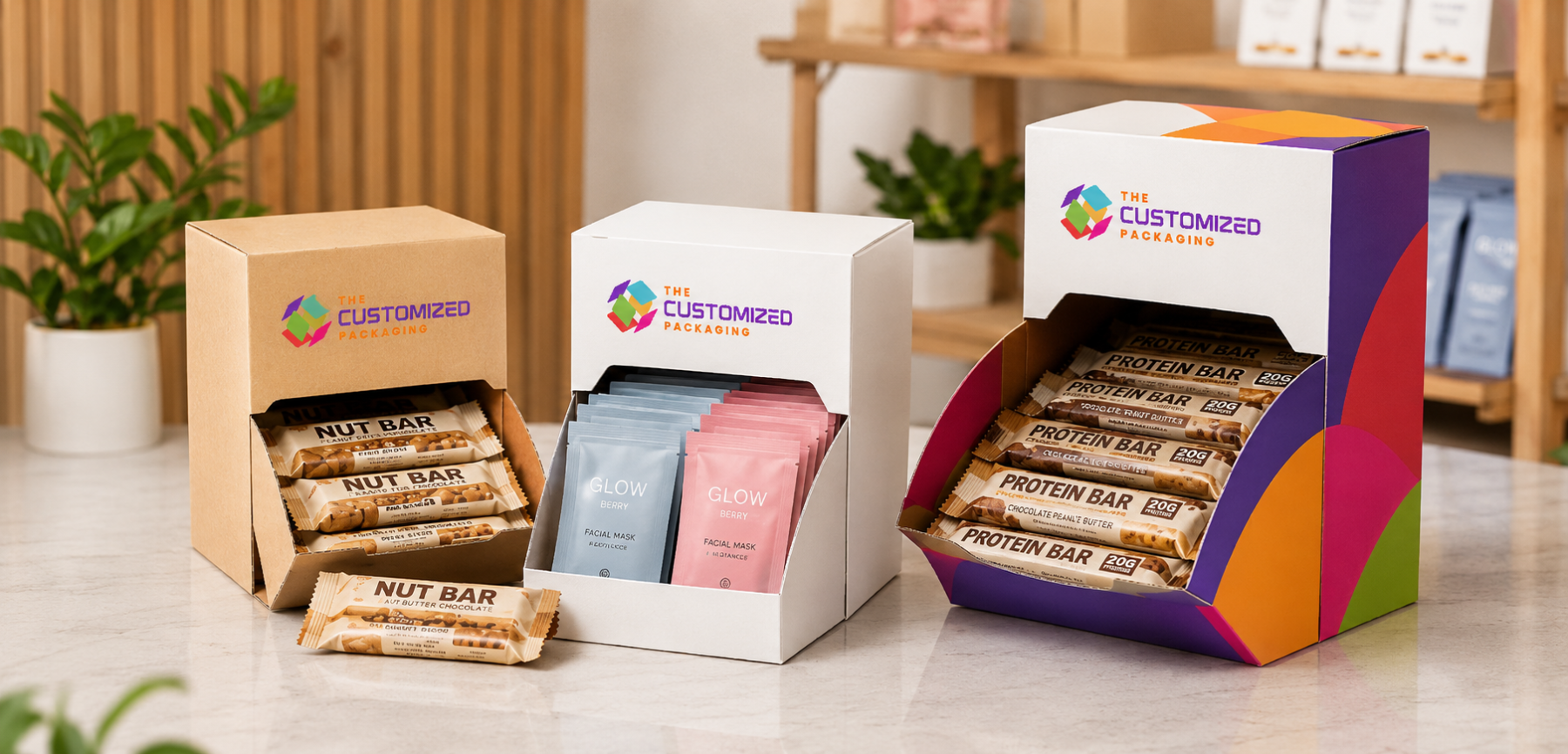
Front-opening dispenser boxes include a rectangular, curved, angled, or custom-shaped access area on the front panel.
The opening may be permanently die-cut or created by removing a perforated section.
This style works well for products arranged vertically or stacked in rows.
Customers and employees can see the product and pull out one unit without lifting the lid.
Custom front-opening corrugated dispenser boxes are commonly used for snack packets, medical supplies, cosmetics, promotional items, stationery, hardware parts, and individually wrapped products.
The bottom edge of the opening should be high enough to retain the remaining products.
A poorly positioned opening may allow packages to fall forward or become difficult to grip.
Wall-Mounted and Workplace Dispenser Boxes
Efficient Access to Frequently Used Supplies
Dispenser boxes can be designed for workstations, warehouses, clinics, manufacturing areas, laboratories, garages, and offices.
The carton may sit on a shelf, attach to a wall, fit inside a rack, or remain on a workbench.
Products may include gloves, protective covers, cleaning wipes, labels, bags, masks, fasteners, cable ties, and disposable supplies.
These boxes may use limited printing because operational performance is the main priority.
However, color coding, product identification, and usage instructions can improve workplace organization.
Dispenser Box Style Comparison
| Dispenser style | Dispensing method | Best suited for | Main structural concern |
|---|---|---|---|
| Front-opening box | Product is pulled through the front | Packets, sachets, pouches, small cartons | Opening must retain remaining items |
| Gravity-feed box | Products move downward toward a lower opening | Bars, pods, packets, lightweight units | Products must flow without becoming stuck |
| Countertop dispenser | Products are selected from an open display | Cosmetics, candy, samples, accessories | Base must remain stable |
| Shelf-ready box | Shipping panel is removed to expose products | Grocery, pharmacy, retail products | Tear-away section must remove cleanly |
| Top-opening dispenser | Products are pulled upward | Tissues, wipes, gloves, bags | Opening should support controlled dispensing |
| Side-opening dispenser | Products are removed horizontally | Warehouse and workstation supplies | Box must remain stable during side pulling |
| Drawer dispenser | Internal tray slides from outer sleeve | Premium sets, samples, accessories | Tray fit and movement must be accurate |
| Hanging dispenser | Box hangs while products are removed | Hardware, cables, accessories | Header and hook hole require reinforcement |
| Wall-mounted dispenser | Products are accessed from a fixed location | Gloves, labels, bags, workplace supplies | Mounting and packed weight must be considered |
| Custom-shaped dispenser | Opening follows product or branding requirements | Promotional and specialty retail packaging | Complex cutting can affect strength and cost |
Physical testing helps confirm whether the selected structure performs consistently.
Understanding Corrugated Material
Fluted Layers Create Strength and Cushioning
Corrugated board is made using one or more fluted paper layers positioned between flat liner sheets.
The fluted structure creates air columns that improve rigidity, cushioning, and resistance to pressure.
This construction is different from standard solid paperboard.
Corrugated material can provide better support for larger dispenser cartons, heavier products, warehouse supplies, retail-ready packaging, and shipping-and-display applications.
The performance of the material depends on the flute profile, paper grade, liner weight, recycled content, moisture exposure, box dimensions, grain direction, and structural design.
A thicker board is not always the best choice. The material should match the product weight, opening size, printing quality, shelf space, and shipping conditions.
Single-Wall Corrugated Board
A Practical Choice for Many Dispenser Boxes
Single-wall corrugated board contains one fluted medium between two liner sheets.
This is one of the most common constructions used for retail displays, ecommerce packaging, dispenser boxes, and shipping cartons.
Single-wall material can provide a balance between strength, weight, printability, and cost.
Different flute profiles can be selected according to the application.
Small retail dispenser boxes may use E flute or F flute, while larger shipping-and-display cartons may use B flute or C flute.
Double-Wall Corrugated Board
Additional Support for Heavy Products and Large Cartons
Double-wall material contains two fluted layers separated by an additional liner.
This creates a thicker and more rigid board.
It can be considered for heavy industrial components, bulk products, large workplace dispensers, long transportation routes, and applications where the carton will experience repeated handling.
Double-wall construction uses more material and can reduce the sharpness of small folds or detailed die-cut openings.
It may also require more storage and freight space.
The additional strength should solve a real packaging need rather than being selected only because it feels more protective.
Triple-Wall Corrugated Board
Heavy-Duty Construction for Specialized Applications
Triple-wall corrugated board includes three fluted layers and multiple liners.
It is used for demanding industrial and heavy shipping applications.
Most retail dispenser boxes do not require triple-wall material.
However, it may be considered for very heavy components, bulk industrial supplies, or large distribution containers that include a dispensing feature.
The packaging manufacturer should confirm whether the material can be converted accurately into the required opening, perforation, and closure system.
Corrugated Flute Selection Guide
| Flute profile | General characteristics | Suitable dispenser applications | Important consideration |
|---|---|---|---|
| F flute | Very thin, smooth, compact | Small countertop displays, cosmetic packets, promotional items | Limited support for heavy products |
| E flute | Thin, rigid, print-friendly | Retail dispenser boxes, shelf-ready packaging, small products | Large openings may require reinforcement |
| B flute | Strong puncture resistance and good rigidity | Hardware, food packets, warehouse products | Slightly thicker retail appearance |
| C flute | General-purpose cushioning and stacking support | Large dispensers and shipping-and-display cartons | Small folds may be less precise |
| A flute | Strong cushioning and compression | Fragile or large products | Thick profile may increase package size |
| Double wall | High rigidity and load support | Heavy supplies, industrial components, large cartons | Higher cost and material usage |
| Microflute combinations | Smooth presentation with added structure | Premium printed retail packaging | Material availability and pricing vary |
The manufacturer should recommend a flute based on testing rather than using one material for every dispenser box.
Kraft Corrugated Dispenser Boxes
Natural Brown Material for Practical and Minimal Branding
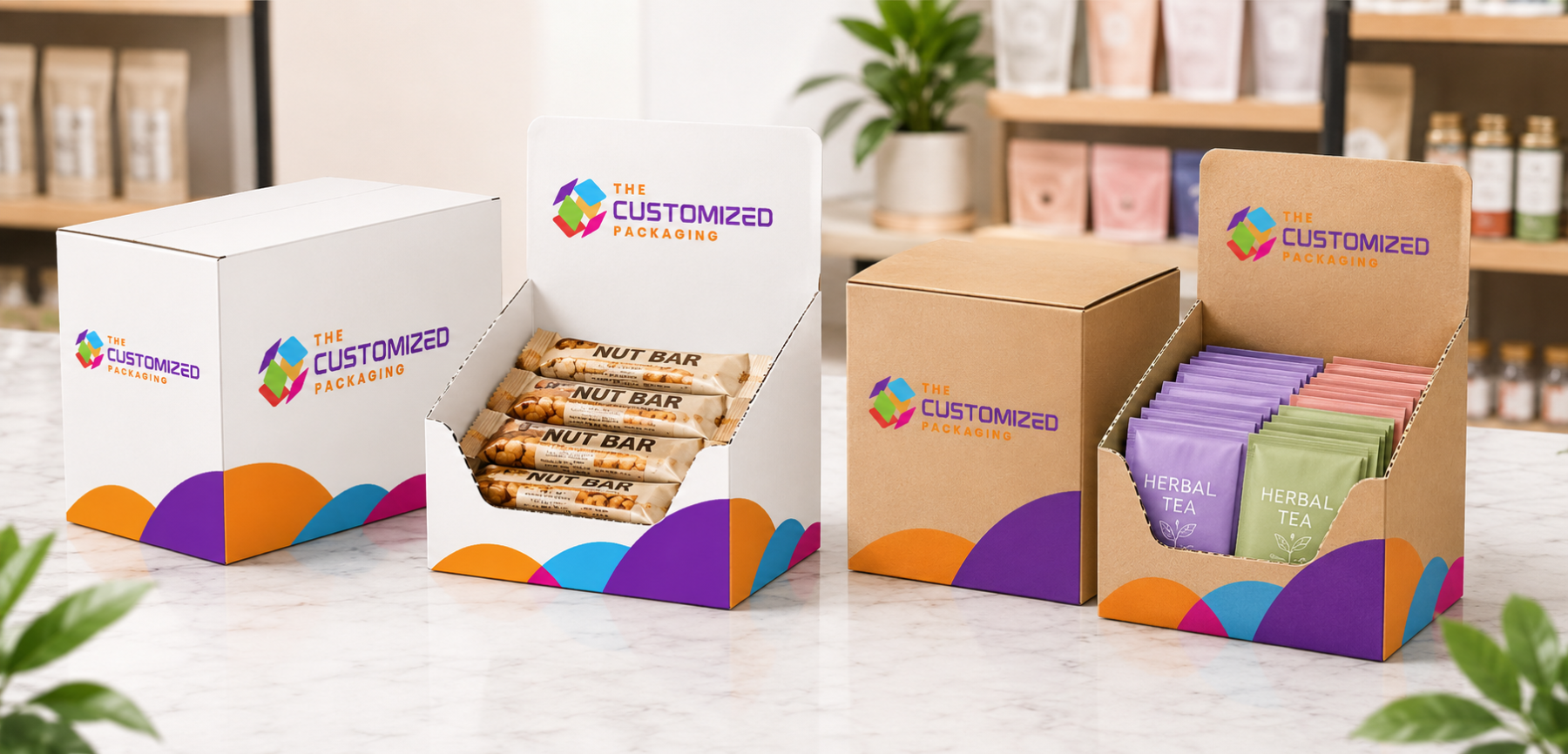
Kraft corrugated dispenser boxes use brown linerboard on the visible exterior.
The natural appearance can support industrial, organic, artisan, eco-conscious, warehouse, and minimalist branding.
Black, white, dark green, purple, orange, red, and other strong colors can create contrast on kraft material.
Simple one-color printing can provide an economical solution for product identification and company branding.
The brown background may change the appearance of light colors and photographs.
A printed sample should be reviewed before production when color accuracy is important.
White Corrugated Dispenser Boxes
A Clean Surface for Detailed Printing
White linerboard creates a brighter background for full-color artwork, photographs, gradients, and detailed product information.
Custom white corrugated dispenser boxes are commonly used for cosmetics, medical products, electronics, retail goods, food packaging, and premium consumer brands.
White surfaces can make colors appear more accurate and vibrant.
The packaging may show dirt, scuffs, and handling marks more easily than natural kraft.
The correct coating or finish can improve appearance, but it may affect cost and disposal claims.
Recycled Corrugated Material
Recovered Fiber Can Support Material-Efficiency Goals
Corrugated board may contain recycled fiber in the liner, fluted medium, or both.
Using recovered paper can reduce reliance on virgin fiber and support material recovery systems.
However, the percentage of recycled content should be confirmed through supplier information.
Brown appearance alone does not prove recycled content.
Recycled material may show variations in shade, texture, and fiber consistency.
The selected board must still provide the compression, puncture resistance, printing surface, and perforation performance required by the dispenser design.
Virgin Fiber Corrugated Board
Consistent Performance for Demanding Structures
Virgin fiber can provide strong and consistent paper properties.
It may be used when the dispenser carton requires higher strength, moisture resistance, clean cutting, or precise printing.
Virgin material can still come from responsibly managed sources.
Businesses should request documentation when they plan to communicate certified sourcing or responsible forestry claims.
The choice between recycled and virgin fiber should consider performance, supply consistency, environmental goals, and total material usage.
Measuring Products for Custom Dispenser Boxes
Dimensions Should Reflect the Complete Packed Unit
The product length, width, thickness, and weight should be measured accurately.
Flexible products should be measured in their normal filled condition rather than flattened.
The required quantity per box should also be confirmed.
Small dimensional errors can multiply across a row of products and create excessive pressure or empty space.
The internal dimensions should allow loading without making the products loose.
Additional clearance may be required for dividers, ramps, inserts, and board thickness.
Dispenser Box Measurement Planning Table
| Measurement | What to provide | Why it matters |
|---|---|---|
| Product length | Longest dimension of one packed product | Determines internal box direction |
| Product width | Side-to-side dimension | Helps calculate rows and dividers |
| Product thickness | Filled thickness, not flattened material | Determines product capacity |
| Individual weight | Weight of one unit | Influences gravity feed and box strength |
| Quantity per box | Total number of units | Determines internal volume |
| Packed box weight | Products, inserts, and carton combined | Helps select board grade |
| Dispensing direction | Front, top, side, or bottom | Defines opening location |
| Shelf dimensions | Available width, depth, and height | Prevents retail-fit problems |
| Shipping orientation | How the carton will be transported | Influences compression strength |
| Stacking height | Number of filled cartons stacked | Helps determine corrugated performance |
| Opening size | Required hand and product clearance | Balances access and retention |
| Loading method | Manual or machine loading | Influences structure and closure |
A prototype should be tested before wholesale production.
Custom Sizing Reduces Product Movement
Better Fit Improves Protection and Presentation
Oversized cartons allow products to move and become disorganized.
Excess space can reduce the performance of gravity-feed structures and make the opening look empty.
A box that is too tight may compress pouches, damage retail cartons, or make dispensing difficult.
Custom-sized corrugated dispenser boxes can be developed around the exact product count and orientation.
Accurate sizing may also improve pallet use, warehouse storage, freight efficiency, and retail shelf utilization.
Corrugated Dispenser Boxes for Retail Stores
Packaging Can Improve Shelf Organization
Retail stores need packaging that is easy to stock, identify, display, and maintain.
Shelf-ready dispenser boxes can reduce the time required to arrange products.
The carton can keep individual units aligned and reduce shelf disorder.
Printed branding remains visible even when several products have been sold.
The box should fit the shelf depth without extending into customer walkways.
Retailers may also require barcodes, case quantities, orientation arrows, and store-specific labeling areas.
Screen Printing and Specialty Printing
Bold Artwork for Selected Applications
Screen printing may be used for strong colors, specialty inks, and selected print areas.
It can support promotional displays and lower-volume specialty packaging.
The suitability depends on the corrugated surface, artwork, quantity, and production process.
Businesses should compare the cost and quality with digital and flexographic printing.
Printing Method Comparison
| Printing method | Best suited for | Main advantage | Main consideration |
|---|---|---|---|
| Flexographic printing | Large wholesale orders and simple artwork | Economical at volume | Printing plates and limited fine detail |
| Digital printing | Short runs and full-color variations | Flexible setup and detailed graphics | Higher unit cost at large volume |
| Litho lamination | Premium retail displays | High-resolution print quality | Additional material and production stages |
| Screen printing | Bold specialty artwork | Strong ink coverage | Limited efficiency for complex designs |
| One-color printing | Industrial and warehouse dispensers | Cost-effective identification | Less visual impact |
| Interior printing | Premium unboxing and instructions | Adds information inside the box | Increases print coverage and cost |
The printing method should match the order quantity, artwork complexity, and sales environment.
Printing on Kraft Corrugated Board
Brown Material Changes Color Appearance
Natural kraft liner creates a warm background.
Dark inks usually create strong contrast.
Black, navy, dark green, purple, red, and orange can work well.
Light colors may appear muted because the brown material influences the final tone.
White ink or a white underbase may improve brightness.
A printed sample can help businesses approve the actual appearance.
Die-Cut Corrugated Dispenser Boxes
Custom Tooling Creates Precise Openings and Shapes
Die-cutting allows the manufacturer to create custom panels, perforations, tabs, slots, handles, openings, and locking systems.
A cutting die is produced according to the approved dieline.
Die-cut dispenser boxes can provide a more customized fit and professional presentation.
Tooling cost may apply during the first order.
Businesses should ask whether the die can be reused for repeat production.
Dielines for Custom Dispenser Packaging
Structural Artwork Begins with an Accurate Template
A dieline shows the flat layout of the box.
It identifies cut lines, folds, perforations, glue areas, openings, and panel boundaries.
Graphic designers place artwork on the dieline.
The supplier should confirm which panels remain visible after the box is assembled and opened.
Text and logos should remain inside safe areas.
The dieline should not be resized or changed without structural review.
What Influences the Cost of Corrugated Dispenser Boxes?
Structure, Material, Printing, and Quantity Determine Pricing
The cost of custom corrugated dispenser boxes depends on dimensions, material grade, flute profile, printing method, print coverage, opening design, perforations, inserts, windows, finishing, quantity, tooling, freight, and production time.
Larger boxes use more corrugated board.
Double-wall material costs more than lightweight single-wall construction.
Complex die-cut structures may require specialized tooling.
Full-color lithographic printing generally costs more than simple one-color flexographic printing.
Custom inserts, ramps, partitions, windows, handles, foil, and coatings add production stages.
Wholesale quantities may reduce unit pricing, but the complete investment and storage costs should be considered.
Corrugated Dispenser Box Cost Factors
| Cost factor | Effect on pricing | Cost-planning direction |
|---|---|---|
| Box dimensions | Larger cartons use more board | Match the box to the exact product quantity |
| Flute profile | Different materials have different costs and thicknesses | Select according to strength and presentation |
| Board grade | Higher-strength and coated liners may cost more | Use performance testing to avoid over-specification |
| Opening design | Complex shapes require detailed tooling | Use a practical opening unless branding requires more |
| Perforations | Add conversion and quality-control requirements | Keep tear lines simple and functional |
| Printing method | Digital, flexographic, and lithographic costs differ | Match the process to volume and artwork |
| Number of colors | Additional colors may increase setup cost | Consider limited-color artwork for wholesale orders |
| Print coverage | Full coverage uses more ink and processing | Keep hidden panels simple |
| Custom insert or ramp | Adds material, design, tooling, and assembly | Use only when required for dispensing |
| Window film | Adds cutting, film, adhesive, and assembly | Compare visibility benefits with material complexity |
| Premium finishes | Foil, spot UV, and lamination add processes | Use finishes selectively |
| Order quantity | Larger runs may reduce unit cost | Balance price with storage and artwork changes |
| Tooling | Custom dies and plates may require initial charges | Ask whether tooling is reusable |
| Freight | Flat cartons still occupy transportation volume | Compare delivered cost, not only unit price |
An accurate quote requires a complete packaging specification.
How to Reduce Dispenser Box Costs
Simplification Can Improve Value Without Reducing Performance
Businesses can control cost by using accurate dimensions and avoiding unnecessary material.
A simple rectangular opening may cost less than a complex custom shape.
One-color flexographic printing may be sufficient for industrial or warehouse applications.
A standard kraft liner may cost less than a premium coated white surface.
One box size may support several similar products when fit and dispensing remain reliable.
Tooling can sometimes be reused for repeat orders.
The business should not reduce board strength, perforation quality, or product fit below the level required for successful performance.
Packaging failure can create damaged products, retail delays, and replacement costs.
Comparing Quotations
Similar Prices May Represent Different Specifications
One supplier may quote E flute with digital printing, while another quotes B flute with flexographic printing.
The prices are not directly comparable unless the material, dimensions, printing, quantity, tooling, freight, and finishing are the same.
Businesses should request written specifications.
The quotation should identify whether pricing includes structural design, cutting dies, printing plates, samples, packing, and shipping.
A low unit price may exclude important setup or freight charges.
How to Choose a Corrugated Dispenser Box Manufacturer
Structural Experience Is as Important as Printing
A professional supplier should understand corrugated material, product flow, perforation, retail display, shipping pressure, loading, and wholesale production.
The manufacturer should ask about the product dimensions, weight, quantity, shelf space, dispensing direction, shipping environment, printing, and expected order volume.
A supplier that focuses only on artwork may overlook structural performance.
Businesses should request dielines, material specifications, digital proofs, prototypes, printing information, production times, and delivered pricing.
The physical sample should be tested with the actual products.
Questions to Ask Before Ordering
| Question | Why it matters |
|---|---|
| Which dispenser style is best for my product? | Confirms the opening and product orientation |
| Which flute profile do you recommend? | Aligns strength, thickness, and printing |
| Will the box ship and display in the same structure? | Determines whether shelf-ready packaging is practical |
| How will the products move toward the opening? | Identifies the need for ramps or dividers |
| Will the perforation remain closed during shipping? | Reduces accidental opening |
| Can I test a physical sample? | Confirms fit, dispensing, and strength |
| Which printing method is recommended? | Aligns artwork quality, quantity, and cost |
| Will the logo remain visible after opening? | Protects retail branding |
| Are dimensions internal or external? | Prevents fit and shelf problems |
| What board grade will be used? | Clarifies material performance |
| Are cutting dies and printing plates included? | Prevents unexpected setup charges |
| Can the tooling be reused for repeat orders? | Supports future cost planning |
| What is the minimum order quantity? | Helps compare short-run and wholesale production |
| Does the quote include freight? | Clarifies the complete delivered cost |
| Can repeat orders match the same specification? | Supports consistent retail presentation |
Detailed answers make supplier comparison easier.
Ordering Custom Corrugated Dispenser Boxes Online
Complete Product Information Produces Better Pricing
Businesses ready to buy custom corrugated dispenser boxes online should provide the product dimensions, individual weight, quantity per box, packed weight, dispensing direction, shelf space, shipping conditions, material preference, artwork, printing colors, inserts, order quantity, and delivery destination.
Physical product samples may be required for flexible packets or gravity-feed designs.
The supplier should create a dieline showing the openings, perforations, folds, glue areas, and printable panels.
A digital proof should be approved before printing.
A physical prototype should be tested before wholesale production.
The final quotation should identify the dimensions, board grade, flute profile, printing, tooling, inserts, finishes, quantity, production time, and freight.
Businesses searching to order corrugated dispenser boxes online should compare complete packaging specifications rather than relying only on an advertised starting price.
Custom Corrugated Dispenser Boxes Across the USA
Retail, Industrial, and Workplace Packaging Nationwide
At The Customized Packaging, we provide custom corrugated dispenser boxes for retailers, manufacturers, distributors, grocery brands, cosmetic companies, pharmacies, healthcare suppliers, hardware businesses, offices, warehouses, automotive companies, ecommerce operations, and subscription brands throughout the USA.
We create front-opening dispensers, gravity-feed cartons, countertop displays, shelf-ready packaging, tear-away boxes, top-opening dispensers, side-opening cartons, drawer-style packaging, workplace supply boxes, hanging displays, custom partitions, ramps, inserts, and printed shipping-and-display packaging.
Businesses searching for corrugated dispenser boxes near me, custom dispenser box manufacturer USA, wholesale corrugated dispenser boxes, retail dispenser packaging supplier, custom printed dispenser boxes, shelf-ready packaging USA, countertop dispenser boxes wholesale, or order custom dispenser boxes online can request packaging developed around their products and operational requirements.
We support businesses in New York, New Jersey, California, Texas, Florida, Illinois, Pennsylvania, Ohio, Georgia, North Carolina, Washington, Massachusetts, Virginia, Michigan, Arizona, Tennessee, Indiana, Missouri, Maryland, Wisconsin, Colorado, Minnesota, Nevada, Oregon, Kentucky, Utah, and other locations throughout the United States.
Want to Estimate Your Corrugated Dispenser Box Cost?
Try the Custom Box Packaging Cost Calculator
Want to estimate your packaging cost before requesting a detailed quotation? Try our Custom Box Packaging Cost Calculator to calculate an initial estimate based on box style, dimensions, material, printing, finishing, inserts, and quantity.
The calculator can help businesses plan custom corrugated dispenser boxes, gravity-feed cartons, countertop displays, shelf-ready packaging, tear-away boxes, kraft corrugated packaging, white printed cartons, retail display boxes, custom inserts, and wholesale packaging.
The initial estimate may change according to the final dimensions, corrugated grade, flute profile, opening size, perforation design, printing method, print coverage, inserts, windows, coatings, premium finishes, tooling, order quantity, freight, and delivery destination.
After reviewing the estimate, businesses can request a detailed custom corrugated dispenser box quote based on the complete product and packaging specification.
Why Choose The Customized Packaging for Corrugated Dispenser Boxes?
Packaging Developed Around Product Access and Performance
At The Customized Packaging, we help businesses create custom corrugated dispenser boxes that organize products, support transportation, simplify access, improve retail presentation, and strengthen branding.
We provide kraft and white corrugated materials, E flute, F flute, B flute, C flute, single-wall and double-wall structures, front openings, gravity-feed systems, tear-away panels, shelf-ready designs, countertop dispensers, internal ramps, dividers, printed headers, logo printing, full-color artwork, digital proofs, physical samples, and wholesale pricing.
Our packaging options support grocery products, cosmetics, healthcare supplies, hardware parts, workplace consumables, food packets, promotional products, ecommerce operations, warehouse supplies, and retail displays.
As a professional custom box manufacturer and corrugated packaging supplier, we develop packaging around the product dimensions, weight, quantity, dispensing method, shelf space, transportation conditions, printing requirements, order quantity, and delivery destination.
Businesses remain responsible for confirming that the selected materials, inks, coatings, adhesives, windows, inserts, product-contact components, labeling, environmental claims, and packaging use meet the requirements applicable to their products and sales markets.
Final Thoughts
Corrugated Dispenser Boxes Combine Storage, Access, Display, and Branding
Custom corrugated dispenser boxes allow businesses to store several product units inside one structured carton while providing controlled and convenient access.
Front openings, gravity-feed systems, countertop displays, shelf-ready cartons, tear-away panels, top openings, side access, drawers, hanging headers, and workplace dispensers can be developed around different products and sales environments.
Corrugated flute profiles such as E flute, F flute, B flute, and C flute allow businesses to balance printing quality, package thickness, shipping protection, and structural support.
Accurate product dimensions, packed weight, opening size, perforation strength, product orientation, shelf space, and transportation conditions should be reviewed before production.
Digital, flexographic, and lithographic printing can turn the dispenser carton into a branded retail and operational tool. Logos, instructions, QR codes, barcodes, product information, and promotional artwork should remain visible after the box is opened.
Internal ramps, dividers, partitions, and inserts can improve dispensing, but they should be added only when they solve a real product-flow or protection requirement.
Wholesale ordering can reduce unit pricing and improve consistency, while physical sampling helps prevent structural, printing, and dispensing problems before bulk manufacturing.
Whether you need front-opening cartons, gravity-feed boxes, countertop displays, shelf-ready packaging, industrial supply dispensers, custom printed retail boxes, wholesale corrugated dispenser boxes, or branded packaging with logo, the right structure can improve product organization, retail presentation, inventory access, and customer convenience.
At The Customized Packaging, we create corrugated dispenser packaging that is built to protect, engineered to dispense, and designed to help businesses display, organize, and grow throughout the USA.
